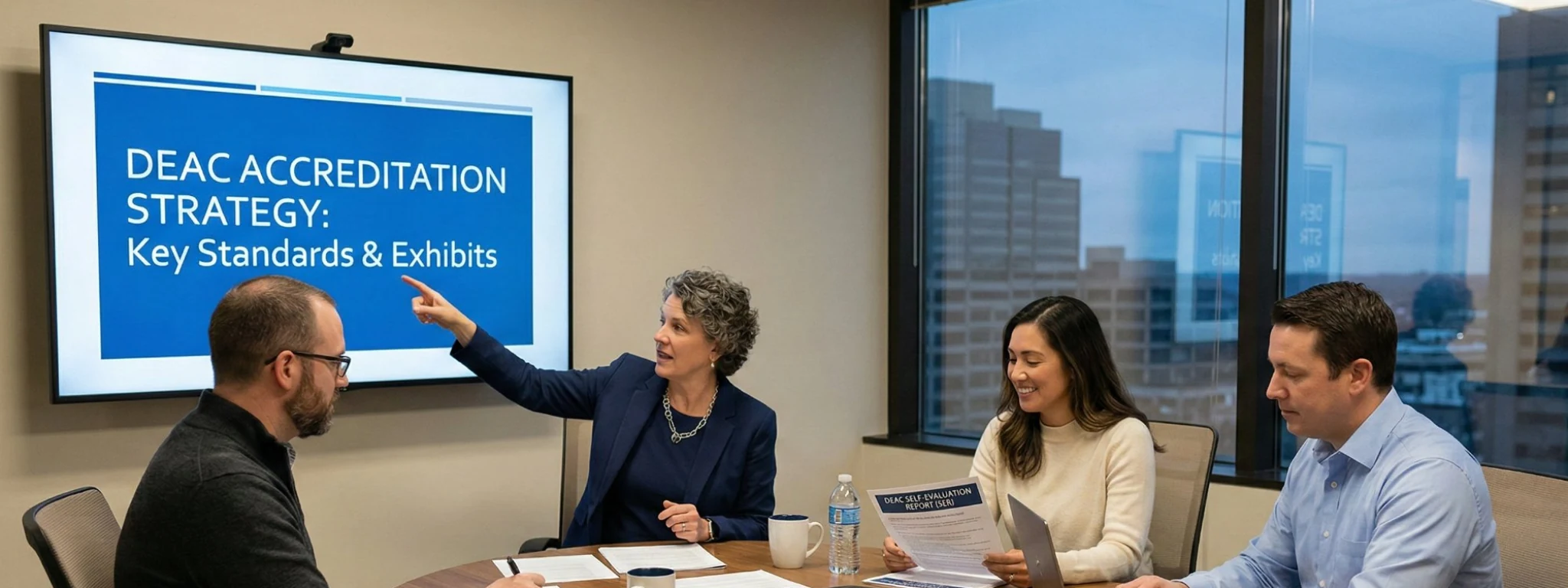
DEAC accreditation is the premier credential for distance education institutions in the United States. Recognized by both the U.S. Department of Education and CHEA, the Distance Education Accrediting Commission has set the standard for online learning quality since 1926. Expert Education Consultants (EEC), led by Dr. Sandra Norderhaug, has helped 115+ institutions across all 50 states navigate the accreditation process.
What Is DEAC?
The Distance Education Accrediting Commission (DEAC) is a private, nonprofit organization headquartered in Washington, D.C. that serves as the leading institutional accreditor for distance education. Founded in 1926 as the National Home Study Council, DEAC has nearly a century of experience evaluating schools that teach primarily through online, correspondence, or other distance methods.
DEAC is recognized by the U.S. Department of Education (since 1959) and the Council for Higher Education Accreditation (since 2001). This dual recognition means DEAC-accredited institutions can participate in Title IV federal student aid programs — a critical gateway for schools that want to offer financial aid to their students.
What makes DEAC stand out? Three things. First, it is the only nationally recognized accreditor focused exclusively on distance education. Second, it accredits institutions at every level — from high school diplomas through professional doctoral degrees. Third, its structured, phase-based process gives institutions a clear roadmap from application to accreditation, typically in 18–36 months.
| Detail | Information |
|---|
| Founded | 1926 (as the National Home Study Council) |
| Headquarters | Washington, D.C. |
| Recognition | U.S. Department of Education (USDE) & Council for Higher Education Accreditation (CHEA) |
| Scope | Institutional accreditor for distance education institutions |
| Degree Levels | High school, non-degree certificates, associate, bachelor’s, master’s, professional doctoral |
| Geographic Scope | U.S.-based recognition; international institutions eligible |
| Delivery Requirement | 51%+ of programs must be delivered via distance education |
| Accreditation Cycle | 3 years (initial) / 5 years (renewal) |
| Current Standards | 15 standards effective January 1, 2025 |
| Title IV Eligibility | Yes — enables institutions to participate in federal financial aid programs |
Wondering if DEAC is the right accreditor for your institution? Book a free strategy call and we’ll help you evaluate your options.
Book a Strategy Call →Is DEAC the Right Accreditor for You?
DEAC is purpose-built for institutions where distance education is the primary mode of instruction. It works best for online colleges and universities, correspondence schools, and hybrid institutions where the majority of learning happens at a distance. Here’s a quick self-assessment:
✓ DEAC Is a Good Fit If…
- Your institution delivers 51%+ of instruction via distance education
- You want to offer Title IV federal financial aid to students
- You offer programs from high school through professional doctoral level
- You are launching a new online college or university in the U.S.
- You need a nationally recognized accreditor with a clear, structured process
- You serve adult learners, military-affiliated students, or working professionals
✗ DEAC May Not Be the Right Fit If…
- Your programs are primarily campus-based with little online delivery
- You need regional accreditation for immediate credit transfer to state universities
- You operate a K–12 school (Cognia or state accreditation may be better)
- Your institution hasn’t been enrolling students for at least 12 consecutive months
- You’re a career/trade school focused on hands-on occupational training (consider ACCSC or COE)
- You have fewer than 10 enrolled students (DEAC requires operational enrollment)
DEAC’s 15 Accreditation Standards (Effective January 1, 2025)
DEAC’s updated accreditation standards are organized into four thematic areas. Each standard has detailed sub-requirements that institutions must document in their Self-Evaluation Report. Here’s what evaluators are looking for:
Standards I – III
Mission, Governance & Planning
Mission: Clear, published mission focused on quality distance education, regularly reviewed by leadership. Governance: Qualified board and administrators with defined roles, org charts, and bylaws. Planning & Effectiveness: Documented strategic planning, measurable goals, data-driven decisions, and evidence of continuous improvement.
Standards IV – X
Academic Quality
Achievement: Systematic assessment of student learning benchmarked against peers. Programs: Coherent curricula meeting DEAC credit-hour minimums (60 for associate, 120 for bachelor’s). Curriculum & Delivery: Faculty-driven design, up-to-date technology, academic integrity safeguards. Faculty: Master’s minimum for undergrad, terminal degree for graduate. Policies: Published rules on admissions, transfer credit, honesty, and progress.
Standards XI – XIII
Ethical & Legal Operations
Recruitment & Enrollment: Ethical recruitment, truthful advertising, compliant enrollment agreements. Student Support: Academic advising, tutoring, technical support, accommodations, responsive communication. Fair Practices: Clear refund policies, FERPA-compliant privacy protections, and written grievance procedures with timelines and appeals.
Standards XIV – XV
Business & Infrastructure
Finance: Sound financial management with GAAP-compliant audited statements for the most recent two fiscal years. Adequate resources to sustain operations. Facilities & Records: Secure physical and virtual infrastructure, reliable technology platforms, and protected student and administrative records.
Key Exhibits to Prepare
DEAC requires roughly 20 exhibits submitted alongside your Self-Evaluation Report (SER). These documents substantiate your compliance with each standard. Here are the most critical ones:
| Exhibit | What You Need | How EEC Helps |
|---|
| Enrollment Data | Student enrollment worksheet with completions, modalities, and program levels | We format data to DEAC specs and verify consistency |
| Org Chart | Visual chart of governance structure with reporting lines | We draft clean org charts aligned to DEAC expectations |
| State Authorization | Licenses and approvals from every state where students reside | We identify gaps and help obtain missing authorizations |
| Academic Catalog | Full catalog with curricula, outcomes, admissions, and policies | We proof and update your catalog for DEAC compliance |
| Meeting Minutes | Board, advisory council, and faculty meeting records | We select and summarize relevant excerpts |
| Effectiveness Plan | Strategic plan, assessment reports, and data summaries | We build your plan-do-check-act documentation |
| Program Outcomes | Learning outcomes mapped to courses via curriculum matrix | We develop outcome statements and alignment maps |
| Credit Hour Chart | Clock-to-credit conversion documentation for all programs | We create compliant conversion tables |
| Academic Honesty | Integrity policy with student acknowledgment procedures | We draft or update your policy to meet standards |
| Financial Statements | Two years of GAAP-audited financial statements | We review and highlight key financial health indicators |
| Complaint Policy | Written grievance procedures with timelines and appeals | We create procedures with DEAC-required elements |
| Assessment Plan | Outcomes assessment plan with methods, frequency, and action plans | We develop the matrix and schedule assessments |
The DEAC Accreditation Timeline
Expect 18–36 months from start to finish for initial accreditation. The Commission meets in January and June to act on applications, so timing your submission is critical. Here’s a realistic phase-by-phase breakdown:
Phase 1
Preparing for Accreditation Tutorial
1–2 months
Your designated compliance officer completes DEAC’s required online tutorial. This must be done within one year before submitting your application.
Phase 2
Submit Application + Fee ($4,500)
1 month
Formal application with nonrefundable fee. DEAC verifies eligibility including 12 months of continuous enrollment. Acceptance starts the 12–18 month accreditation clock.
Phase 3
Prepare & Submit Self-Evaluation Report (SER)
3–9 months
The most intensive phase. Compile 20+ exhibits and write narrative responses addressing all 15 standards. EEC drafts or co-authors your entire SER.
Phase 4
Readiness Assessment
10–12 weeks (DEAC review)
An independent DEAC-appointed evaluator reviews your SER. If “Deemed Ready,” you advance to curricular review. If not, you have 6 months to revise and resubmit.
Phase 5
Curricular Review by Subject Specialists
3–6 months
DEAC subject specialists review 50% of courses for every degree program offered. Materials must meet quality and outcome-alignment standards.
Phase 6
Revised SER + On-Site Evaluation
1–3 months
Submit your updated SER at least 5 weeks before the on-site visit. Evaluators meet staff, review processes, and verify compliance.
Phase 7
Commission Decision
1–3 months to next meeting
The Commission acts at its January or June meeting. Initial accreditation is granted for 3 years; renewals for 5 years.
With EEC’s support, many institutions compress the timeline by 3–6 months by avoiding common pitfalls like incomplete SERs, misaligned curricula, or missing state authorizations.
DEAC Accreditation Fees
All fees below are paid directly to DEAC. They are non-refundable and due in full. Source: deac.org
| Fee Type | Amount | Notes |
|---|
| Initial Application | $4,500 | Due at time of submission; nonrefundable |
| Legal Structure Review | $3,000 | Invoiced if applicable to your institution’s structure |
| 1st Readiness Assessment | $4,000 | Due with SER submission |
| 2nd Readiness Assessment | $5,000 | If first assessment results in “not ready” |
| 3rd Readiness Assessment | $6,000 | Includes virtual on-site visit |
| Site Visit — Degree & Non-Degree | $2,250/day/evaluator (1st day); $2,000 thereafter | Number of evaluators and days depends on institution size |
| Site Visit — Doctoral Programs | $3,250/day/evaluator; $3,000 thereafter | Separate doctoral evaluator required |
| Curricular Review — Vocational | $1,350 per program | For non-degree / vocational programs |
| Curricular Review — Degree | $1,450 base + $100/representative course | 50% of courses reviewed per degree program |
| Curricular Review — Doctoral | $2,050 base + $100/representative course | For doctoral or first professional degrees |
| Renewal Application | $3,000 | For institutions seeking reaccreditation |
| Annual Dues | Formula-based | See DEAC’s Annual Dues and Fees Schedule |
| Appeals Fee | $25,000 | For appealing an adverse accreditation decision |
Important: These are DEAC’s fees paid directly to the Commission. EEC’s consulting fees are separate and customized to each institution’s needs, size, and scope. Contact us for a personalized quote after a free consultation.
Need help budgeting for DEAC accreditation? We provide transparent, itemized consulting proposals after your free strategy call.
Get a Custom Quote →How EEC Helps You Achieve DEAC Accreditation
🔍
Gap Analysis & Readiness
Review your documentation, data systems, and operations against all 15 DEAC standards. Identify missing policies, weak exhibits, and data gaps. Receive a prioritized compliance roadmap with clear action items.
📅
Strategic Planning & Timeline
Build a project plan aligned to DEAC’s Commission meeting dates (January and June), application deadlines, and curricular review windows. Assign responsibilities and keep your team on track.
📂
Exhibit & Evidence Development
Compile, organize, and quality-check every exhibit — from enrollment worksheets and faculty credential files to financial summaries and assessment plans. Formatted and labeled to DEAC expectations.
✍️
Self-Evaluation Report Drafting
Write clear, evidence-based narrative for each of the 15 standards, referencing your exhibits and citing DEAC criteria. Designed to make the evaluator’s job easier and your compliance case stronger.
📚
Curricular Review Preparation
Ensure your course materials, syllabi, learning outcomes, and assessments are polished and aligned before DEAC subject specialists review 50% of your courses per program.
📈
Site Visit & Follow-Up
Mock interviews, evaluator question coaching, document preparation, and post-visit response drafting. Support through the Chair’s Report and the Commission’s final accreditation decision.
Frequently Asked Questions
How long does DEAC accreditation take?
Institutions should anticipate 18 months to 3 years from the first step through the final Commission decision. Smaller, well-prepared institutions may move faster. The Commission meets in January and June to act on applications, so timing your submission to align with these meetings is critical.
Is DEAC recognized by the U.S. Department of Education?
Yes. DEAC has been recognized by the U.S. Department of Education since 1959 and by the Council for Higher Education Accreditation (CHEA) since 2001. This recognition makes DEAC-accredited institutions eligible to participate in Title IV federal student aid programs.
What’s the difference between DEAC (national) and regional accreditation?
DEAC is a national accreditor focused specifically on distance education institutions. Regional accreditors (like SACSCOC, HLC, WSCUC, etc.) cover institutions within specific geographic areas and are often considered the “gold standard” for traditional universities. Credits from DEAC-accredited schools may not transfer as easily to regionally accredited institutions, though this gap has narrowed significantly. For online-first institutions, DEAC offers a faster, more accessible path to recognized accreditation.
Can I get financial aid with DEAC accreditation?
Yes. Because DEAC is recognized by the U.S. Department of Education, accredited institutions can apply for Title IV eligibility, allowing students to access federal Pell Grants, student loans, and other financial aid. You must separately apply to the Department of Education for Title IV participation after achieving accreditation.
What are DEAC’s eligibility requirements?
Key eligibility requirements include: the institution must deliver 51% or more of its programs via distance education; it must have been enrolling students in current programs for at least 12 consecutive months; it must hold proper state licensure or authorization; a compliance officer must complete DEAC’s “Preparing for Accreditation” tutorial; and the institution must demonstrate financial stability.
How much does DEAC accreditation cost in total?
Total costs vary by institution size and number of programs. DEAC fees alone (application, readiness assessments, site visit, curricular reviews) typically range from $15,000 to $50,000+. Add consulting fees, internal staff time, and institutional improvements, and total investment can range from $50,000 to $150,000+. However, accreditation unlocks Title IV revenue that far outweighs the investment for most institutions.
What happens if DEAC finds my institution “not ready”?
If the readiness assessment deems your institution not ready, you have six months to revise and resubmit your SER (with a second submission fee of $5,000). If still not ready after a second review, a third assessment ($6,000) includes a virtual on-site visit. If the on-site Chair’s Report finds you not ready, you can reapply after at least one year.
Does DEAC accredit international institutions?
Yes. DEAC’s accreditation is U.S.-based in recognition, but institutions located outside the U.S. can seek DEAC accreditation. Additional fees and requirements apply, including business-class travel costs for evaluators and compliance with both DEAC standards and applicable local laws.
Ready to start?
Begin your DEAC accreditation journey with expert guidance.
115+ institutions launched across all 50 states. We partner with institutions from readiness assessment through grant of accreditation and ongoing compliance.