How to Start an
Allied Health School
in the United States
America's healthcare workforce shortage creates a sustained, growing demand for allied health programs. Whether you're learning how to start a nursing program, a medical assisting school, or a full multi-discipline allied health campus, here's how to build an institution that meets it — compliantly, credibly, and with the right accreditation plan in place.
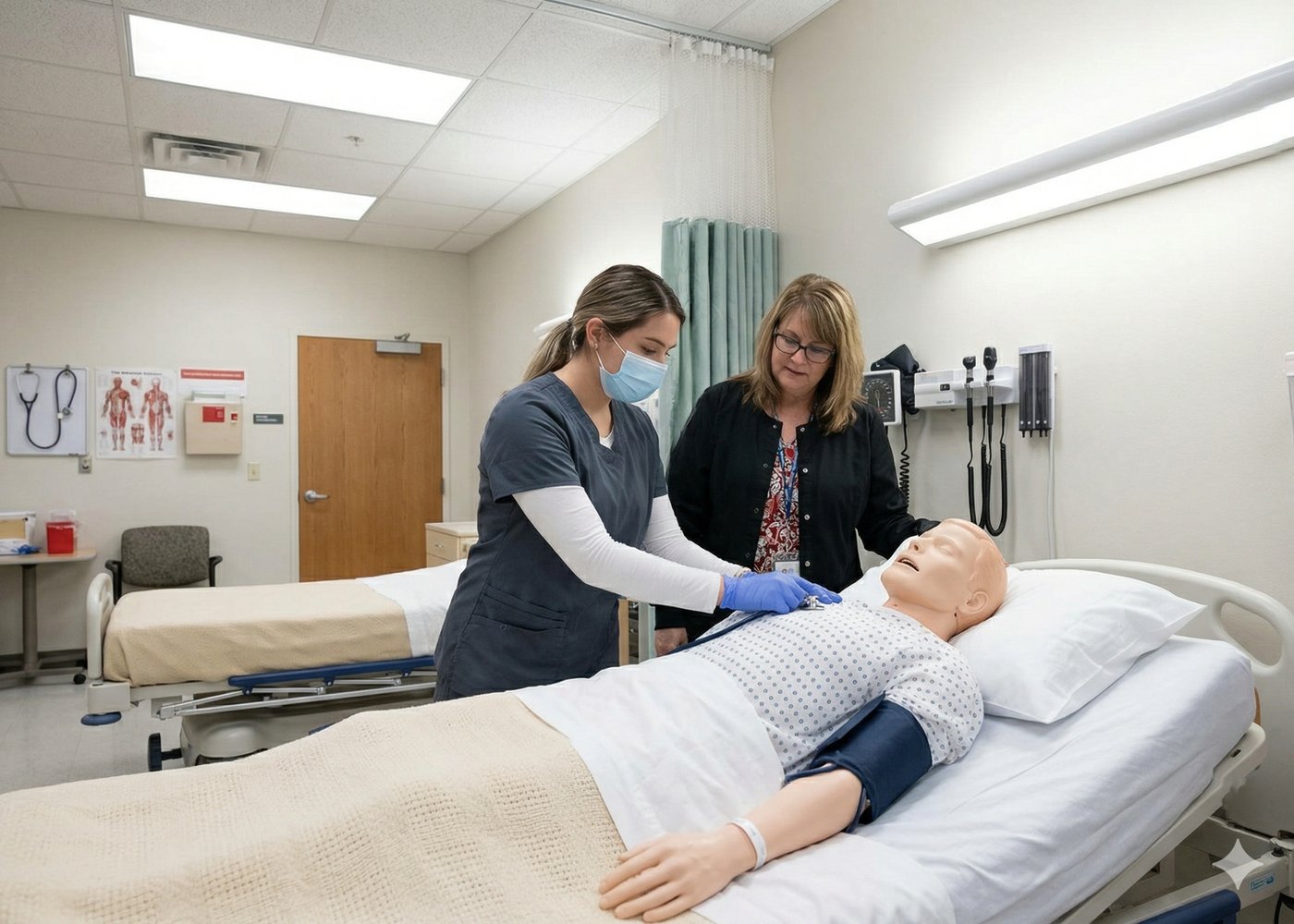
To legally prepare graduates for clinical licensure and certification, an allied health school often must hold BOTH institutional accreditation AND programmatic accreditation — from two different bodies.
Covers the overall institution (e.g., ABHES, ACCSC). Understanding accreditation requirements for your institution type is critical: institutional accreditation is the foundation for Title IV federal financial aid eligibility and general recognition. Without it, students cannot access Pell grants.
Covers specific clinical programs (e.g., CAAHEP for surgical technology, ACEN for nursing, JRCERT for radiologic technology). Required by professional licensing boards for graduates to sit for national certification exams.
Critical Planning Note: Failing to pursue the correct programmatic accreditor means your graduates may not be eligible for their professional licensing exam — regardless of how excellent the education was. EEC's accreditation consulting services identify the correct dual-accreditation sequence before you invest a dollar in curriculum development. Our university accreditation consultants have mapped this pathway for healthcare schools across all 50 states.
Accrediting Bureau of Health Education Schools
The most comprehensive accreditor for allied health institutions. Provides both institutional accreditation (whole school) and programmatic accreditation (specific programs). Recognized by U.S. Department of Education for Title IV.
Commission on Accreditation of Allied Health Education Programs
Accredits 2,000+ programs across 32 health science professions. Required for surgical technology, medical assisting, and many other clinical fields for graduates to sit for national certification.
Accreditation Commission for Education in Nursing / Commission on Collegiate Nursing Education
Nursing programs at all levels must hold ACEN or CCNE accreditation for recognition by state nursing boards and for graduates to be eligible for the NCLEX licensing examination.
Joint Review Committee on Education in Radiologic Technology
Required for radiologic technology, radiation therapy, and magnetic resonance programs. Graduates must attend an accredited program to sit for the ARRT national board exam.
One of the most demanding aspects of launching an allied health school is establishing clinical placement sites before you open — and managing them once you do.
EEC helps clients build their clinical site network before launch. Without confirmed clinical placements, your accreditation application will not be accepted. We open doors to hospital systems, medical groups, and clinic networks — and our accreditation consulting services ensure every affiliation agreement meets state authorization and accreditor requirements simultaneously.
Do I need both institutional and programmatic accreditation?
For most clinical programs, yes. Understanding the full accreditation requirements is essential: institutional accreditation (ABHES or ACCSC) qualifies students for federal financial aid, while programmatic accreditation (CAAHEP, ACEN, JRCERT) is required for graduates to sit for professional licensing and certification exams. How do you get accredited correctly? EEC maps the complete dual-accreditation pathway for every program before you begin development.
How do I find clinical placement sites?
Clinical site development requires building relationships with local hospitals, clinics, physicians' offices, and specialty practices. EEC assists with affiliation agreement templates and site development strategy. Most accreditors require confirmed, executed affiliation agreements before accepting your application.
Can I start with just one allied health program?
Yes — and this is often the recommended approach. Many successful allied health schools launch with one flagship program (medical assisting or dental assisting) and expand once the institution is accredited and operationally stable.
What qualifications must allied health instructors hold?
Most states require instructors to hold active professional licensure in their field plus teaching experience. Nursing instructors typically require a master's degree in nursing. EEC provides state-specific instructor requirement analysis for every program.
Do I need a higher education accreditation consultant for an allied health school?
Yes — the complexity of dual accreditation (institutional plus programmatic) makes allied health one of the highest-risk sectors for accreditation missteps. An experienced higher education accreditation consultant ensures your curriculum, faculty, clinical sites, policies, and self-study are built to the exact standards of both your institutional and programmatic accreditors. EEC provides full accreditation consulting services for allied health institutions across all program types.
Can allied health programs be offered online?
Some programs can be offered in hybrid format — online theory combined with in-person clinical labs. Fully online delivery of clinical programs is not accepted by most state licensing boards or programmatic accreditors.
Ready to Build Your Allied Health School?
EEC has launched healthcare education institutions across all 50 states. As a full-service licensing and accreditation consulting firm, we guide you from state authorization through dual accreditation — from single-program schools to multi-discipline campuses.