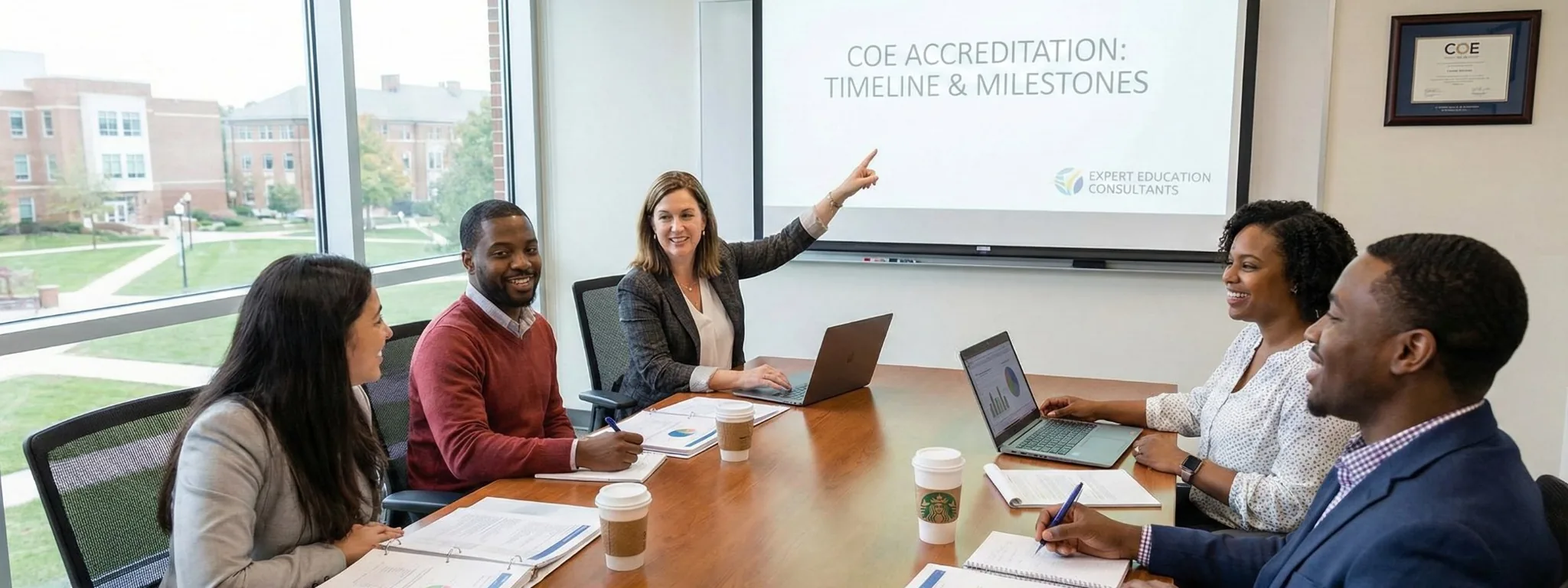
COE accreditation is the national quality credential for career and technical education institutions in the United States. Recognized by the U.S. Department of Education, the Council on Occupational Education has been the trusted authority for occupational education quality since 1971. Expert Education Consultants (EEC), led by Dr. Sandra Norderhaug, has helped 115+ institutions across all 50 states navigate the accreditation process.
What Is COE Accreditation?
The Council on Occupational Education (COE) is a national institutional accrediting agency recognized by the U.S. Department of Education. Founded in 1971 as the Commission on Occupational Education Institutions (COEI) within the Southern Association of Colleges and Schools (SACS), COE became fully independent in 1995 and has grown into one of the most respected voices in postsecondary career and technical education.
COE accredits institutions that offer certificates, diplomas, and applied associate degrees in occupational fields. Its member institutions include public technical colleges (like Tennessee Colleges of Applied Technology), private career colleges (both for-profit and nonprofit), U.S. military training programs (Army, Navy, and Department of Defense schools), and Job Corps centers. With approximately 500+ accredited institutions, COE’s reach spans every corner of the workforce education landscape.
What makes COE unique? It’s laser-focused on workforce outcomes. Every standard, every evaluation, and every data point is designed to answer one question: Are students leaving your institution prepared to work? If your institution lives and breathes career education, COE speaks your language.
| Detail | Information |
|---|
| Founded | 1971 (independent since 1995) |
| Headquarters | Atlanta, Georgia |
| Recognition | U.S. Department of Education (USDE) |
| Scope | Non-degree-granting and applied associate degree-granting postsecondary occupational institutions |
| Member Institutions | 500+ (public technical colleges, private career schools, military programs, Job Corps) |
| Standards | 10 Standards of Accreditation (2024 Handbook) |
| Reaffirmation Cycle | 6 years |
| Title IV Eligibility | Yes — qualifies institutions to apply for federal financial aid |
| Commission Meetings | Quarterly (March, June, September, December) |
Not sure if COE is the right accreditor for your institution? Book a free strategy call and we’ll help you evaluate your options.
Book a Strategy Call →Is COE the Right Accreditor for You?
COE is purpose-built for career and technical schools with a campus-based presence. Not every institution is a natural fit. Here’s a quick self-assessment:
✓ COE Is a Good Fit If…
- You offer career and technical education programs (certificate, diploma, or applied associate degree)
- You operate a brick-and-mortar campus (at least 25% of FTE is in-person instruction)
- You want Title IV federal financial aid eligibility for your students
- You’re a public technical college, private career school, military training program, or Job Corps center
- You value a systems-focused evaluation with strong community and employer input
- You want a well-defined, manageable timeline to accreditation (18–30 months typical)
- You need an accreditor that understands occupational education and workforce outcomes
✗ COE May Not Fit If…
- You offer bachelor’s, master’s, or doctoral degrees (COE caps at applied associate)
- You’re a fully online institution with no physical campus (COE requires 25% brick-and-mortar FTE)
- Your programs are primarily liberal arts or general education, not career-focused
- You have fewer than 10 FTE students at the time of candidacy application
- You’ve been denied or dropped by another USDE-recognized accreditor
- You offer more than 50% VESL (Vocational English as a Second Language) programs
COE’s 10 Standards of Accreditation (2024 Handbook)
COE’s evaluation framework is organized around ten standards published in the 2024 edition of the Handbook of Accreditation. Each criterion under these standards is a requirement for acquiring and maintaining accreditation. Here’s what evaluators are looking for:
Standard 1
Institutional Mission
Focus: Mission must explicitly target career and technical education, be publicly available, concise, and reviewed annually with input from an Institutional Advisory Committee (minimum 3 external members). The mission drives program design, planning, and resource allocation.
Standard 2
Educational Programs
Focus: Every program must align with real workforce needs and have clearly stated objectives. Occupational Advisory Committees required for each program area, providing industry input on curriculum, labor-market relevance, and student readiness. Associate degree programs must meet COE criteria for title, length, and general education.
Standard 3
Program & Institutional Outcomes
Focus: Track completion rates, job placement rates, and licensure pass rates. Results must meet or exceed COE benchmarks. Employer and graduate satisfaction surveys required. A written follow-up plan describes data collection methods, responsible personnel, and how results improve programs.
Standard 4
Strategic Planning
Focus: Documented plan spanning minimum 3 years, updated annually. Must include measurable objectives, strategies, and resource allocations. Faculty, staff, administration, and advisory committees must review and revise the plan each year using objective data.
Standard 5
Educational Resources
Focus: Libraries, media, technology, labs, and learning resources must directly support program objectives. Designated staff must oversee resources, orient users, and maintain current inventories. Annual budgeting and evaluation of resource effectiveness are required.
Standard 6
Institutional Infrastructure
Focus: Safe, well-maintained facilities and IT systems. A written facilities maintenance and operations plan reviewed annually. Health and safety plan covering emergency procedures and incident reporting. Reliable data security and privacy protections.
Standard 7
Financial Resources
Focus: Sound financial management is non-negotiable. Audited financial statements, qualified financial staff, responsible budgeting, and evidence of sufficient funds to operate and complete education for enrolled students. Compliance with refund policies and Title IV rules.
Standard 8
Human Resources
Focus: Written job descriptions, fair complaint/grievance procedures, published evaluation and orientation processes. Adequate staffing levels. Faculty must be qualified by education and experience. Professional development and contributions to curriculum, advising, and industry engagement.
Standard 9
Organizational Structure
Focus: Legally constituted governing board with authority over operations. Designated chief executive (president/CEO) and accreditation liaison on main campus. Clear organizational chart depicting reporting relationships. Necessary legal documents (charter, state license) must be current.
Standard 10
Student Services & Activities
Focus: Academic advising, career guidance, financial aid counseling, orientation, retention programs, grievance resolution, and record-keeping. Career services must include job placement assistance and conduct follow-up surveys of graduates and employers.
Plus: Institutions must also meet COE’s Conditions of Accreditation (baseline operational requirements detailed in Sections II–V of the Handbook) covering state authorization, institutional changes, legal compliance, and enrollment eligibility.
Key Exhibits You’ll Need to Prepare
COE requires a Self-Study Report (SSR) supported by documentary exhibits organized using COE’s check sheets. Each exhibit is linked to specific Standards and Conditions. Here are the most critical categories:
| Exhibit Category | What You Need | Supports |
|---|
| State Authorization | Current state vocational license for main campus and all branches/extensions | Conditions 7 & 8 |
| Institutional Advisory Minutes | Agendas, attendance logs, and minutes from annual meetings with majority external members | Standards 1 & 4 |
| Occupational Advisory Minutes | Minutes from program-specific advisory meetings with industry representatives | Standard 2 |
| Strategic Plan | 3-year minimum plan with measurable objectives, annual updates, and stakeholder review evidence | Standard 4 |
| Catalog & Policies | Complete catalog with all required policies (admissions, attendance, refund, grievance, academic integrity) | Standards 2, 8, 10 |
| Faculty & Staff Credentials | Resumes, transcripts, licenses, background checks for all faculty and key administrators | Standard 8 |
| Program Curricula & Syllabi | Detailed curriculum sheets, course outlines, and program outcomes for each approved program | Standards 2 & 5 |
| Student Achievement Data | Completion rates, placement rates, licensure pass rates, annual report data | Standard 3 |
| Financial Statements | CPA-audited financial statements (two years), annual budgets, composite score worksheets | Standard 7 |
| Marketing Materials | Samples of brochures, website pages, advertisements from the past 2–3 years | Standards 2 & 4 |
The COE Accreditation Timeline
Expect 18–36 months from your first step to a Commission decision, depending on institutional readiness. The Commission meets quarterly (March, June, September, December) to act on candidacy and accreditation applications.
Initial Accreditation Process (New Institutions)
Step 1
Letter of Intent
Day 1
Submit a letter to COE expressing your intent to seek candidacy. COE responds with Candidate Academy registration information.
Step 2
Attend Candidate Academy
Next scheduled Academy (April or October)
A full-time institutional representative attends the Candidate Academy. Offered twice a year. Must attend within 12 months before submitting your candidacy application.
Step 3
Submit Candidacy Application
Within 12 months of Academy
Submit application through EDvera with application fee ($1,500), first year’s dues (based on FTE), and $3,000 site visit deposit.
Step 4
Candidate Site Visit
1–3 months after application
A two-person COE team visits your institution for two days to review eligibility requirements and staff readiness.
Step 5
Candidacy Granted by Commission
Next quarterly meeting (March, June, Sept, or Dec)
The Commission reviews the team report and grants candidacy. You may remain in candidate status for up to 3 years.
Step 6
Self-Study & Annual Report Workshops
Within 12 months of candidacy
A representative attends required workshops at the Spring Accreditation Institute or Annual Meeting.
Step 7
Prepare Self-Study Report
12–18 months
The most intensive phase. Your entire staff documents compliance with all 10 Standards and Conditions in the Self-Study Report (SSR).
Step 8
Preliminary Visit
~90 days before full visit
A COE Fellow visits to confirm preparations and finalize the agenda for the accreditation visit.
Step 9
Accreditation Team Visit
Within 24 months of candidacy
A full evaluation team visits your campus for 2–3 days — reviewing documentation, touring facilities, and interviewing faculty, staff, students, and advisory committee members.
Step 10
Response to Findings & Commission Decision
30 days + next quarterly meeting
You have 30 days to respond to any non-compliance findings. All issues must be resolved before accreditation is granted. The Commission then votes at its next meeting.
With EEC’s support, most institutions complete the process in 18–24 months. We begin gap analysis and document preparation before candidacy, compress the self-study timeline through parallel workstreams, and ensure you arrive at each milestone fully prepared.
Reaffirmation Cycle (Accredited Institutions)
Once accredited, institutions follow a 6-year reaffirmation cycle:
Annually
Annual Report Submission
Due each December
Maintain accreditation through annual electronic report submitted via COE’s accreditation management system, including enrollment, outcomes, and financial data.
Year 6
Reaffirmation of Accreditation
Full evaluation cycle
Prepare a new Self-Study Report, host a full team visit, and go through the Commission review process for reaffirmation of accreditation for the next 6 years.
COE Accreditation Fees
COE charges a combination of application fees, annual membership dues (based on FTE enrollment), and visit-related costs. All fees below are paid directly to COE. Always verify current amounts at council.org.
Application & Visit Fees
| Fee Type | Amount |
|---|
| Candidacy Application Fee | $1,500 (non-refundable) |
| Candidate Site Visit Deposit | $3,000 (applied toward actual visit costs) |
| Accreditation Team Visit Costs | Variable — institution reimburses transportation, lodging, and meals |
| Workshop & Conference Fees | Registration fees for Spring Institute and Annual Meeting |
| Substantive Change Applications | Varies by change type (new program, new campus, distance ed, etc.) |
Annual Membership Dues
| Component | Amount |
|---|
| Annual Dues | Based on FTE enrollment (1 FTE = 900 clock hours / 45 quarter credits / 30 semester credits) |
| Non-Main Campus Dues | Per-site fee for each branch or extension campus beyond the main campus |
| Late Fees & Penalties | Assessed per COE schedule for overdue reports, payments, or unreported changes |
Important: These are COE’s fees paid directly to the Commission. EEC’s consulting fees are separate and customized to each institution’s needs, size, and scope. Contact us for a personalized quote after a free consultation.
Need help estimating total COE accreditation costs? We provide transparent, itemized consulting proposals after your free strategy call.
Get a Custom Quote →How EEC Helps You Achieve COE Accreditation
🔍
Gap Analysis & Readiness
Review documentation and operations against all 10 COE standards and Conditions. Receive a detailed compliance roadmap of what’s missing, what needs updating, and what’s on track.
📅
Strategic Planning & Timeline
Build a project plan with milestones aligned to Academy schedules, Commission meeting dates, and submission deadlines. No more guessing what comes next.
📂
Exhibit Development
Compile, organize, and quality-check every exhibit using COE’s check sheets — from advisory committee minutes and faculty credentials to audited financials and student outcome data.
✍️
Self-Study Report Drafting
Write the SSR narrative for each standard, referencing exhibits and citing COE criteria. Clear, compliant, and compelling content that demonstrates full compliance.
📈
Data Analysis & Reporting
Analyze student outcomes (completion, placement, licensure), calculate composite financial scores, benchmark against COE thresholds, and create visual summaries.
🎯
Site Visit & Follow-Up
Mock interviews, leadership coaching, exhibit room setup. Post-visit response to findings within the 30-day window and support through the Commission’s final decision.
Frequently Asked Questions
How long does COE accreditation take?
From your first Candidate Academy attendance to a Commission decision, expect 18 to 36 months. With EEC’s support, most institutions complete the process in 18–24 months because we front-load preparation and keep you on schedule.
What are COE’s eligibility requirements?
Your institution must offer postsecondary career and technical education exclusively, offer credentials no higher than an applied associate degree, have been licensed and in continuous operation for at least one year, have at least 10 FTE students, derive at least 25% of FTE from traditional (campus-based) instruction, and maintain at least 50% FTE in non-VESL programs.
Can I get Title IV financial aid with COE accreditation?
Yes. COE is recognized by the U.S. Department of Education, which qualifies your institution to apply for a Program Participation Agreement to offer federal financial aid. However, accreditation alone doesn’t automatically grant Title IV access — a separate application to the U.S. Department of Education is required.
How often does COE reaffirm accreditation?
COE operates on a 6-year reaffirmation cycle. Between reaffirmation visits, institutions maintain accreditation through submission of an Annual Report each December via COE’s accreditation management system.
What’s the difference between COE and ACCSC?
Both are national accreditors for career schools, but they differ in focus and membership. COE historically served institutions in the Southeast and has a strong presence among public technical colleges and military training programs. ACCSC tends to serve private career schools with a heavier emphasis on employment outcomes documentation. Your choice often depends on institution type, location, and program mix. EEC can help you determine the best fit.
Does COE accredit online programs?
Yes. COE expanded its scope to include distance education programs in 2007. However, at least 25% of your institution’s total FTE must come from traditional (brick-and-mortar) instruction. Fully online institutions with no campus-based component should consider DEAC instead.
What happens during a COE site visit?
The accreditation team visits your campus for 2–3 days. They review documentation, tour facilities, interview faculty, staff, students, and advisory committee members, and evaluate compliance with all 10 standards. About 90 days before the full visit, a COE Fellow conducts a preliminary visit to confirm readiness and finalize the agenda.
What if my institution receives findings of non-compliance?
After the site visit, you receive an Official Visit Team Report. You have 30 days to submit a written response demonstrating how each finding has been addressed and resolved. Accreditation will not be granted until all non-compliance issues are resolved to the Commission’s satisfaction. EEC helps you draft a strong, evidence-backed response.
Ready to start?
Begin your COE accreditation
journey with expert guidance.
115+ institutions launched across all 50 states. We partner with career and technical institutions from readiness assessment through grant of accreditation.