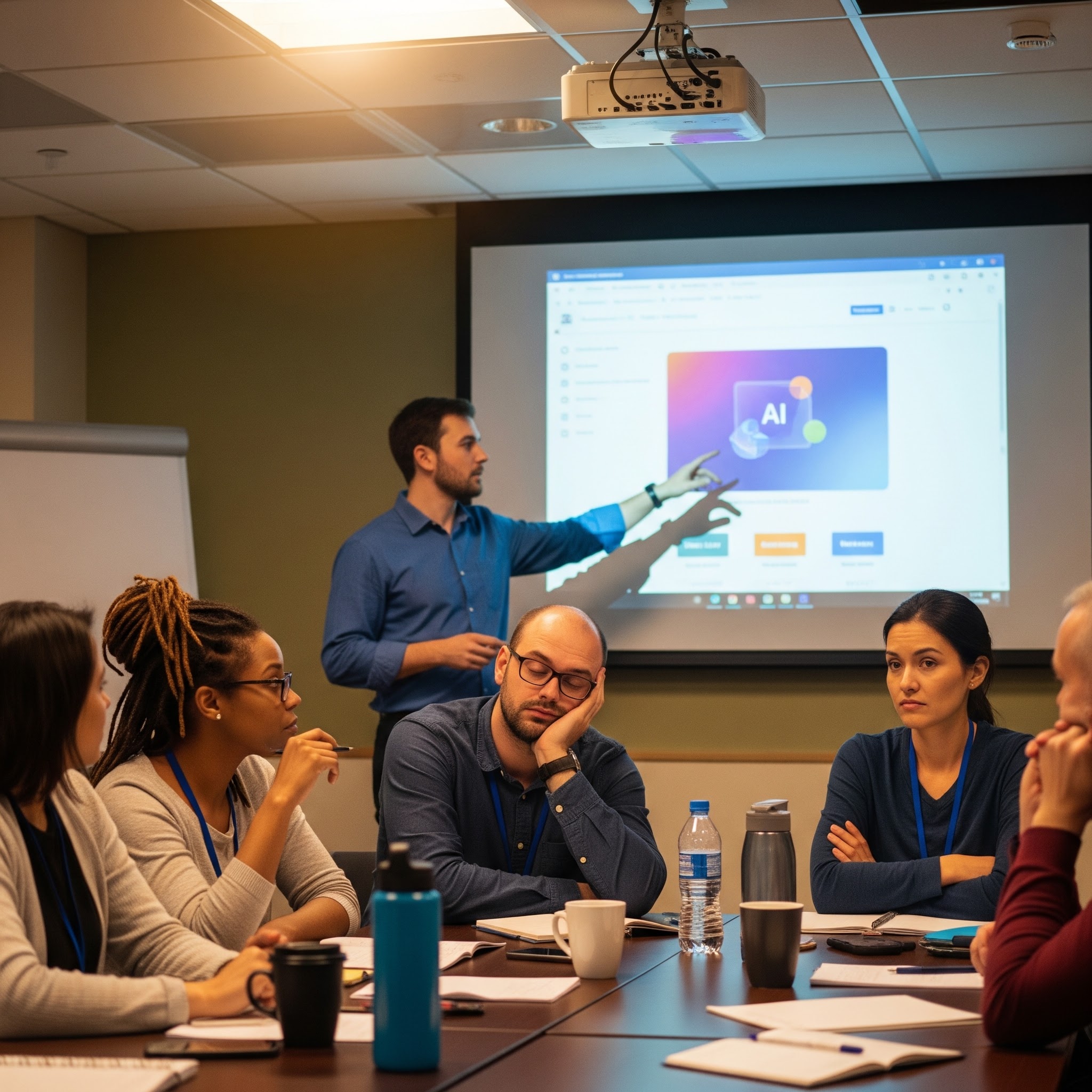



Let me ask you something directly: if a student can get a personalized lecture from an AI tutor at 2 a.m., earn a competency badge verified by a blockchain credentialing system, receive career counseling from an AI advisor trained on ten million job market data points, and graduate with a portfolio of AI-graded projects—why do they need your campus?
That's not a rhetorical provocation. It's a question I've been hearing from founders, investors, and even sitting presidents of established institutions over the last eighteen months. And the honest answer—the one that most people in higher education don't want to say out loud—is that we don't have a guaranteed answer. What we have is evidence. Evidence that institutions which understand their irreplaceable value and build around it will thrive. Evidence that institutions which mistake the container for the content—the campus experience for the mere delivery of information—will struggle.
This is the existential question for higher education in the AI era: not whether AI will change how we teach, but whether the institution itself remains necessary. And as someone who has spent over two decades helping founders build new schools, I'm going to give you my most direct assessment yet.
The short version? Students will still need us—but not for the reasons we've historically assumed. The institutions that survive and grow won't be the ones that defend the old model. They'll be the ones that honestly reckon with what AI can and cannot do, and rebuild their value proposition around what's genuinely irreplaceable.
That's what this post is about.
The Competitive Landscape Has Changed Permanently
Start with the hard reality. AI-powered learning platforms have become genuine competitors to traditional postsecondary enrollment in a way that no prior technology managed. The internet threatened to democratize education for decades and mostly didn't—the quality, completion, and outcomes of fully online education remained stubbornly below residential alternatives. AI is different.
Khan Academy's Khanmigo is delivering Socratic-method tutoring to millions of students at essentially zero marginal cost. Coursera and edX have shifted from simple video courses to AI-adaptive learning pathways with assessment, credentialing, and employer verification built in. Startups like Synthesis and Learnly are building AI-native educational experiences that adapt in real time with a level of personalization that no human instructor—working with thirty students per class—can replicate.
The numbers matter here. As of early 2026, AI-powered learning platforms collectively serve hundreds of millions of learners globally. Employer-sponsored upskilling programs, powered by platforms like Coursera for Business and LinkedIn Learning's AI-adaptive pathways, are growing at double-digit rates. The U.S. Bureau of Labor Statistics has documented that employer tuition benefits are increasingly being redirected toward these platforms and away from traditional degree programs.
For investors building new institutions, this isn't cause for panic—it's cause for strategic clarity. The question isn't whether AI learning platforms will exist. They will. The question is whether the institution you're building offers something those platforms can't.
The institutions that will fail aren't the ones that compete with AI—they're the ones that try to out-AI the AI platforms, racing to automate away the very things that made human-centered education worth attending.
What AI-Only Education Actually Delivers Today
To understand what institutions are up against—and where the gaps are—you need an honest assessment of what AI-only educational pathways actually deliver in 2026.
The pattern is clear: AI platforms are approaching parity for information delivery, adaptive practice, and basic credentialing. They are nowhere near parity for the relational, developmental, and civic dimensions of education. Those gaps are not incidental—they're structural. They emerge from the nature of the technology, not just its current maturity.
What Human-Centered Institutions Actually Provide
Here's where I want to be careful, because this is where the defensive instincts of higher education get dangerous. The temptation is to list everything traditional institutions do and declare it all irreplaceable. That's not honest. Some of what institutions have historically done—delivering content, testing retention, transmitting credentials—AI really does do comparably well and at lower cost.
So let's be precise. What do human-centered institutions provide that AI platforms structurally cannot?
Community and Belonging
This sounds soft. It isn't. The research on sense of belonging in higher education is robust and directly linked to outcomes that matter: persistence rates, completion, post-graduation earnings, and long-term civic engagement. Students who feel they belong at their institution complete at dramatically higher rates than those who don't.
AI platforms can simulate social interaction. They cannot create genuine community. The difference isn't marginal—it's categorical. Community requires shared vulnerability, real stakes, genuine difference, and the irreducible experience of being in the same room (or the same difficult moment) as other human beings who can see you fail and keep showing up anyway.
I've worked with founders who initially dismissed this dimension as soft science. Then they started looking at their completion data. The single strongest predictor of whether a student finishes—more powerful than academic preparation, financial situation, or program difficulty—is whether they have at least one relationship on campus that they'd call meaningful. That's not AI-deliverable. Not yet, and not soon.
Mentorship and Human Relationships
There's a version of AI mentorship that's impressive on a demo. The AI asks thoughtful questions. It remembers your goals from last session. It offers encouragement at the right moments. It knows the job market in your field better than most human advisors do.
And then a student gets a call from a faculty member who says: "I've been thinking about what you shared in class last week. I know a researcher at Johns Hopkins who's doing exactly what you described wanting to do. Can I make an introduction?"
That's a different thing. It's not about information or personalization. It's about a human being deciding that this particular student is worth investing in—that their potential is real and worth a phone call. That kind of recognition is formative in a way that optimized AI interaction simply isn't. And the research backs this up: mentorship relationships with faculty and industry professionals are among the strongest predictors of career trajectory and long-term professional network quality.
For institutions serving first-generation students, students from underrepresented groups, or adult learners returning after years away from education, this dimension is especially critical. Many of these students have never had an authority figure tell them they were capable of more. An AI that's been trained to be encouraging is not the same thing.
Socialization and Civic Formation
Higher education has always had a dual mission: developing individual capability and preparing citizens. The second part—civic formation, learning to engage productively with people who think and live differently from you—is something that AI-mediated education cannot replicate. You can't develop the capacity for democratic participation through personalized, optimized learning pathways. You develop it through the friction of genuine encounter with difference.
This isn't nostalgia for the traditional campus. Many institutions failed at this mission, sorting students into homogeneous cohorts and insulating them from genuine engagement with difference. But the possibility exists in human-centered institutions in a way it categorically does not on AI platforms that optimize for individual satisfaction.
For founders building new institutions, this represents a genuine differentiator. The question isn't whether you have a beautiful campus—it's whether your design deliberately creates the conditions for formative human encounter. That's a mission element that AI cannot commoditize.
The Credential Question: Do Employers Trust AI-Only Pathways?
Let's deal directly with the credentialing issue, because it's the one where the threat to institutions is most concrete and the timeline is most uncertain.
Skills-based hiring is real. The percentage of job postings requiring a four-year degree has declined meaningfully across multiple sectors, including technology, financial services, and even some healthcare functions. Companies like Google, Apple, IBM, and Accenture have publicly removed degree requirements from significant portions of their hiring. Some of this is genuine—they've found that competency-based assessments predict job performance better than GPA from a name-brand institution.
But here's what the skills-based hiring narrative often obscures: the credential that's declining in value isn't all credentials—it's low-value credentials from institutions without strong outcomes data. Degrees from institutions with strong placement rates, employer relationships, and demonstrated graduate outcomes are still extremely valuable. What's declining is the credential from an institution that can't demonstrate outcomes.
So what about AI-only credentialing? Micro-credentials from AI platforms are genuinely valuable for specific, technical, verifiable skills—a Python programming certificate from Coursera, a Google Analytics certification, a Salesforce admin credential. Employers use these for specific roles. But for broader professional entry, for management tracks, for the careers that require judgment, communication, and leadership—employer trust in AI-only credentials remains low and the data supports that assessment.
The honest picture: AI-only credentials are gaining ground in specific, verifiable skill domains. They are not gaining ground as primary qualifications for broad professional roles. Regional accreditation—the gateway to Title IV federal financial aid—still carries unique weight because it signals a quality assurance process that employers understand and trust, even if imperfectly.
For new institutions, this means the credential you offer matters. An accredited degree from a well-governed institution with strong outcomes data is a fundamentally different product than an AI platform certificate. The former is not under existential threat. It's under pressure to prove its value—which is appropriate and healthy.
Reimagining the Campus Experience for an AI-Augmented World
The response to AI isn't to pretend it doesn't exist—and it isn't to replicate what AI does better than humans. The response is to reimagine what the institution does and experience it can create around the things AI structurally cannot provide.
Let me walk through what that looks like in practice.
The Flipped Institution Model
The most forward-thinking institutions are moving toward what some are calling the flipped institution model. Instruction—content delivery, practice problems, initial assessment—is handled by AI tools that do it well. The institution's human resources—faculty, advisors, mentors, peers—are freed up to do what only humans can: facilitate discussion, challenge assumptions, coach individual students through difficulty, build relationships, and connect students to professional networks.
This isn't theoretical. Several early-stage institutions I've worked with have already moved to this model in specific programs. In one allied health program, AI tutoring systems handle all the content delivery and initial competency assessment for anatomy and medical terminology. Faculty spend 100% of their classroom time in clinical simulation, Socratic discussion, and individual coaching. Completion rates went up. Faculty satisfaction went up. Student satisfaction went up. Cost per student went down.
High-Touch, Low-Lecture Campus Design
The physical and experiential design of your campus needs to reflect this shift. If you're building a new institution, the lecture hall is largely obsolete as the primary learning environment. What you need instead: collaboration spaces where students work through complex problems together; mentorship suites where faculty hold individual and small-group coaching sessions; project spaces where industry-connected capstone work happens; wellness and community spaces designed for genuine social encounter.
This isn't just philosophical—it's practical. Accreditors want to see that your physical resources support your educational model. If your educational model is genuinely different from the traditional lecture-based approach, your facilities should reflect that. And they should be designed not to compete with AI on information delivery, but to create the human experiences AI cannot.
Industry-Integration as Differentiator
One area where institutions have a structural advantage over AI platforms: they can have real relationships with real employers. Not simulated career counseling—actual employer partnerships, advisory boards, hiring pipelines, internship programs, and co-op arrangements that AI platforms cannot replicate.
I worked with a founder in 2025 who was building a healthcare operations school. Her institution's core differentiator wasn't curriculum design or technology—it was a network of twelve regional health systems that had agreed to hire her graduates exclusively for a specific operations role type, and to serve on the advisory board that shaped the curriculum. No AI platform can offer that. That's a human relationship that took her three years to build and would take a competitor another three years to replicate.
Scenario Planning: Higher Ed in 2030 and Beyond
Let me get specific about what the landscape might look like in four years, because 2030 is close enough to plan for. I'll map out three scenarios—not to predict the future, but to help you think strategically about positioning.
Here's my honest read: the most likely scenario is a version of Differentiated Coexistence with elements of Credential Disruption in specific sectors. AI platforms will become the default for content delivery and foundational skill development. But human-centered institutions that can demonstrate real outcomes, real community, and real professional connections will hold their market position—and likely improve it, because the competition for students who want that experience will thin out as weaker institutions fail.
The institutions that will fail are the ones that try to compete with AI on AI's terms—building more sophisticated learning management systems, adding more AI tutoring features, automating more of the student experience. They'll lose that race every time. The institutions that will thrive are the ones that double down on what humans do: relationship, community, judgment, and the messy, irreplaceable work of becoming.
Strategic Implications for Founders Building in 2026
If you're in the planning stages of a new institution, this analysis should shape some concrete decisions.
Don't Build for Information Delivery
Your value proposition cannot be that you teach things students couldn't learn on their own with AI tools. That battle is over, and AI won. Build your curriculum around things that require human presence: clinical simulation, performance assessment, project-based work with real industry partners, and the kind of discussion that requires people in the same room to disagree productively.
Design for Retention Through Belonging
The single highest-leverage thing you can do for your students and your institution is to design systematically for belonging. This means small cohort structures, faculty who know students by name, peer mentoring programs, advising relationships that start before enrollment and continue after graduation, and a physical (or hybrid) environment designed for genuine social encounter. It also means measuring it—tracking belonging as a KPI alongside persistence and completion.
Build Employer Relationships That AI Can't Replicate
Your institution's relationship with employers is your strongest differentiator. Invest early in building an employer advisory board for every program. Create hiring pipelines, not just career services. Design programs around what employers actually need, with employers involved in curriculum design. These relationships take time to build and are extremely difficult for AI platforms to replicate.
Be Transparent About What AI Can Do
Here's a counterintuitive piece of advice: tell prospective students exactly what AI can and can't do in education. The institutions that are earning student trust right now are the ones that say: "AI can deliver information better than we can. Here's why you're paying to come here anyway." That's a compelling message for students who understand what they're buying, and it filters out students who would be better served by a platform credential for their specific goals.
Accreditation as Moat
Don't underestimate the strategic value of accreditation in a world where AI platforms are challenging traditional credentials. Regional accreditation—the process of demonstrating through an external quality review that your institution meets rigorous standards for student outcomes, governance, faculty qualifications, and financial stability—is a barrier that AI platforms have not yet cleared and won't clear easily. The Department of Education's recognition of accrediting agencies creates a trust infrastructure that protects accredited institutions from direct AI platform competition in the Title IV market.
For founders, this means the time and investment required to earn initial accreditation isn't just a regulatory hurdle—it's a competitive moat. Build your accreditation strategy knowing that the quality assurance process you're completing is itself a differentiator.
The Populations That Will Always Choose Human-Centered Institutions
One more strategic lens: not all students are equally replaceable by AI platforms. Some populations have reasons to choose human-centered institutions that won't disappear regardless of how good the AI gets.
- First-generation college students who need more than content delivery—they need socialization into professional environments, help navigating systems they've never encountered, and mentorship from people who believe in them.
- Adult learners returning to education after workforce gaps, who need not just knowledge but professional re-entry support, credentialing that employers recognize, and community with peers navigating similar transitions.
- Hands-on and clinical learners in allied health, skilled trades, and applied technology fields, where physical practice, supervised clinical experience, and hands-on lab work cannot be replaced by simulation.
- Students who are specifically seeking the social and civic development dimensions of higher education—who want the full college experience, not just the credential.
- International students seeking U.S. credentials and the professional networks that come with U.S.-based institutional relationships.
These populations are large, growing in some cases, and genuinely underserved by AI platforms. A new institution designed specifically to serve one or more of these populations with excellence has a durable value proposition that AI platform competition will not eliminate.
What This Means for How You Talk About Your Institution
The language institutions use to describe their value proposition needs to change. The old model—"we deliver quality education"—is insufficient when AI platforms can plausibly claim the same thing. The new model needs to be specific about what makes human-centered education worth attending.
I've helped several founders develop what I call an irreplaceability statement—a concise articulation of the specific dimensions of their institution's value that AI platforms structurally cannot replicate. It sounds like this: "Our graduates leave with a professional network of fifty regional employer contacts, clinical hours supervised by licensed practitioners, and four years of community with peers who will be colleagues for decades. No platform provides that."
That's not defensive. It's honest. And it's compelling to prospective students who are smart enough to ask the right question: "What am I actually getting here that I couldn't get elsewhere?"
Key Takeaways
- AI platforms are genuine competitors for information delivery, adaptive practice, and some credentialing functions. Institutions that try to out-AI the AI will lose.
- The irreplaceable dimensions of human-centered education—community, belonging, mentorship, civic formation, and hands-on training—are structural, not incidental. They can't be optimized away.
- Employer trust in accredited credentials remains high relative to AI-only pathways, particularly for broad professional roles. Accreditation is a competitive moat worth investing in.
- The institutions that will thrive are those that design deliberately around what AI can't do: belonging, human relationships, employer connections, and physical or clinical training.
- The flipped institution model—AI for content delivery, humans for relationship and judgment—offers a practical framework for restructuring the student experience around genuine irreplaceability.
- Specific populations—first-generation students, adult learners, clinical/hands-on learners—have especially strong reasons to choose human-centered institutions regardless of AI platform quality.
- Be transparent about what AI can do. Telling students exactly why your institution is worth attending despite AI alternatives builds trust and filters toward students you can genuinely serve.
- Scenario planning for 2030 suggests a likely path of differentiated coexistence, with platform consolidation in content delivery and institutional differentiation in experience and outcomes.
- Start building employer relationships now. These take time and are the hardest thing for AI platforms to replicate.
- Design for belonging as a KPI, not an afterthought. Belonging drives persistence, completion, and outcomes more reliably than any other single institutional factor.
Frequently Asked Questions
Q: Are AI-powered degrees and certificates from platforms like Coursera or Khan Academy going to replace traditional degrees within ten years?
A: For specific, verifiable technical skills—probably yes, in some sectors. For broad professional entry, management roles, and careers that require judgment and communication, the evidence suggests no. Employer trust in accredited credentials remains strong, and the quality assurance infrastructure that underpins regional accreditation is not something AI platforms can quickly replicate. The more accurate prediction: AI-only credentials will grow in niche legitimacy while accredited degrees remain the standard for broad professional roles. The pressure is on institutions to demonstrate outcomes, not just confer credentials.
Q: Should a new institution worry about enrollment competition from AI learning platforms?
A: Yes—but the correct response is differentiation, not imitation. The students most vulnerable to AI platform substitution are those who genuinely only needed information delivery and a credential. Those students were often poorly served by traditional institutions anyway. The students who benefit most from human-centered institutions are the ones you want to build for: first-generation learners, hands-on program students, adult learners who need community and professional re-entry support. Design for them, not against AI.
Q: What does an 'irreplaceability statement' look like for a small trade school?
A: Something like: 'Our graduates leave with 600 supervised clinical hours, a state license, and relationships with twelve regional employers who actively recruit from our program. Our campus is designed for hands-on practice that no simulation can replicate. Our faculty have an average of fifteen years of industry experience. That's not transferable to a platform.' Make it specific. Make it honest. Make it about outcomes and experiences that are verifiably yours.
Q: How should institutions measure 'belonging' as a KPI?
A: Several validated instruments exist for measuring sense of belonging in higher education—the Sense of Belonging Scales developed by researchers like Walton and Brady are widely used. Institutions typically measure belonging through mid-semester check-in surveys, early-alert advising triggers, and retention data analyzed by cohort. The key is connecting belonging data to intervention: when scores drop, advisors reach out. The institutions that do this well treat belonging as an early warning system for attrition, not just a feel-good metric.
Q: What does 'flipped institution' design look like in practice for a healthcare program?
A: In a healthcare program, the flipped model means AI tools handle anatomy content delivery, terminology quizzing, and initial competency verification—often available 24/7 via mobile. Class time is entirely clinical simulation, case discussion, hands-on skills lab, and faculty-led coaching. Faculty have data from the AI tools showing which students are struggling with which concepts before class, so they can target coaching appropriately. Students get the efficiency of AI content delivery and the irreplaceable value of supervised human practice. It's not easier to implement, but the outcomes data consistently supports it.
Q: How should institutions respond to students who prefer AI-mediated learning?
A: With honesty. Some students genuinely learn better through self-paced AI tutoring than through the social dynamics of a classroom. Those students may be better served by AI platforms for certain components of their education. The response isn't to force them into a model that doesn't work for them—it's to design a curriculum that leverages AI for what they prefer and humans for what requires human presence. A student who hates lectures can still benefit enormously from mentorship, clinical practice, and employer connections.
Q: What are the biggest mistakes institutions make when trying to compete with AI platforms?
A: Three patterns we see repeatedly. First, trying to out-personalize AI—spending millions on adaptive learning technology to match what AI platforms do natively, at enormous cost and with inferior results. Second, dismissing the threat and assuming brand recognition alone will sustain enrollment. Third, eliminating human touchpoints to cut costs, which undermines the very value proposition that makes institutions worth attending. The institutions that get this right invest in human capital—faculty, advisors, mentors—rather than trying to replace it.
Q: Can a new institution build the employer relationships you describe from scratch?
A: Yes, but it takes time and intentionality. Start before you open. In the year before enrollment begins, build your employer advisory board—reach out to ten to fifteen regional employers in your sector and ask them to help shape your curriculum. Offer them real input, not just a logo on your website. Many will say yes, because they have genuine workforce pipeline problems. Those early relationships become hiring pipelines, which become your outcomes data, which become your enrollment marketing. It compounds over time, but you have to start early.
Q: Will accreditation standards eventually apply to AI learning platforms, leveling the playing field?
A: Possibly, and this is worth watching. The Department of Education's recognition of accrediting agencies creates a framework for applying quality assurance standards to any institution seeking Title IV access. As pressure grows for AI platforms to access federal financial aid, regulatory frameworks will likely develop. But the timeline is uncertain, and the quality standards may differ significantly from those applied to traditional institutions. For accredited institutions, this is a structural advantage that should not be taken for granted—but it's real and durable in the near term.
Q: How does the existential AI question affect institutional mission statements?
A: It should force mission statements to be more specific. A mission statement that says 'we provide quality education that transforms lives' is as plausible for an AI platform as for a residential college. A mission statement that says 'we build the professional networks, clinical competencies, and community belonging that launch careers in healthcare for first-generation students in the greater Phoenix area' is specific, human-centered, and genuinely irreplaceable. The mission should name what only you can provide.
Q: What's the role of accreditors in protecting institutions from AI platform competition?
A: Accreditors—especially regional accreditors like SACSCOC, HLC, WSCUC, and MSCHE—are the quality gatekeepers for Title IV federal financial aid. AI platforms cannot access Pell Grants, federal student loans, or GI Bill benefits without meeting the same standards as traditional institutions. This creates a significant barrier to AI platform competition in the traditional student market. As long as accreditation remains the gateway to federal aid, accredited institutions have a structural advantage that AI platforms have not cleared.
Q: Should new institutions market themselves as 'AI-free' alternatives for students who prefer human instruction?
A: No—that's a defensive strategy that ages poorly. Marketing yourself as AI-free is positioning against technology rather than positioning for value. It also misrepresents what students actually want: most students don't care whether their tutoring is delivered by a human or an AI. They care whether they're learning, whether they have support, whether they're building a future. Market your institution's human dimensions—community, mentorship, outcomes, employer connections—not the absence of AI.
Q: How should founders think about the 2030 scenario where AI credentials gain broad employer acceptance?
A: Plan for it now by building your outcomes infrastructure. If AI credentials gain ground, the institutions that survive are the ones with verifiable, demonstrably superior outcomes—placement rates, earnings data, employer satisfaction surveys, alumni networks. An institution that has ten years of outcomes data showing its graduates outperform AI-credential holders in career trajectory is in a very different position from one that's been coasting on reputation. Start collecting that data today.
Q: Is the 'community and belonging' argument mainly relevant for residential colleges, or does it apply to online and hybrid institutions?
A: It applies across all modalities, but it's harder to achieve online and requires more deliberate design. Online institutions that build belonging successfully tend to use cohort-based structures where students move through programs together, synchronous sessions that require real-time interaction, peer mentoring structures, and strong advisor relationships. The institutions that built belonging successfully in hybrid environments during and after COVID showed it's possible—but it requires intentional investment, not just a discussion forum.
Glossary of Key Terms
Current as of March 2026. AI platform capabilities, employer credentialing practices, and regulatory frameworks are evolving rapidly. Consult current sources and expert advisors before making institutional planning decisions.
If you're ready to explore how EEC can de-risk your AI-integrated launch, reach out at sandra@experteduconsult.com or +1 (925) 208-9037.