


When people talk about AI in higher education, they almost always mean the classroom: AI tutors, AI-generated content, AI-powered assessments. And yes, those conversations matter. But here's what I tell every founder I work with in our first serious planning session: the administrative applications of AI will show you better ROI faster, with fewer pedagogical complications and less faculty resistance, than almost anything you do in the curriculum.
That's not a knock on instructional AI. It's a recognition of where the friction is lowest and the wins are most measurable. Enrollment management. Financial aid processing. Compliance monitoring. Student advising. Content operations. These are areas where institutions spend enormous amounts of time and money on work that is, frankly, information-intensive and process-driven—which is exactly what AI is good at.
I've watched institutions spend six months arguing about AI policy for classrooms while their admissions team was manually sorting through applications, their compliance staff was drowning in documentation requests, and their advising department had a 300-student-per-advisor caseload that made meaningful guidance impossible. The operational AI wins were sitting right there, uncaptured, because everyone was looking at the shiny instructional use cases.
This post is a practical guide to administrative AI—where the genuine ROI is, what the pitfalls look like, and how to build a change management strategy that actually works. Whether you're building from scratch or operating an institution that's behind on AI adoption, there are real gains available here that most institutions are leaving on the table.
The Administrative AI Landscape in 2026
Let's start with a realistic assessment of what administrative AI is actually doing well in institutions today, because the vendor marketing in this space is enthusiastic and not always accurate.
The honest assessment: administrative AI delivers consistent, measurable ROI in enrollment management, financial aid processing, compliance monitoring, and retention prediction. It delivers more modest gains in chatbot advising and content operations. And it's developing, but not yet mature, in HR applications.
For a new institution with limited staff and high workload demands, the enrollment management and compliance applications deserve immediate attention. They're the ones where understaffed teams are most at risk of falling behind, and where AI augmentation creates the most direct return on investment.
Enrollment Management: Where AI Delivers Fastest ROI
Enrollment management—the practice of attracting, admitting, and retaining the right students—is among the most data-intensive functions in higher education. It's also the one where AI applications are most mature and most proven. For a new institution, getting enrollment management right is existential: you don't make payroll if you don't enroll students.
Predictive Analytics for Yield Optimization
Here's the core problem enrollment teams face: you know who applied, and you have to make admissions decisions, but you have no perfect way of knowing which admitted students will actually enroll. Yield—the percentage of admitted students who enroll—is notoriously hard to predict without data. Traditional approaches rely on experience and gut instinct.
AI-powered predictive models change this significantly. By analyzing patterns across application data, communication touchpoints, financial aid award size, geographic distance, program preferences, and historical enrollment decisions from comparable students, these models can predict with reasonable accuracy which admitted students are likely to enroll—and which are likely to melt before the first day of classes.
This information is operationally valuable. If your model flags an admitted student as high melt risk, your admissions counselor can prioritize outreach before the decision deadline. If it identifies a student who is strongly likely to enroll, you can focus your resources elsewhere. Several platforms—Slate by Technolutions, EAB Navigate, and Salesforce Education Cloud—integrate AI-powered yield prediction into their CRM functions.
For a new institution without historical data to train models, this is worth knowing: the models get better over time as you accumulate enrollment history. In your first one or two cohorts, you're largely using industry benchmark data. By year three or four, your models are trained on your actual students—and they become significantly more accurate.
Personalized Outreach at Scale
The second major enrollment management application: personalized outreach. Prospective students—especially adult learners and first-generation students—respond much better to communications that feel tailored to their specific situation than to mass-blast email campaigns. But personalization at scale used to require either a very large admissions staff or a very low volume of applicants.
AI changes the calculus. Email sequencing tools powered by AI can generate personalized communication flows based on where a student is in the enrollment funnel, what program they've expressed interest in, what objections they've raised, and what similar students have responded to in the past. The communications feel personal without requiring an admissions counselor to write each one individually.
An important caveat: AI-personalized outreach requires careful governance. FERPA applies to student inquiry data, and some students have raised concerns about AI-driven communication that feels manipulative rather than helpful. Build transparency into your outreach—letting students know that your communication is automated and how to reach a human—reduces this risk significantly.
Transfer Credit and Prior Learning Assessment
One enrollment management function that's dramatically underutilized by AI: transfer credit evaluation and prior learning assessment. For institutions serving adult learners and career changers, the ability to quickly and accurately evaluate whether a student's prior coursework or work experience should translate into credit can be the difference between enrollment and dropout.
Traditional transfer credit evaluation is manual, inconsistent, and slow. Faculty committees review transcripts case by case, with widely varying results. AI tools trained on course catalog data, learning outcome frameworks, and transfer credit precedents can produce consistent preliminary evaluations much faster, which faculty can then review and approve. Institutions using AI-assisted transfer evaluation report processing time reductions of 60--70% without loss of accuracy.
AI-Powered Student Advising: Promise and Limits
Let's be precise about what AI advising chatbots actually do well—and where they fail—because this is an area where institution leaders often end up either over-relying on AI or dismissing it entirely. Both mistakes are costly.
What Chatbots Do Well
The honest answer: AI advising chatbots excel at high-volume, low-complexity student inquiries. Questions like 'When is the last day to withdraw from a course?', 'How do I apply for financial aid?', 'What are the graduation requirements for my program?', and 'Where can I get tutoring?' are time-consuming for human advisors and eminently answerable by a well-trained AI system that has access to your institutional knowledge base.
The volume of this type of inquiry is enormous. At many institutions, 60--70% of advisor contacts are for information that could theoretically be found in the catalog or website. An AI chatbot that handles these inquiries effectively frees your human advisors for the complex, relationship-intensive work that actually drives retention: a first-generation student who doesn't understand what financial probation means, a student who's failing two courses and is too embarrassed to ask for help, an adult learner managing a family crisis and trying to figure out whether to withdraw or take a medical leave.
Where Chatbots Fail—and Where Failure Is Dangerous
Here's the part that gets institutions in trouble: AI chatbots are not equipped to handle emotionally complex, legally sensitive, or highly individualized advising situations. And students in crisis don't always self-identify before typing their first message. A student who opens with 'I need to withdraw' might be contemplating a straightforward process—or might be in the middle of a mental health crisis.
Every AI advising system deployed in a student-facing context needs robust escalation protocols. When the system detects specific language patterns—financial distress keywords, mental health signals, academic integrity questions, disability accommodation requests, Title IX-related language—it should immediately route to a human. This isn't optional. It's a legal and ethical requirement, and it's the area where I see the most dangerous gaps in institutional deployments.
An AI chatbot that fields mental health distress inquiries without a human escalation protocol isn't a cost-saving tool—it's a liability waiting to happen.
The platforms that do this well—Mainstay (formerly AdmitHub), EAB Navigate, and newer entrants like Ivy.ai—build escalation logic directly into their systems and provide audit trails of when and how escalations occurred. When evaluating advising chatbot vendors, this should be a non-negotiable requirement.
The Right Human-AI Ratio for Advising
We've found that the most effective models use AI to handle 60--70% of routine inquiry volume, reducing per-advisor caseload enough that advisors can genuinely reduce their case counts and focus on proactive, relationship-based work. This means you don't reduce your advising staff—you restructure their time. The ROI comes from retention improvement, not headcount reduction.
Financial Aid Processing: AI Where It Counts Most
Financial aid processing is one of the most labor-intensive, error-prone, and compliance-critical functions in higher education. It's also an area where AI delivers measurable, significant ROI with relatively low implementation complexity—and where the cost of getting it wrong is severe.
Verification Processing
When a student's FAFSA is selected for verification—the process by which the Department of Education requires institutions to confirm the accuracy of the information submitted—the institution must collect supporting documentation (tax transcripts, identity verification, household information) and compare it to the FAFSA data. This is highly manual at most institutions. Trained staff must review documents, identify discrepancies, request corrections, and update the student's aid package.
AI-powered verification tools can automate the document review step—extracting data from uploaded tax transcripts, comparing it to FAFSA data, and flagging discrepancies for human review—dramatically reducing processing time. Institutions using AI verification tools report processing time reductions of 50--60% per file, with error rates that are consistently lower than purely manual review.
Fraud Detection
Financial aid fraud is a real and growing problem, particularly for online and hybrid institutions. Patterns of fraud include application submissions with fabricated household information, synthetic identity fraud, and enrollment-then-withdraw schemes designed to capture Pell Grant disbursements without completing coursework. Traditional fraud detection is based on manually reviewing flags and following up with students—a process that catches some fraud but misses a great deal.
AI-powered fraud detection models analyze application and enrollment patterns at a scale human reviewers can't match. They flag anomalous patterns—multiple applications with similar information, IP addresses associated with fraud rings, enrollment patterns inconsistent with genuine educational intent—for human review before disbursement occurs. The Department of Education's FSA office has invested significantly in AI-powered fraud detection at the federal level, and they're increasingly expecting institutional-level fraud prevention as part of Title IV program review.
For new institutions, this matters for a specific reason: fraud can trigger Department of Education program reviews that are enormously disruptive and expensive. Early investment in AI fraud detection is materially cheaper than the cost of a program review triggered by a fraud problem that wasn't caught early.
Satisfactory Academic Progress Monitoring
Title IV eligibility requires students to maintain Satisfactory Academic Progress (SAP)—minimum GPA and completion rate thresholds that must be monitored each term. SAP monitoring is another manually intensive process where AI automation delivers significant efficiency gains. AI tools integrated with your Student Information System (SIS) can automatically calculate SAP status, flag students who are at risk of failing SAP requirements before the end of the term (allowing for intervention), and generate required notifications to students and Department of Education when SAP failures occur.
Compliance Reporting and Audit Readiness
Here's a function that almost every founder underestimates until they're in the middle of their first accreditation site visit or state authorization review: compliance documentation is a significant ongoing burden. The institutions that handle it well do so because they've built systems—increasingly AI-assisted systems—that collect, organize, and surface compliance evidence continuously, not just when a review is imminent.
Automated Compliance Monitoring
Compliance requirements in higher education span federal regulations (Title IV, FERPA, the Americans with Disabilities Act, Title IX), accreditation standards, and state authorization requirements. Each of these frameworks has documentation requirements that institutions must maintain. For a small institution with limited staff, keeping up with all of these simultaneously is genuinely difficult.
AI-assisted compliance monitoring tools work by mapping your institutional activities and documentation to the specific requirements of each framework, flagging gaps or expiring documents, and generating alerts when documentation needs to be updated. Think of it as a compliance dashboard that's always on, rather than a manual checklist that gets pulled out once a year when a review is scheduled.
This is directly relevant to accreditation. SACSCOC (Southern Association of Colleges and Schools Commission on Colleges), HLC (Higher Learning Commission), and other regional accreditors require institutions to demonstrate ongoing compliance with their standards, not just point-in-time compliance during reviews. Institutions with AI-assisted compliance monitoring can produce evidence of continuous improvement—a direct accreditation requirement—much more easily than those relying on manual systems.
Annual Federal Reporting
Every institution participating in Title IV programs must submit an array of annual reports to the federal government: the Integrated Postsecondary Education Data System (IPEDS) surveys, which collect data on enrollment, completion, financial aid, staffing, and finances; annual audited financial statements; and, for many institutions, Gainful Employment disclosure data.
AI tools that integrate with your SIS and financial systems can automate the data collection and preliminary report assembly for these submissions, significantly reducing the staff time required and improving data accuracy by eliminating manual transcription errors. Several vendors now offer IPEDS-specific reporting automation that connects directly to common SIS platforms including Banner, Colleague, and Jenzabar.
Building the AI-Ready Administrative Infrastructure
Having the right AI tools matters, but they won't work without the right data infrastructure underneath them. This is the part most founders skip, and it's why many AI administrative deployments underperform.
The Integration Problem
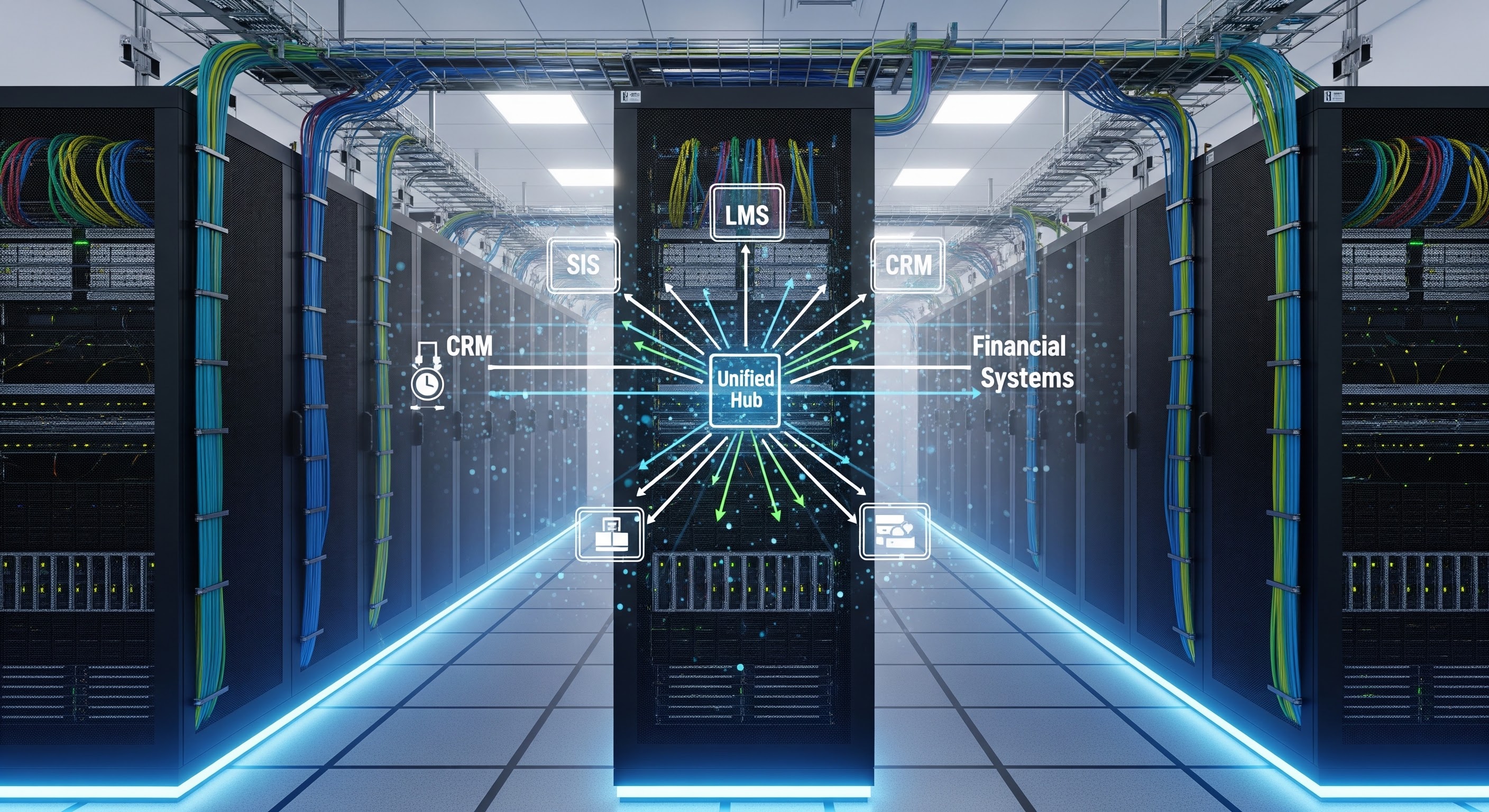
Higher education institutions typically run multiple separate systems: a Student Information System (SIS) for academic records, a Customer Relationship Management (CRM) system for enrollment management, a Learning Management System (LMS) for course delivery, a financial aid management system, and often a separate system for advising and student success functions. These systems frequently don't talk to each other natively.
AI tools that are supposed to surface early-alert warnings based on student engagement data need access to data from both the LMS (course login frequency, assignment completion) and the SIS (grades, enrollment status) and the financial aid system (aid disbursement status). If those systems aren't integrated, the AI can't see the full picture—and its predictions will be less accurate and less useful.
This is why I consistently tell founders: before you invest in AI administrative tools, invest in data integration. A well-integrated data infrastructure with a single source of truth for student records will make every AI tool you layer on top of it dramatically more effective. Fragmented data infrastructure is the most common reason AI administrative implementations fail to deliver their promised ROI.
Common SIS/CRM Integration Patterns
Change Management: The Factor Most Implementations Get Wrong
I want to spend real time on this because it's where the majority of AI administrative implementations fail—not because the technology doesn't work, but because the people side wasn't managed well.
Here's the pattern I've seen play out multiple times: leadership decides to implement AI tools in admissions, advising, or compliance. Vendors are selected. Systems are deployed. Training happens, sort of. And then six months later, the tools are being underused or circumvented, staff are frustrated, and leadership is wondering why the ROI hasn't materialized.
The root cause is almost always the same: staff didn't understand what the AI was supposed to do for them, feared it was designed to replace them, and found ways to work around it. The technology worked fine. The change management failed.
The Fear of Replacement
This is the central emotional challenge in administrative AI adoption, and it needs to be addressed directly, not dismissed. When an admissions director hears that AI is going to automate enrollment management, their first thought isn't efficiency—it's whether they still have a job. When a financial aid counselor learns that AI is going to handle verification processing, they wonder what's left for them to do.
The answer—which is true, not just reassuring—is that AI administrative tools are most valuable when they handle high-volume, low-judgment work, freeing human staff for the complex, relationship-intensive functions that require professional judgment. Admissions directors who used to spend 40% of their time on manual data entry now spend that time building employer relationships, visiting high schools, and coaching individual students through the application process. Financial aid counselors who used to spend hours on verification can now spend that time on holistic advising for students navigating complex financial situations.
But this requires being explicit about how roles are changing—not hoping staff will figure it out. Every AI implementation needs a clear narrative about what staff will do with the time they recover, ideally with specific examples tied to institutional priorities. Staff who understand that AI is expanding their capacity to do meaningful work are far more likely to adopt it than staff who feel the technology is being imposed on them.
A Practical Change Management Framework
The Role of Internal Champions
Every successful AI administrative implementation I've observed has had at least one internal champion in each functional area—someone who is genuinely excited about the technology, understands its limitations, and can translate between the vendor's technical language and the day-to-day workflow concerns of their colleagues. These people are worth identifying and investing in. Give them additional training, involve them in vendor conversations, and explicitly recognize their contribution to the implementation.
In a new institution with a small staff, you may have only one or two people per department. That's fine—the champion role is about enthusiasm and credibility with peers, not headcount. A director of financial aid who is genuinely positive about AI verification tools and can answer her team's questions credibly is worth more to your implementation than any amount of vendor-provided training.
Cost-Benefit Analysis: What Administrative AI Actually Costs
Let me be direct about the numbers, because the vendor pitches in this space often obscure the real costs. Here's what a realistic budget looks like for an institution implementing AI across enrollment, advising, financial aid, and compliance functions.
These numbers are mid-market estimates for a small to medium institution. Larger institutions will pay more; smaller ones may find lower-cost options. The key point is that the ROI is real: institutions consistently report staff time savings of 20--40% in the affected functions, measurably improved enrollment yield, and reduced compliance risk exposure. Over a three-year period, most institutions report that the total cost of these implementations is substantially exceeded by the combination of efficiency gains, improved retention outcomes, and fraud prevention.
Pitfalls to Avoid
Let me end this section with the mistakes I see most often, because awareness is the best prevention.
- Buying AI tools before fixing the data integration problem. If your systems don't talk to each other, no AI tool will perform as advertised.
- Choosing vendors based on demo quality rather than integration capability. A beautiful dashboard means nothing if it can't pull data from your actual SIS.
- Skipping change management to save time. The time you save now you will spend later on workarounds, retraining, and failed adoptions.
- Using AI fraud detection without human review. Automated fraud flags must be reviewed by a qualified financial aid professional before any adverse action is taken against a student.
- Deploying student-facing AI tools without escalation protocols for mental health and safety concerns. This is both a legal risk and an ethical failure.
- Treating AI tools as set-and-forget. These systems require ongoing governance, data quality monitoring, and regular vendor check-ins to perform well over time.
Key Takeaways
- Administrative AI delivers faster, more measurable ROI than instructional AI in most institutions. Start there.
- Enrollment management AI—predictive yield modeling, personalized outreach, and transfer credit automation—delivers among the highest ROI in the shortest timeframe.
- AI advising chatbots work best for high-volume, low-complexity inquiries. Never deploy them without robust human escalation protocols for mental health, safety, and legally complex situations.
- Financial aid AI applications—verification processing, fraud detection, SAP monitoring—are high-ROI and reduce the compliance risk that can trigger costly Department of Education reviews.
- Data integration is the non-negotiable prerequisite. AI tools perform dramatically better when your SIS, CRM, LMS, and financial aid systems are integrated and share clean data.
- Compliance monitoring AI enables continuous accreditation-readiness instead of frantic pre-review documentation sprints—a structural advantage for institutions seeking regional accreditation.
- Change management is where most implementations fail, not technology. Address replacement fears directly, involve staff in design, and build internal champions.
- Expect mid-range implementation costs of $130,000-$375,000 total across core administrative AI functions for a small-to-medium institution. The ROI over three years typically exceeds this investment.
- FERPA governs student data in AI administrative tools. Every AI vendor that handles student records needs a FERPA-compliant data processing agreement.
- Never use AI fraud detection as the sole basis for adverse action against a student. Human review is required before any determination that affects a student's aid status.
Frequently Asked Questions
Q: What's the single highest-ROI administrative AI investment for a new institution just starting out?
A: For most new institutions, the highest-ROI starting point is AI-assisted enrollment management—specifically, a CRM with predictive analytics for yield management and personalized outreach. Enrollment is existential: if you don't fill your classes, nothing else matters. Even a modest improvement in yield rate (5-10 percentage points) can translate to hundreds of thousands of dollars in tuition revenue at a small institution, making the investment self-financing in the first year or two. The second highest-ROI application, especially for institutions with financial aid programs, is fraud detection in financial aid processing.
Q: How do FERPA requirements apply to AI administrative tools?
A: FERPA (Family Educational Rights and Privacy Act) applies whenever an AI tool accesses or processes student education records—which includes essentially all administrative AI functions discussed here. Any vendor handling student data must qualify as a 'school official' under FERPA, which requires a data-sharing agreement that limits the use of student data to the school's educational purposes, prohibits using student data for model training or other purposes, and requires appropriate security standards. Before deploying any AI administrative tool that accesses student records, require a FERPA-compliant data processing addendum from the vendor.
Q: How many staff can an AI advising chatbot realistically replace?
A: This is the wrong question, and it leads to implementation failures. The better question is: how many students can your existing advisors serve effectively when AI handles routine inquiries? Research consistently shows that meaningful advising relationships—the kind that actually drive retention—require an advisor-to-student ratio of no more than 200:1. Most institutions operate at 400-600:1 or worse. AI chatbots that handle routine inquiries don't replace advisors; they make it possible for your advisors to actually advise. That's the ROI—not headcount reduction, but meaningful improvement in the quality of human advising that students actually receive.
Q: What data integration approach should a new institution build from day one?
A: Build for integration from the start by choosing platforms with strong API capabilities and a track record of interoperability. When evaluating SIS, CRM, LMS, and financial aid systems, ask specifically: Does it have open APIs? Does it participate in the IMS Global Learning Consortium's interoperability standards? What integrations do you maintain natively, and what requires custom development? Prefer platforms that are part of common integration ecosystems (Salesforce Education Cloud, Canvas, Banner, Slate) over proprietary systems with limited integration options. The extra cost of better-integrated systems pays for itself quickly in AI tool performance.
Q: How should we handle AI fraud detection given the due process requirements for adverse financial aid actions?
A: AI fraud detection flags should trigger a human review process, not automatic adverse action. When a flag is raised, a qualified financial aid officer should review the file, compare the flagged patterns to the student's full application and enrollment context, and make a determination. If the determination is that fraud is likely, the student must be notified and given the opportunity to provide documentation and respond before any action is taken. This due process requirement is both a legal obligation under Title IV and sound institutional practice—fraud flags are not perfect, and legitimate students get flagged. Your AI tool is a triage instrument, not a judge.
Q: What are the accreditation implications of implementing AI in administrative functions?
A: Accreditors—regional and programmatic alike—increasingly expect institutions to demonstrate effective use of data in decision-making, which AI administrative tools support directly. SACSCOC Standard 7.3, for example, addresses the assessment of administrative effectiveness. HLC's Criteria for Accreditation include institutional effectiveness documentation that benefits from AI-assisted compliance monitoring. Having AI tools that enable continuous data collection and evidence production for accreditation is a genuine competitive advantage. Document your AI administrative implementations and include them in your institutional effectiveness reporting.
Q: How do I choose between building custom AI tools versus buying commercial platforms?
A: For almost all small and medium institutions, buy commercial platforms. Building custom AI tools requires significant technical expertise, ongoing maintenance, and vendor-level security infrastructure that most institutions cannot sustain. The commercial platforms discussed in this post—Slate, EAB Navigate, Mainstay, and others—have invested years and millions of dollars into their AI capabilities. You can almost certainly spend your development budget on something more strategic than trying to replicate what they've built. The exception: if you have a highly specific use case that no commercial platform addresses, and you have the technical staff to sustain a custom build, there may be a case for custom development.
Q: How do AI administrative tools affect our staffing plan as a new institution?
A: Plan for AI tools to increase the effectiveness of each staff member rather than reduce headcount. In admissions, one enrollment manager with AI tools can manage a yield optimization process that would previously have required two or three people. In financial aid, one counselor with AI verification tools can process twice the volume with higher accuracy. In advising, one advisor with AI-handled routine inquiries can carry a caseload of 200 students effectively instead of 400 students inadequately. Use these efficiency gains to maintain human staffing ratios at manageable levels rather than simply cutting positions—the retention and completion improvements pay for themselves.
Q: What is the typical implementation timeline for administrative AI across key functions?
A: Plan for 4-6 months for initial implementation of any single platform, including vendor selection, contract negotiation, data integration, configuration, training, and initial rollout. Running multiple implementations in parallel is possible but requires careful project management—most institutions stagger them over 12-18 months to manage the change management demands. IPEDS reporting automation and compliance monitoring tools typically take longer to implement because of the complexity of the underlying data requirements; plan 6-9 months for these.
Q: Are there federal grant opportunities to fund administrative AI implementation?
A: Yes. The Department of Education's FIPSE program has funded AI implementation projects in higher education, including administrative applications. The January 2026 FIPSE allocations totaling $169 million included funding for responsible AI integration that encompasses administrative as well as instructional applications. State-level workforce and innovation funds have also been used to fund AI administrative infrastructure, particularly at community colleges and vocational schools. Check with your state higher education agency and FIPSE directly for current funding opportunities.
Q: What security standards should I require from AI administrative vendors?
A: At minimum: SOC 2 Type II certification, which verifies ongoing compliance with security, availability, and confidentiality standards; ISO 27001 certification is an additional positive signal. For financial aid tools that interact with federal systems, ask specifically about the vendor's compliance with Department of Education security standards and their history of security incidents. Require notification provisions in your contract that mandate disclosure of any data breach within 72 hours. Cyber liability insurance for your institution should cover AI vendor data breaches, but only if you've disclosed the vendor relationships—check your policy.
Q: How should we document AI administrative tool usage for accreditation purposes?
A: Build documentation into your implementation from the beginning. Keep records of vendor selection criteria and processes, data processing agreements, training completion, workflow changes, and outcome metrics. For accreditation self-studies, you want to be able to show: what AI tools you use and why you selected them, how you govern data privacy, how you ensure human oversight for decisions that affect students, and what outcomes you've observed. Map your AI administrative practices to specific accreditation standards in your self-study documentation—accreditors appreciate this level of organizational self-awareness.
Q: What's the biggest organizational mistake new institutions make with administrative AI?
A: Treating it as a technology project rather than a people project. The technology rarely fails. The adoption fails, the change management fails, the governance fails. Institutions that succeed with administrative AI treat it as an organizational transformation initiative with technology as one component. They invest equally in people—training, communication, role redesign, champion development—as in the platform itself. The institution that buys Slate and doesn't invest in training its admissions team to actually use the AI features will underperform the institution that invests equally in platform and people.
Glossary of Key Terms
Current as of March 2026. Platform capabilities, regulatory requirements, and vendor offerings evolve rapidly. Verify current specifications directly with vendors and consult education technology advisors before making procurement decisions.
If you're ready to explore how EEC can de-risk your AI-integrated launch, reach out at sandra@experteduconsult.com or +1 (925) 208-9037.