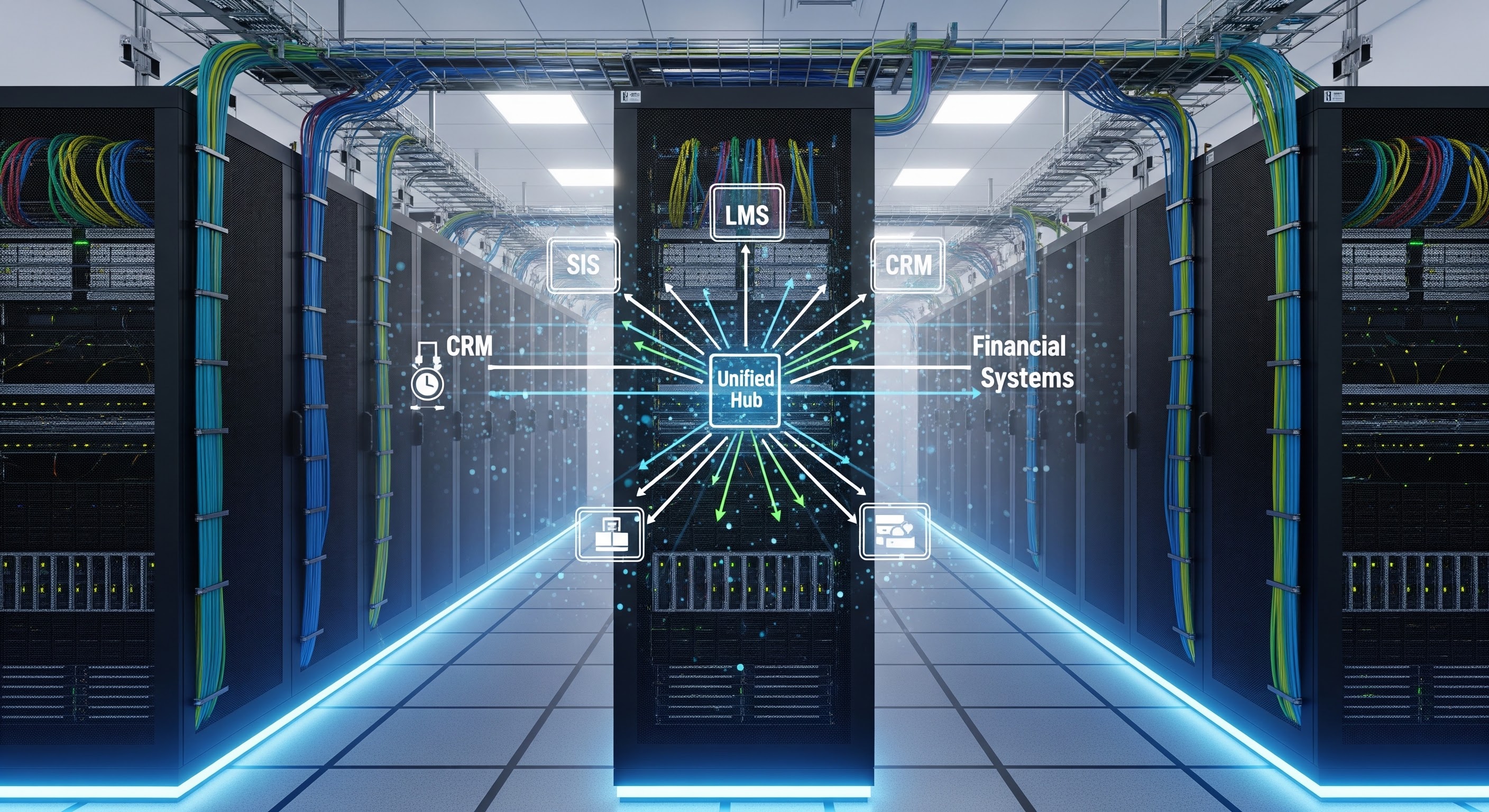


Here’s a scenario that’s playing out at institutions across the country right now: a well-meaning instructor adopts an AI tutoring platform for her developmental writing course. Students log in, type their essays, receive automated feedback, and revise. The tool is free. It works well. Everybody’s happy—until someone reads the terms of service and discovers that every student submission is being used to train the vendor’s AI model. Student names, writing samples, performance data—all of it flowing into a commercial dataset that the institution never authorized and the students never consented to.
That’s not a hypothetical. I’ve seen versions of this story at three different institutions in the past year alone. And in every case, the institution didn’t realize it had a FERPA problem until the problem had already metastasized.
FERPA—the Family Educational Rights and Privacy Act (20 U.S.C. § 1232g)—is the federal law that governs how educational institutions handle student education records. It’s been on the books since 1974. It was written for a world of paper files and registrar’s offices. And it absolutely was not designed for an era where AI platforms can ingest, process, and redistribute student data at scale in milliseconds.
But here’s the thing: FERPA still applies. Every bit of it. And its requirements don’t shrink just because the technology has gotten more complicated. If anything, the AI revolution has made FERPA compliance both more important and more difficult to achieve.
If you’re an investor planning to launch a private college, university, trade school, or career program, this is one of the highest-stakes compliance areas you’ll face. A FERPA violation can jeopardize your institution’s eligibility for Title IV federal financial aid—which, for most schools, means jeopardizing your entire business model. I’ve spent twenty-plus years in this space, and I’ll tell you plainly: getting FERPA right in the age of AI isn’t optional. It’s existential.
This post is your field guide. We’ll cover what FERPA requires in the context of AI, where most institutions go wrong, how to build a vendor vetting process that actually protects you, what state privacy laws add to the equation, and how to set up a data governance structure that scales. No hand-waving. No generic advice about “being careful with data.” Concrete steps and real costs.
FERPA Fundamentals: What the Law Actually Requires (And Why AI Changes the Calculus)
Let’s make sure we’re working from the same foundation. FERPA applies to every educational institution that receives federal funding—which, if you’re pursuing accreditation and Title IV eligibility, means you. The law creates two core requirements.
First, institutions must give parents (or eligible students age 18 and older) the right to inspect and review the student’s education records. Second, institutions generally cannot disclose personally identifiable information (PII) from education records without prior written consent from the parent or eligible student.
There are exceptions to the consent requirement, and the one that matters most for AI is the school official exception (34 CFR § 99.31(a)(1)). Under this exception, an institution can share student data with a third party that is performing a function the institution would otherwise do itself—provided that the third party is under the institution’s direct control regarding data use and protection, and the data is used only for the purpose for which it was disclosed.
This is where AI tools enter the picture. When your institution contracts with an AI vendor—whether it’s an adaptive learning platform, an AI tutoring system, a predictive analytics engine for enrollment management, or an AI-powered chatbot for student advising—that vendor typically needs access to student data to function. Under FERPA, the vendor is acting as a school official: performing an institutional function with access to education records.
The critical question is: does your agreement with that vendor meet FERPA’s requirements for the school official exception? And this is precisely where most institutions fail.
The Three FERPA Failures I See Most Often with AI Tools
Failure #1: No written agreement—or a vague one. FERPA requires that the institution designate which outside parties qualify as school officials and ensure they’re under the institution’s direct control with respect to data use. Many institutions adopt AI tools through informal processes—a faculty member signs up for a free account, an IT director runs a trial—without ever executing a formal data-sharing agreement. If there’s no written contract specifying what data the vendor can access, how it can be used, how it must be protected, and when it must be deleted, you have a compliance gap.
Failure #2: Vendor uses student data for model training. This is the big one, and it’s remarkably common. Many AI platforms—especially those offered at low or no cost—include terms of service that allow the vendor to use data processed through the platform to improve their AI models. In plain English: your students’ essays, quiz responses, course performance data, and interaction patterns become training data for a commercial product. Under FERPA’s school official exception, the data can only be used for the purpose for which it was disclosed—i.e., providing the educational service. Using it for model training almost certainly exceeds that purpose.
Failure #3: No data deletion protocol. What happens to student data when the contract ends? FERPA requires that education records disclosed to school officials remain under the institution’s control. If a vendor retains student data indefinitely after your contract terminates—or can’t confirm that the data hasn’t been incorporated into their training corpus—you have an ongoing compliance exposure that doesn’t go away just because the contract did.
If you remember only one thing from this post, let it be this: any AI tool that processes student education records needs a formal, FERPA-compliant data agreement before it touches a single student record. Not after. Not eventually. Before.
AI Vendor Contracts and Data Sharing: Building Your FERPA Defense
The vendor agreement—specifically the Data Processing Addendum (DPA)—is your primary legal instrument for ensuring FERPA compliance when AI tools process student data. A DPA is a contractual document that sits alongside (or within) your master service agreement and specifies exactly how the vendor will handle, store, protect, and ultimately dispose of institutional data, including student education records.
Let me be direct: if an AI vendor won’t sign a FERPA-compliant DPA, don’t use that vendor. Full stop. It doesn’t matter how good the tool is, how cheap it is, or how many other schools use it. If they won’t commit in writing to protecting student data in a way that meets your federal obligations, they’re not a partner—they’re a liability.
What Your DPA Must Include
I’ve reviewed hundreds of ed-tech vendor contracts over the years, and the quality varies enormously. The major enterprise education platforms—your Canvas, Blackboard, Anthology, Ellucian-tier vendors—generally have FERPA compliance built into their standard agreements, though you still need to read the fine print. It’s the smaller AI startups and the free-tier tools where compliance gaps are most common. That innovative AI writing feedback tool a faculty member found online? Its terms of service probably say something like “by using this service, you grant us a perpetual, irrevocable license to use all content submitted through the platform.” That language is incompatible with FERPA.
Here’s a practical step I recommend to every client: before you evaluate an AI tool’s educational features, request their standard DPA and their security certifications. If they can’t produce both within 48 hours, that tells you everything about their institutional readiness.
De-Identification Standards for AI Training Data: What Counts as “Anonymous”?
Some AI vendors will argue that they’re not covered by FERPA because they “de-identify” student data before using it for model training. This argument deserves scrutiny, because de-identification under FERPA is a defined standard, not a vague concept.
Under FERPA’s regulations (34 CFR § 99.31(b)), an institution may release records without consent if they’ve been de-identified—meaning all personally identifiable information has been removed or obscured so that the student’s identity is not reasonably determinable. The regulations list 18 categories of identifiers that must be removed, including names, social security numbers, dates of birth, biometric records, and “other information that, alone or in combination, is linked or linkable to a specific student.”
That last phrase is the killer. In the context of AI, even ostensibly “anonymized” datasets can be re-identified through pattern matching—especially when the dataset includes writing samples, behavioral patterns, or course interaction data. Research has repeatedly demonstrated that seemingly anonymous data can be re-linked to individuals when combined with other available datasets. The more granular the data AI tools collect (timestamps of every interaction, detailed performance patterns, writing style characteristics), the easier re-identification becomes.
FERPA also requires that de-identified data releases include no “reasonable basis” to believe the information could be used to identify students. If a vendor claims to de-identify data but retains rich behavioral or performance profiles, that claim may not survive regulatory scrutiny.
My advice to institutions: don’t accept “we anonymize the data” as a compliance answer. Ask specifically: What identifiers are removed? What method of de-identification is used? Has the process been validated against re-identification risk? Can you provide a written attestation that de-identified data cannot be reasonably re-linked to students? If the vendor can’t answer these questions with specificity, assume the data isn’t adequately de-identified.
Student Consent Models for AI-Driven Analytics: Getting Transparency Right
FERPA’s school official exception doesn’t technically require student consent for most AI tool deployments—as long as the vendor meets the school official criteria and the data-sharing agreement is in place. So why am I dedicating a section to consent?
Because consent isn’t just about legal compliance. It’s about institutional ethics, student trust, and increasingly, accreditation expectations. And because several states have consent requirements that go beyond FERPA’s framework.
There’s a growing consensus in higher education that students should be informed about—and in some cases, have the ability to opt out of—AI-powered systems that collect, analyze, or act on their data. This is especially important for AI-driven analytics platforms that use student data for predictive modeling: identifying students at risk of dropping out, recommending courses, flagging academic concerns. These systems can be enormously beneficial, but they also make algorithmic decisions that affect students’ lives.
A Tiered Consent Model That Works
Based on our work with multiple institutions, here’s the consent framework I recommend. It balances transparency with operational reality.
The key principle is proportionality: the more sensitive the data and the less transparent the AI’s decision-making, the more robust the consent mechanism should be. A student using an adaptive math platform in a required course is one thing. A system that profiles students’ emotional states through keyboard patterns is something entirely different.
One practical tip: whatever consent approach you use, put it in plain language. I’ve reviewed consent disclosures that were more complicated than the tools they described. If a student can’t understand what they’re agreeing to after reading it once, it’s too complex. Write it at an eighth-grade reading level, use bullet points for the key data practices, and make the opt-out mechanism genuinely accessible.
A community college I worked with in the Midwest took an approach I thought was particularly effective. During new student orientation, they included a 15-minute session on “Your Data and AI at [School Name]” that walked students through which AI tools the institution used, what data was collected, and how to access their data or raise concerns. They also created a one-page “AI Data Card” for each major AI tool—a simple reference document listing the tool name, what data it collects, how long data is retained, and who to contact with questions. Students reported feeling more informed and more trusting of the institution’s technology practices. That’s not just good compliance—it’s good enrollment retention.
Beyond FERPA: State Privacy Laws That Change the Game
FERPA is the floor, not the ceiling. Depending on where your institution operates and where your students are located, you may be subject to state privacy laws that impose additional requirements—and several of these laws are more restrictive than FERPA, particularly when it comes to AI.
Let me walk through the major ones.
California: SOPIPA and CCPA/CPRA
SOPIPA (the Student Online Personal Information Protection Act, California Business and Professions Code §§ 22584-22585) is one of the most significant student privacy laws in the country. It prohibits operators of online education services from using student data for non-educational purposes, including targeted advertising. It prohibits using student information to create advertising profiles. And it requires operators to implement reasonable security procedures.
For AI vendors, SOPIPA creates restrictions that go beyond FERPA. Even if your FERPA agreement is airtight, an AI vendor operating in California (or serving California students) can’t use student data for product improvement in ways that aren’t directly related to the educational service. If your institution enrolls California students—including through distance education—SOPIPA applies.
California’s CCPA/CPRA (California Consumer Privacy Act / California Privacy Rights Act) is the state’s broader consumer privacy law. It gives California residents rights over their personal information, including the right to know what data is collected, the right to delete it, and the right to opt out of its sale. While there’s an exemption for data covered by FERPA, the exemption is narrower than many people realize—it only applies to education records as defined by FERPA, not to all data an institution might collect about a student.
Other Critical State Laws
What’s the practical takeaway? If your institution enrolls students from multiple states—which nearly every distance education provider does—you need to comply with the most restrictive applicable law, not just FERPA. Your vendor agreements, consent processes, and data governance policies should be built to the highest standard among the states where you operate or enroll students. Building to the California/New York standard generally ensures you’re covered everywhere.
And don’t forget COPPA (the Children’s Online Privacy Protection Act), which applies to children under 13. If your institution runs K–12 programs, dual-enrollment programs, or early college programs that serve minors, COPPA adds another layer of consent and data protection requirements that interact with both FERPA and state laws.
Building Your Institutional Data Governance Committee: The Engine of FERPA-AI Compliance
Individual policies and vendor agreements are necessary but not sufficient. What makes FERPA-AI compliance sustainable is a data governance committee—a cross-functional team with defined authority to oversee how student data is collected, stored, used, shared, and deleted across the institution.
This isn’t the same as your IT department. It’s not the same as your AI governance committee (though the two should coordinate closely). A data governance committee is specifically focused on data management, privacy, and compliance—the nuts and bolts of ensuring that every system touching student data does so lawfully and responsibly.
Committee Composition
Based on what I’ve seen work at institutions of various sizes:
For smaller institutions—a startup trade school with 15 employees, for example—you don’t need a six-person committee. But you do need at least three people (IT, academic leadership, and someone with legal/compliance knowledge) formally charged with data governance responsibilities, meeting regularly (at minimum quarterly), and documenting their decisions. Accreditors will ask about your data governance process, and “the IT guy handles it” is not an acceptable answer.
What the Committee Actually Does
In practical terms, your data governance committee should own four ongoing functions.
1. AI Tool Inventory and Classification. Maintain a current inventory of every AI tool that accesses student data. Classify each tool by data sensitivity level: no student data, de-identified data, or PII. Update the inventory whenever a new tool is adopted or an existing tool changes its data practices. I mentioned this in our earlier post on AI policy—it’s worth repeating because it’s the foundation of everything else.
2. Vendor Vetting and DPA Management. Review and approve every AI vendor before the tool is deployed. Ensure each vendor has a current, signed DPA meeting your institutional standards. Conduct annual reviews of existing vendor agreements to confirm ongoing compliance. Flag any vendor whose terms of service or data practices have changed.
3. Incident Response. Maintain a documented breach response protocol. If a vendor experiences a data breach, who gets notified? What’s the timeline? Who communicates with affected students? How are regulatory notifications (FERPA, state breach notification laws) handled? Run a tabletop exercise at least once a year to make sure the protocol works.
4. Policy Review and Compliance Monitoring. Review data governance policies at least annually. Monitor changes in FERPA interpretation, state privacy laws, and accreditor expectations. Ensure that institutional practices match written policies—because the gap between policy and practice is where compliance failures live.
What FERPA-AI Compliance Actually Costs: A Realistic Budget
Because this audience cares about numbers, here’s what I’ve seen institutions spend on FERPA-AI compliance in 2025 and 2026.
The disparity between proactive and reactive costs isn’t just significant—it’s existential for a startup institution. A data breach at a new school can destroy student trust, trigger regulatory investigations, jeopardize accreditation, and drain financial reserves before you’ve even hit enrollment targets. Every founder I’ve worked with who invested proactively in FERPA-AI compliance has told me it was money well spent. The two who didn’t—well, one is still dealing with the fallout.
What Actually Happened: Lessons from the Field
The Vendor That Changed Its Terms
An online college we advise had vetted an AI-powered study companion tool and executed a solid DPA in early 2025. The tool worked well, students liked it, and faculty reported improved engagement. Then, six months in, the vendor updated its terms of service to include a clause granting itself a license to use “content processed through the platform” for “service improvement purposes.”
Because the institution’s data governance committee had a quarterly vendor review process, they caught the change within weeks. They immediately paused deployment, contacted the vendor, and negotiated revised terms that explicitly carved out student data from the model training clause. The vendor agreed—they didn’t want to lose an institutional client. Had the committee not been monitoring, the institution could have been feeding student data into a commercial AI model for months without knowing it.
The lesson: vendor vetting isn’t a one-time event. Terms change. Corporate ownership changes. Data practices change. Your monitoring process needs to be ongoing.
The FERPA Scare That Never Needed to Happen
A career school in the Southeast deployed an AI chatbot for student FAQs—admissions questions, financial aid basics, course schedules. The chatbot was designed to handle general information, not access student records. But the vendor’s integration with the school’s student information system (SIS) was configured more broadly than intended, giving the chatbot read access to individual student records including GPA, financial aid status, and enrollment history.
A student asked the chatbot about her financial aid status and received her actual balance—displayed in a chat interface with no authentication. She took a screenshot and sent it to a reporter. The school discovered the misconfiguration in the worst possible way.
The fix was technical—restricting the chatbot’s SIS access to public directory information only—and it took about two hours. But the reputational damage lasted months. The school had to issue breach notifications under the state’s data breach law, fund credit monitoring for affected students, and endure local media coverage that called into question its data security practices.
The root cause wasn’t malice. It was an IT configuration error that nobody caught because the data governance committee hadn’t included a review of system integration permissions in their deployment checklist. After the incident, they added a mandatory “data access audit” step to their AI tool deployment process. It takes about two hours per tool. That’s cheap insurance.
The School That Built Privacy Into Its Brand
On the positive side, an allied health school I worked with made data privacy a visible part of its institutional identity. Their enrollment materials included a section titled “How We Protect Your Data.” Their website featured a student-facing data practices page. Every AI tool used in instruction had a posted “Data Card” accessible through the LMS.
The result? During accreditation review, the evaluators specifically praised the institution’s transparency. In student satisfaction surveys, “trust in the school’s handling of personal information” scored in the 90th percentile. And in enrollment conversations, prospective students—particularly adults and career changers who’d seen news about data breaches—cited the school’s privacy transparency as a factor in their decision to enroll.
Privacy isn’t just a compliance obligation. Handled well, it’s a competitive advantage.
A Step-by-Step Roadmap for AI-FERPA Compliance
Let me lay out the exact sequence I walk clients through when they’re building FERPA-AI compliance from scratch. Whether you’re pre-launch or already operating with AI tools in place, this roadmap applies.
Step 1: Conduct a complete AI tool inventory (Weeks 1–2). List every AI-powered system that touches student data—LMS features, tutoring platforms, chatbots, analytics engines, proctoring tools, advising systems, and anything faculty have adopted independently. For each tool, document: what student data it accesses, whether it stores data, where the data is hosted, and whether there’s an existing vendor agreement. This step consistently reveals surprises. One institution I worked with discovered 23 AI-powered tools in use—12 of which IT leadership didn’t know about.
Step 2: Classify each tool by data sensitivity (Week 2). Sort your inventory into three categories: tools that access no student data, tools that access de-identified data, and tools that access personally identifiable student data. This classification drives every subsequent decision. Tools in the third category require the most rigorous vendor agreements and governance oversight.
Step 3: Audit existing vendor agreements (Weeks 2–4). For every tool that touches PII, pull the existing contract and terms of service. Check for: a signed DPA, explicit prohibition on using student data for model training, defined data retention and deletion terms, security certifications, and breach notification obligations. Flag any vendor where these protections are missing or inadequate.
Step 4: Negotiate or replace non-compliant agreements (Weeks 4–8). For flagged vendors, either negotiate FERPA-compliant terms or identify replacement tools. This is the step that takes the most time and sometimes the most courage—walking away from a popular tool that won’t agree to adequate data protections isn’t easy, but it’s necessary.
Step 5: Establish your data governance committee (Weeks 3–4). Formally charter the committee, assign roles, and set a regular meeting schedule. Even if you’re a tiny institution with three people on the committee, formalize the structure. Documentation of governance processes is as important as the processes themselves.
Step 6: Develop student notification and consent procedures (Weeks 4–6). Draft your tiered consent framework, create plain-language disclosure documents, and integrate notifications into your onboarding process, student handbook, and course syllabi.
Step 7: Create your breach response plan (Weeks 6–8). Document who does what when a breach occurs. Include notification timelines for each applicable law (FERPA, state breach notification statutes), communication templates, and escalation procedures. Run a tabletop exercise to test it.
Step 8: Train everyone who touches student data (Weeks 8–10). Faculty, staff, IT, and any contractor who accesses student records through AI tools. The training doesn’t need to be exhaustive—a focused 60-minute session covering FERPA basics, AI-specific risks, and your institutional policies will cover the essentials. Schedule annual refreshers.
Step 9: Implement ongoing monitoring (Ongoing). Set quarterly vendor review dates. Assign someone to monitor vendor communications for terms changes. Update your AI tool inventory whenever a new tool is adopted. Review your breach response plan annually. Report compliance status to your governance committee at every meeting.
The entire process takes 8–12 weeks for a small to mid-sized institution. Larger institutions with extensive AI deployments may need 16–20 weeks. The investment is front-loaded: once the framework is in place, maintaining it requires significantly less effort than building it.
Key Takeaways
1. FERPA applies to every AI tool that accesses student education records. No exceptions for free tools, popular tools, or tools “everyone else uses.”
2. The most common FERPA failure with AI: vendors using student data for model training without institutional authorization. Your DPA must explicitly prohibit this.
3. De-identification claims from vendors require scrutiny. Ask for specifics about methodology, re-identification risk, and written attestation.
4. Build a tiered consent model that scales transparency and opt-out options to the sensitivity of the AI application.
5. State privacy laws (SOPIPA, CCPA/CPRA, New York Ed Law § 2-d, and others) add requirements beyond FERPA. Build to the highest applicable standard.
6. A data governance committee is essential—not optional—for sustainable FERPA-AI compliance. At minimum: IT, academic leadership, and legal/compliance representation.
7. Vendor vetting is an ongoing process, not a one-time event. Terms of service change. Monitor quarterly.
8. Proactive FERPA-AI compliance costs $12,000–$35,000 in year one. Post-breach response can exceed $250,000.
9. Privacy transparency builds student trust and can differentiate your institution in a competitive market.
10. Start before you deploy. Every AI tool should have a vetted DPA, a data classification, and a governance review before it touches a single student record.
Glossary of Key Terms
Frequently Asked Questions
Q: Does FERPA apply if students voluntarily use an AI tool on their own?
A: Generally, no—if a student independently decides to use ChatGPT for homework, that’s their choice and FERPA doesn’t apply to the vendor. But if your institution recommends, requires, integrates, or even just provides a link to an AI tool as part of a course or service, you may have created an agency relationship that triggers FERPA obligations. The safest interpretation: if the institution facilitates the student’s use of the tool in any way, vet the tool for FERPA compliance. Consult with a FERPA-experienced attorney for your specific circumstances.
Q: What happens to our Title IV eligibility if we have a FERPA violation?
A: In theory, the penalty for FERPA violations is the loss of federal funding, including Title IV financial aid eligibility. In practice, the Department of Education’s Student Privacy Policy Office (SPPO) typically works with institutions to achieve compliance rather than immediately pulling funding. However, a significant or willful violation—especially one involving widespread unauthorized disclosure of student data—could trigger a compliance investigation, corrective action requirements, and in extreme cases, funding penalties. The reputational damage alone can devastate enrollment. Don’t test this.
Q: Can an AI vendor use student data for model training if we give consent?
A: This is a contested legal question. FERPA’s school official exception limits data use to the purpose for which it was disclosed—providing the educational service. Model training is a secondary purpose. Some legal scholars argue that institutional consent could authorize this under a different FERPA exception (the consent exception, 34 CFR § 99.30), but that requires prior written consent from the student, not just the institution. In practical terms, allowing vendors to use student data for model training creates significant legal risk and minimal institutional benefit. We recommend prohibiting it in every DPA.
Q: How do state privacy laws interact with FERPA?
A: FERPA sets a federal floor, but it doesn’t preempt state laws that provide greater privacy protections. If a state law (like California’s SOPIPA or New York’s Education Law § 2-d) imposes additional requirements on how student data is handled, your institution must comply with both. In practice, this means building your data governance framework to the most restrictive standard among all applicable jurisdictions. If you enroll students from multiple states through distance education, the compliance landscape is complex—budget for legal counsel who specializes in education privacy.
Q: Do we need a Data Protection Officer?
A: FERPA doesn’t require one, but New York’s Education Law § 2-d does for institutions with New York students, and the EU’s GDPR requires one if you process data of EU residents. Even where not legally required, designating someone as your institutional data privacy lead—whether it’s a full-time DPO or a compliance officer with data privacy in their portfolio—dramatically improves your compliance posture. For small institutions, this doesn’t have to be a new hire. It can be an existing role with added responsibilities and appropriate training.
Q: How do we handle AI tools that faculty adopt independently?
A: This is one of the most common compliance gaps. Faculty members often discover AI tools on their own and start using them in courses without going through institutional vetting. Your AI policy should require that any AI tool used in institutional instruction or services be approved through the data governance committee before deployment. Enforcement requires both a clear policy and a culture of compliance. Don’t make it punitive—make it easy. Create a streamlined “tool request” process where faculty can nominate tools and get them vetted within two to three weeks.
Q: What about AI proctoring tools—do they create special FERPA concerns?
A: Yes. AI proctoring tools often collect biometric data (facial recognition, keystroke patterns, eye tracking), video recordings, and behavioral analytics—all of which are education records under FERPA if they’re maintained by the institution or its agent. Additionally, several states have enacted or proposed laws specifically regulating biometric data collection, with some requiring explicit consent. AI proctoring also raises equity concerns (the tools have documented higher error rates for students of color) and ADA compliance questions. Vet these tools with extra care, and consider whether less invasive assessment alternatives might be more appropriate.
Q: How often should we review our AI vendor agreements?
A: At minimum, annually. But also conduct a review whenever a vendor notifies you of changes to their terms of service, when your institution changes which data it shares with a vendor, when a vendor is acquired by another company (change of ownership often triggers new data practices), or when new state privacy laws take effect in jurisdictions where you enroll students. Your data governance committee should maintain a vendor review calendar and assign responsibility for monitoring vendor communications.
Q: What should our breach response plan include?
A: A complete plan covers: who is responsible for managing the response (your incident commander—typically the CIO or compliance officer); how the breach is assessed and contained; notification timelines for affected students, the Department of Education (if FERPA-related), and state regulators (state breach notification laws vary widely on timeline—some require notification within 30 days, others sooner); communication templates and channels; legal counsel engagement; forensic investigation procedures; remediation steps; and a post-incident review process. Run a tabletop exercise at least annually to identify gaps before a real incident reveals them.
Q: Is it worth investing in cyber liability insurance for AI-related risks?
A: Absolutely. Cyber liability insurance is essential for any institution deploying AI tools that process student data. A good policy covers breach notification costs, legal defense, regulatory fines and penalties, credit monitoring for affected individuals, business interruption, and crisis communications. Make sure your policy specifically accounts for AI vendor relationships—some insurers exclude third-party breaches unless the relationship is disclosed. Premiums for education institutions in 2026 typically range from $3,000 to $15,000 annually depending on institution size, data volume, and risk profile.
Q: We’re a small trade school with two programs. Do we really need all of this?
A: The scale adjusts but the principles don’t. A small trade school needs fewer vendor agreements, a simpler governance structure, and less complex documentation—but it still needs a DPA for every AI tool touching student data, a data governance process (even if it’s three people meeting quarterly), a written policy on AI data practices, and a breach response plan. FERPA doesn’t have a small-institution exemption. A FERPA violation at a 200-student school carries the same legal consequences as one at a 20,000-student university. The investment is smaller—a small trade school might spend $8,000–$15,000 in year one—but it’s equally essential.
Q: How does FERPA apply to AI-generated content that includes student information?
A: If an AI tool generates content that includes or is derived from student education records—such as an AI advising tool that produces personalized academic plans based on a student’s transcript, or an early-alert system that generates risk profiles—that output is itself an education record under FERPA. It must be treated with the same protections as any other student record: accessible to the student upon request, protected from unauthorized disclosure, and governed by your institutional data policies. Don’t assume that because AI generated the content, it’s somehow outside FERPA’s scope.
Q: What’s the most important step we can take today?
A: Conduct an AI tool inventory. Identify every AI-powered system that touches student data at your institution. For each one, determine: Is there a written vendor agreement? Does the agreement include a FERPA-compliant DPA? Does the vendor use student data for model training? What data is collected, and how long is it retained? This inventory will immediately reveal your highest-risk gaps and prioritize your next steps. For most institutions, this exercise takes one to two weeks and costs nothing beyond staff time—but the clarity it provides is invaluable.
Current as of February 18, 2026. FERPA interpretation, state privacy laws, and vendor data practices evolve rapidly. Consult current sources and education privacy counsel before making institutional decisions.
If you’re ready to explore how EEC can de-risk your AI-integrated launch, reach out at sandra@experteduconsult.com or +1 (925) 208-9037.