

A few years ago, the AI conversation in higher education was mostly about chatbots. Could you deploy a bot to answer student FAQs? Could you use it to handle admissions inquiries at midnight? Would it work for basic academic advising? And yes, those early chatbots had real utility. But they also had obvious limits—they couldn't take action, couldn't remember context across sessions, couldn't connect to multiple institutional systems, and couldn't do anything genuinely complex.
We've moved well past that now. The market is shifting—fast—from generic chatbot tools to purpose-built AI agents and platforms designed specifically for educational contexts. The difference isn't incremental. It's categorical. And if you're building or operating an educational institution in 2026, understanding this shift matters for your procurement strategy, your pedagogy, and your competitive positioning.
Here's the essential distinction: a chatbot responds to prompts. An AI agent pursues goals. A chatbot answers the question 'When is the last day to withdraw?' An AI agent notices that a student's LMS engagement has dropped 40% over three weeks, cross-references their academic history, flags them as at-risk in your early-alert system, drafts a personalized outreach email for their advisor's review, and schedules a follow-up check-in—all without a human initiating the process.
That's a different kind of tool. And the education-specific versions of these agents—built with the specific knowledge, compliance requirements, and pedagogical principles of postsecondary education in mind—are arriving in force right now. Let me walk you through what's actually in the market, what's worth paying attention to, and how to make smart procurement decisions without getting burned by vendor hype.
From Generic Tools to Education-Native Platforms
The first wave of AI in education ran on consumer tools—ChatGPT, Google Gemini, Claude. Faculty and students used general-purpose AI assistants that weren't designed for educational contexts: they didn't know your learning management system, didn't understand your institutional policies, couldn't access your student data, and didn't have built-in guardrails for academic integrity or FERPA compliance.
The second wave—where we are now—is the emergence of education-native AI platforms: tools built from the ground up for educational use cases, with pedagogical models, compliance frameworks, and institutional data integrations designed in from day one. These platforms understand what a rubric is, what Bloom's Taxonomy means, how FERPA constrains data sharing, and what a formative assessment should accomplish. That context makes them fundamentally more useful—and safer—than general-purpose tools adapted for educational use.
The difference between a general-purpose AI tool and an education-native platform isn't just features. It's whether the tool was built by people who understand how learning actually works, what institutions are legally required to do, and what educators actually need from technology.
Let me be direct about what this means for procurement. Choosing general-purpose AI tools—even powerful ones—for core educational functions carries risks that education-native platforms are specifically designed to mitigate. Academic integrity guardrails, FERPA-compliant data handling, pedagogically sound tutoring logic, and integration with standard educational systems are not afterthoughts in these platforms. They're the core design premise.
The Education-Specific AI Platform Landscape
Let me give you an honest, current assessment of the platforms that matter. This is not a comprehensive market review—the space is moving too fast for that—but a map of the key players and their distinct approaches as of early 2026.
Khanmigo (Khan Academy)
Khanmigo is the AI tutoring agent built by Khan Academy, and it remains one of the most pedagogically sophisticated tools in the market. What distinguishes it from simpler tools is its deliberate commitment to Socratic tutoring: it's designed never to give answers directly, but to ask questions that guide students toward their own understanding. This is a significant pedagogical choice with a strong research basis—the act of arriving at an answer through guided questioning produces more durable learning than being given the answer.
Khanmigo also has a teacher-side interface that lets faculty see what students are working on, where they're stuck, and what questions they're asking the AI. This transparency is important for maintaining instructional oversight in AI-augmented learning environments—something accreditors are increasingly looking for.
For new institutions, especially those serving K-12 or early postsecondary populations, Khanmigo is worth serious attention. Its limitations: it's most effective in the subject areas where Khan Academy has deep curriculum content (math, science, some humanities), and its integration with external LMS platforms is more limited than some competitors.
MagicSchool AI
MagicSchool AI has grown rapidly as a faculty-facing platform, primarily focused on reducing administrative burden for educators. Its AI agent functions include: curriculum planning assistance that generates lesson outlines and activity ideas; differentiation tools that help teachers adapt content for different learning levels; communication drafting for parent and student outreach; rubric generation; and accommodation plan support for students with disabilities.
What makes MagicSchool notable is its explicit focus on teacher augmentation rather than teacher replacement. The platform is designed around the idea that teachers are the experts and the AI is their assistant—not the other way around. Faculty adoption rates at institutions using MagicSchool have been notably higher than at comparable institutions deploying more general AI tools, which I attribute partly to this framing.
Limitations: MagicSchool's strength is at the K-12 level and in faculty productivity; it's less developed as a student-facing tutoring or advising tool for postsecondary contexts.
EAB Navigate AI
EAB Navigate has integrated AI agent capabilities into its student success platform that are specifically designed for postsecondary advising contexts. Its AI functions include: automated early-alert generation based on LMS engagement data, grade trends, and financial aid status; appointment scheduling and reminder systems; proactive outreach drafting for advisors; and predictive analytics for retention risk. Crucially, EAB Navigate's AI capabilities are built on top of a platform that already manages real student data from integrated SIS and LMS systems—which means the AI agents have access to the context they need to be genuinely useful.
For institutions building student success functions from scratch, Navigate represents one of the most mature integration of AI agent capabilities in a student-facing platform. It's not cheap—expect mid-market to enterprise pricing—but the integration with existing systems and the depth of the AI functionality justify the investment for institutions where retention is a strategic priority.
Coursera Coach and LinkedIn Learning AI
On the credential and workforce side, both Coursera Coach and LinkedIn Learning's AI-powered recommendations have evolved into genuine AI agents for professional development. Coursera Coach provides personalized learning path recommendations, tracks progress against career goals, suggests relevant courses based on job market trends, and answers questions about program content. These tools are primarily relevant for institutions managing corporate partnerships, workforce development programs, or continuing education offerings.
Anthology (formerly Blackboard) and Canvas AI
The major LMS platforms are integrating AI agent capabilities directly into their core systems. Anthology Ally has long provided AI-powered accessibility features; Anthology's newer AI functions include automated course design assistance and student engagement analytics. Canvas (Instructure) has integrated AI features including discussion facilitation assistance, assignment feedback tools, and—through its partnership ecosystem—connections to third-party AI tutoring platforms.
For new institutions choosing an LMS, the AI capabilities of the platform are now a procurement criterion worth evaluating explicitly. The platforms that have integrated AI natively—rather than bolted on external tools—deliver more coherent student experiences and simpler data governance.
Here is a quick comparison between these platforms:
Khanmigo
- Primary use case: Student tutoring
- Key AI agent capability: Socratic AI tutoring, teacher transparency
- Best fit institution type: K-12, early college, remedial postsecondary
- Integration strength: Moderate — primarily own content
MagicSchool AI
- Primary use case: Faculty productivity
- Key AI agent capability: Lesson planning, differentiation, rubric generation
- Best fit institution type: K-12, smaller postsecondary institutions with limited faculty professional development
- Integration strength: Moderate — tool-based
EAB Navigate
- Primary use case: Student success and retention
- Key AI agent capability: Early alert, proactive outreach, retention prediction
- Best fit institution type: Postsecondary institutions with a retention focus, especially community colleges
- Integration strength: High — SIS/LMS integrated
Coursedog
- Primary use case: Academic operations
- Key AI agent capability: Program planning, catalog management, compliance
- Best fit institution type: Postsecondary institutions with complex curriculum management
- Integration strength: High — integrates with Banner and Colleague
Anthology/Blackboard AI
- Primary use case: LMS and course delivery
- Key AI agent capability: Accessibility, course design, analytics
- Best fit institution type: Institutions already using Blackboard
- Integration strength: High — native LMS integration
Canvas AI ecosystem
- Primary use case: LMS and course delivery
- Key AI agent capability: Discussion facilitation, partner AI integrations
- Best fit institution type: Institutions seeking an open ecosystem
- Integration strength: High — strong API ecosystem
Salesforce Education Cloud AI
- Primary use case: CRM and enrollment
- Key AI agent capability: Yield prediction, personalized outreach, advising
- Best fit institution type: Larger institutions with Salesforce infrastructure
- Integration strength: High — enterprise integration
Mainstay (AdmitHub)
- Primary use case: Student engagement
- Key AI agent capability: Conversational AI for enrollment and retention
- Best fit institution type: Community colleges, high-volume enrollment contexts
- Integration strength: Moderate — API-based
What 'Agentic AI' Actually Means for Education
The term agentic AI is becoming common in education technology conversations, and it's worth being precise about what it means—because vendors use it loosely and the capabilities vary dramatically.
At the technical level, an AI agent is a system that can: perceive its environment (read data from connected systems), make decisions based on goals (not just respond to prompts), take actions (modify data, send communications, trigger workflows), and iterate toward objectives over time without requiring a human to initiate each step. This is genuinely different from a chatbot that waits for a user to type something and then responds.
In educational contexts, this agentic capability enables use cases that weren't previously possible:
Proactive Student Monitoring
An AI agent connected to your LMS, SIS, and financial aid system can continuously monitor student engagement and performance data, identify students showing patterns associated with dropout risk, and proactively surface these students to advisors—not just when advisors ask, but when the patterns warrant attention. This is qualitatively different from a static early-alert dashboard that advisors have to remember to check. The agent monitors continuously and alerts proactively.
Autonomous Workflow Management
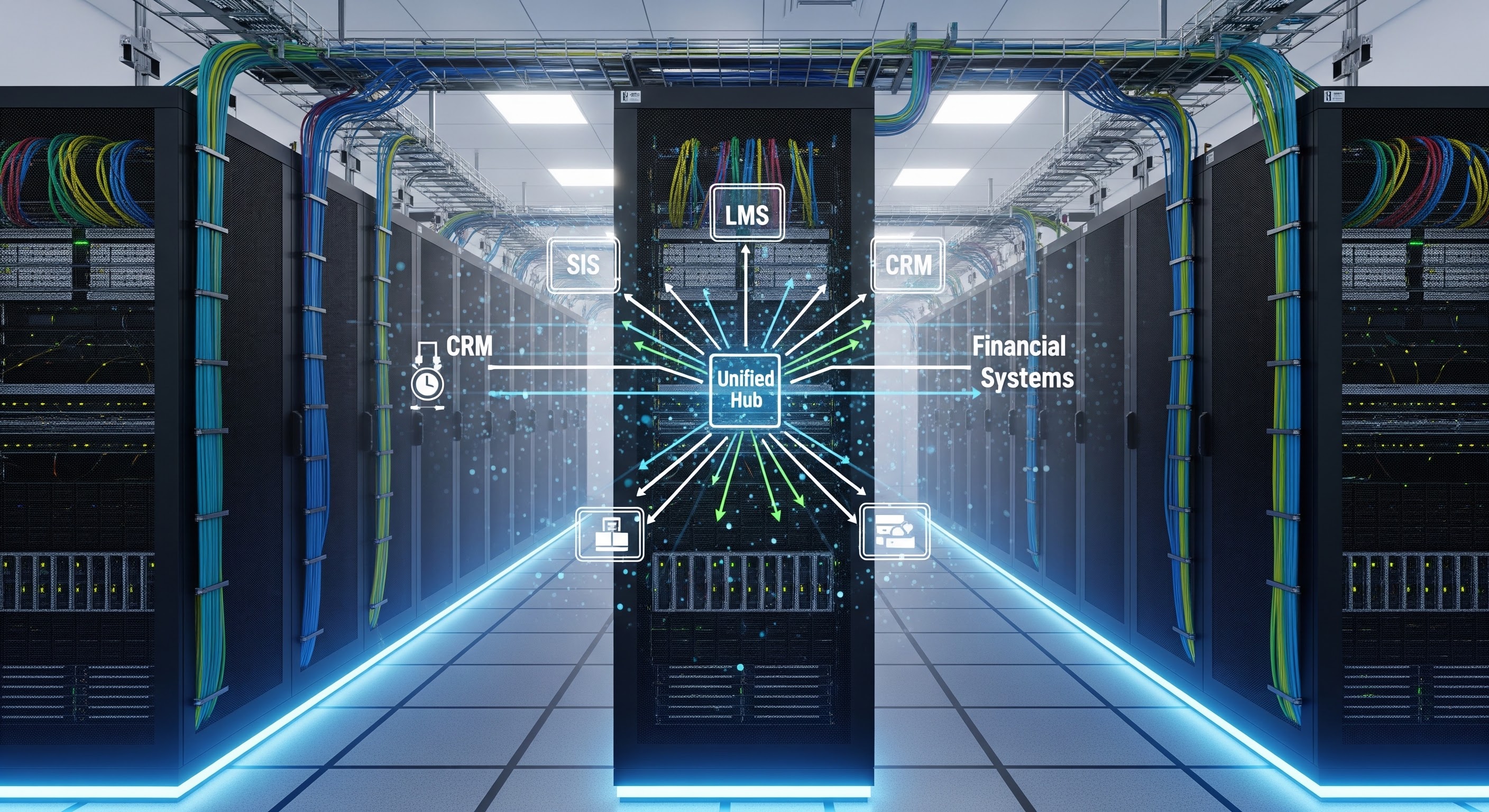
AI agents can manage multi-step administrative workflows without requiring a human to initiate each step. An enrollment agent might: receive an inquiry from a prospective student, check which programs match their stated interests, pull current enrollment capacity from the SIS, draft a personalized response with accurate program information, schedule a follow-up call with an admissions counselor, and log the interaction in the CRM—all as a connected workflow triggered by the initial inquiry. Each step would traditionally require a human.
Adaptive Curriculum Delivery
In learning contexts, AI agents can adjust the pace, difficulty, and content sequence of instruction based on real-time assessment of student comprehension—not just offering different content when a student gets a wrong answer, but restructuring the learning pathway over time based on emerging patterns in how the student processes new information. The most sophisticated adaptive learning systems (ALEKS in mathematics being the classic example) have done this for years. The newer generation of agents extends this logic to more complex, open-ended learning contexts.
Procurement Framework: Buying Education AI Without Getting Burned
The AI education platform market is growing fast, and with growth comes a proliferation of vendors making claims that aren't always supported by evidence. Here's how to evaluate what you're actually buying.
The Five Non-Negotiable Procurement Criteria
These five criteria should be present in any education-specific AI platform you seriously consider. If a vendor can't answer these questions clearly, walk away.
- FERPA compliance with specific data processing commitments. Not 'we take privacy seriously'—a signed Data Processing Addendum that explicitly prohibits using student data for model training, limits data retention, and specifies breach notification procedures. This is non-negotiable.
- Evidence of pedagogical foundation. Can the vendor explain the learning science principles behind their AI's instructional approach? For tutoring tools in particular, you want to understand whether the AI is designed around retrieval practice, spaced repetition, Socratic questioning, or some other evidence-based approach. Tools that can't articulate this should be treated with skepticism.
- Integration documentation. Real integrations with your specific SIS, LMS, and CRM platforms—not vague claims of 'API compatibility.' Ask for references from institutions using the same integration stack you're planning to use. The most common cause of education AI implementation failure is integration that doesn't work as advertised.
- Human escalation and oversight design. For any student-facing tool, how does the system ensure that complex, sensitive, or safety-related situations reach a human? Ask for documentation of the escalation logic and recent case examples.
- Outcomes data from comparable institutions. Not pilot program results—real, longitudinal data from institutions comparable to yours in size, type, and student population. Ask for references you can call directly, not just case studies on the vendor's website.
The Evaluation Process
A rigorous procurement process for an AI platform should take 8-12 weeks and include the following steps:
One thing I've seen founders skip because they're moving fast: the pilot. Running a full pilot before committing to institution-wide deployment is worth the time. I've seen multiple institutions sign three-year contracts with AI platforms that looked perfect in the demo and performed poorly in actual student use. The pilot surfaces integration gaps, user experience problems, and adoption challenges that no demo will reveal.
Integration with Existing LMS and SIS Platforms
This deserves its own focused attention because it's the most common source of AI platform disappointment. Here's what actually good LMS integration looks like versus what vendors often mean when they say they 'integrate with Canvas' or 'support Blackboard':
The same logic applies to SIS integration. An AI advising agent that can't see whether a student is on academic probation, has a hold on their account, or is failing to make Satisfactory Academic Progress is operating with a critical blind spot. The most dangerous outcomes I've seen from AI advising tools involve agents providing inaccurate guidance to students precisely because they didn't have access to current SIS data.
Evaluating AI Tool Effectiveness in Educational Settings
Once you've deployed an AI platform, how do you know if it's actually working? This is where most institutions go wrong: they measure usage metrics (number of sessions, messages sent, time spent) instead of outcome metrics (did students learn more, persist longer, graduate at higher rates?).
The Right Metrics Framework
Measuring AI tool effectiveness in educational settings requires a framework that connects tool usage to the outcomes you actually care about. Here's a layered approach:
The honest challenge with measuring AI effectiveness in educational settings is that the most important outcomes—learning and graduation—take time to manifest. You won't know in month three whether your AI tutoring platform is improving graduation rates. What you can know is whether it's being used, whether students who use it perform better on assessments, and whether advisors are spending more time on high-value interactions. Build your measurement plan around both short-term proxy metrics and long-term outcome metrics.
The A/B Testing Problem
Rigorous evaluation of AI tools ideally involves comparing outcomes for students who use the tool versus those who don't. In practice, this is ethically complicated in educational settings: if you believe the AI tool helps students, you can't ethically withhold it from a control group. The practical alternative is quasi-experimental design: compare outcomes for students who actively use the tool versus those who have access but don't engage, controlling for confounding factors. This isn't perfect, but it's more rigorous than simple before-after comparisons.
Some platforms—EAB Navigate is a notable example—have invested in their own research on this question and have published quasi-experimental evidence of their impact on retention. When evaluating vendors, ask directly: what peer-reviewed or independently validated research exists on the outcomes your platform produces? Vendors who can point to real research are meaningfully more credible than those relying entirely on internal case studies.
The Accreditation and Compliance Implications
As education-specific AI agents become more capable and more central to institutional operations, accreditors and regulators are increasingly interested in how institutions govern them. Let me map the compliance landscape for AI agents specifically.
What Accreditors Are Looking For
Regional accreditors—SACSCOC, HLC, WSCUC, and others—evaluate AI tool usage through several existing standards frameworks:
- Student learning outcomes assessment: If AI platforms deliver instruction or tutoring, accreditors want to see evidence that student learning is being assessed rigorously, not just that AI interaction is occurring. 'Students used Khanmigo for X hours' is not evidence of learning. Assessment scores, competency mastery data, and longitudinal outcome comparisons are.
- Faculty qualifications and oversight: AI tools that deliver instruction must be overseen by qualified faculty. Accreditors will ask who is responsible for the quality of AI-delivered content, how faculty review and validate what AI tools teach, and how curricula using AI are reviewed for accuracy and relevance.
- Academic integrity: AI tutoring and advising tools raise integrity questions that accreditors are actively exploring. Your institution should have documented policies about how AI tools are disclosed to students, what guardrails prevent AI-assisted completion of assessed work, and how integrity violations are identified and addressed.
- Student data privacy: FERPA compliance documentation for AI vendors is a compliance item that accreditors are increasingly asking to see during reviews. Have your Data Processing Addenda organized and current.
The OCR Guidance Dimension
The Department of Education's Office for Civil Rights (OCR) released guidance in November 2024 on AI in education, addressing concerns about algorithmic bias and civil rights implications of AI-assisted decision-making in educational settings. This guidance is relevant to education-specific AI agents in several specific ways: admissions AI that may produce disparate outcomes for protected class students, early-alert systems that may have differential accuracy by demographic group, and academic support AI that may not perform equally well for English language learners or students with disabilities.
For any AI platform that makes or informs consequential decisions about students—admissions recommendations, at-risk flags, academic progression determinations—you need a documented bias audit process. This doesn't require a full algorithmic audit by an external firm (though that's ideal), but it does require regular review of whether the AI's recommendations and flags are distributed consistently across demographic groups. Disparate patterns need investigation and remediation.
What's Coming: The Next Generation of Education AI Agents
A few developments worth watching as you build your AI platform strategy for the next two to three years.
Multi-Agent Orchestration
The most advanced institutional AI architectures are moving toward multi-agent systems—where multiple specialized AI agents work in coordination. A student support architecture might have a learning agent (monitoring academic performance and tutoring), a wellness agent (tracking engagement and flagging distress signals), a financial agent (monitoring aid status and alerting about risks), and an advising agent (synthesizing inputs from all three and prioritizing advisor interventions). These agents share data and coordinate actions in ways that no single platform currently manages well.
This is where the field is heading, and it's why data integration infrastructure—having your institutional data in a coherent, accessible form—is such a foundational investment. Multi-agent systems only work when agents can access the data they need. The institutions building clean, integrated data infrastructure today are the ones that will be able to deploy next-generation AI agent systems effectively in two to three years.
AI-Augmented Faculty Tools
The next wave of faculty-facing AI agents will go beyond lesson planning and rubric generation to genuine instructional partnership: AI that analyzes patterns in student work across a class to identify common misconceptions, suggests adjustments to instruction in real time, generates formative assessment questions calibrated to the class's current level, and provides faculty with actionable insight about each student before they walk into office hours.
Some of this is available now in early form. Within two to three years, it will be table stakes. Institutions that are building faculty AI fluency now will be better positioned to deploy these tools effectively than institutions that wait.
Workforce-Connected AI Pathways
As Workforce Pell Grant expansion takes effect in July 2026, opening federal financial aid to short-term credential programs, we'll see the emergence of AI agents specifically designed for workforce-focused short-term programs: agents that know the specific competencies required for target jobs, can map student progress against those competencies, and can connect students directly with employer networks when they're ready for placement. This is a major opportunity for institutions building workforce-focused programs with AI-integrated delivery.
A Framework for Building Your AI Platform Strategy
Let me close with a practical framework for thinking about your institution's AI platform strategy across the spectrum of tools now available.
Key Takeaways
- The market has shifted from generic chatbots to purpose-built education AI agents with agentic capabilities—proactive monitoring, multi-step workflow management, and real-time adaptation.
- Education-native platforms are fundamentally different from general-purpose AI tools: they're built with pedagogical principles, FERPA compliance, and educational system integrations designed in from the start.
- Khanmigo, MagicSchool AI, EAB Navigate, and the AI capabilities within major LMS platforms represent the current leading edge of education-specific AI agents.
- FERPA compliance with a signed Data Processing Addendum is non-negotiable for any AI platform that accesses student data. No DPA means no deployment.
- Integration depth is the single most predictive factor in AI platform success or failure. Insist on documented, tested integration with your specific SIS, LMS, and CRM systems before signing.
- Measure effectiveness at multiple levels: adoption, engagement quality, learning outcomes, retention impact, efficiency gains, and satisfaction—not just usage statistics.
- Accreditors are evaluating AI tool usage through existing standards for student learning outcomes, faculty oversight, and academic integrity. Your documentation should map AI tool governance to specific accreditor requirements.
- OCR's November 2024 AI guidance requires institutions to audit AI-assisted decisions for demographic disparate impact. Build bias review into your AI governance process.
- The next generation of education AI will involve multi-agent orchestration—systems where specialized AI agents share data and coordinate actions. Data integration infrastructure built today enables this capability tomorrow.
- Pilot before you commit. No demo predicts real-world performance. A controlled pilot with defined success metrics is worth the extra time it takes.
Frequently Asked Questions
Q: What is the practical difference between an AI chatbot and an AI agent in educational contexts?
A: A chatbot responds to prompts—it waits for a user to ask something, then answers. An AI agent pursues goals autonomously. In an educational context, a chatbot can answer 'What time is the library open?' An AI agent can notice that a student hasn't logged into Canvas in ten days, cross-reference their grade trend and financial aid status, assess their risk score, draft a check-in email for their advisor's review, and schedule a follow-up reminder—all without any human initiating the process. The distinction matters for procurement because agents require more sophisticated integration and governance than chatbots, but they deliver proportionally more operational value.
Q: How should a new institution prioritize between instructional and administrative AI investments?
A: For most new institutions, administrative AI delivers faster, more measurable ROI, so start there. A CRM with enrollment analytics, an advising chatbot with escalation protocols, and basic financial aid processing automation will pay for themselves quickly and reduce the operational risk of your early cohorts. Instructional AI investments—tutoring platforms, adaptive learning systems—require more careful faculty development and take longer to show measurable learning outcomes. Don't neglect instructional AI, but sequence your investments with administrative first if you're resource-constrained.
Q: Is Khanmigo appropriate for postsecondary instruction, or is it primarily K-12?
A: Khanmigo is most polished in the K-12 and early college subject areas where Khan Academy has extensive curriculum content—mathematics, science, introductory humanities. For remedial postsecondary instruction and developmental education programs, it's genuinely well-suited. For upper-division undergraduate or vocational/technical content, it's more limited. Khan Academy has been expanding its content coverage and Khanmigo's contextual capabilities, but for a postsecondary institution building a tutoring platform for specialized programs, evaluate whether Khanmigo covers your curriculum before committing.
Q: What does 'LTI 1.3 compliant' mean and why does it matter for AI platform procurement?
A: LTI 1.3 (Learning Tools Interoperability) is the current standard protocol for integrating external tools with Learning Management Systems like Canvas and Blackboard. An AI platform that is LTI 1.3 certified can be launched from within your LMS without requiring a separate login, can receive and return grade data to the LMS gradebook, and can access course roster information in a standardized, secure way. When vendors say they 'integrate with Canvas,' ask specifically whether they are LTI 1.3 certified and grade passback enabled. These are the specific technical capabilities that matter for seamless integration. LTI 1.1 is an older, less secure standard; LTI Advantage (LTI 1.3 with additional security features) is the current gold standard.
Q: How do I evaluate whether an AI tutoring platform's pedagogical approach is sound?
A: Ask the vendor directly: what learning science research informs your AI's instructional design? You should hear references to specific evidence-based approaches: spaced repetition for memory consolidation, retrieval practice (testing as learning) for retention, worked example effects in mathematics and science, or Socratic questioning for higher-order thinking. Ask whether these design decisions are documented. Ask whether the platform has been evaluated in peer-reviewed research or by independent researchers—not just the vendor's internal team. Khanmigo and ALEKS can point to substantive research bases. Many newer platforms cannot, which doesn't disqualify them but should affect how much you rely on vendor outcome claims.
Q: What's the right approach to AI tools for students with disabilities?
A: This is a significant compliance dimension. Under Section 504 of the Rehabilitation Act and the Americans with Disabilities Act, educational institutions must ensure that technology used in instruction is accessible to students with disabilities. AI tools you deploy must meet WCAG 2.1 AA accessibility standards at minimum. For students with specific learning disabilities, some AI tools—text-to-speech integration, adaptive pacing, alternative format content—can be genuinely accommodating. For others, AI-generated content may create new accessibility barriers (poorly described images, insufficient captions, rapid-paced adaptive interfaces). Work with your disability services coordinator when evaluating AI tools for accessibility before deployment.
Q: How do I handle the situation where a student prefers human instruction over AI-assisted tools?
A: This should be accommodated where possible, especially in contexts where AI tools are not essential to the course experience. For AI tutoring tools used as supplemental resources, student choice is generally appropriate. For AI tools integrated into the core instructional sequence—where AI is delivering primary content—the institution needs to have thought through whether opting out affects the student's ability to complete the program. Document your position on this in your course syllabi and student handbook, and build reasonable alternatives for students who cannot or prefer not to use specific AI tools. Check your programmatic accreditor's guidance, as some fields have specific requirements around technology use in clinical or professional training.
Q: What should we look for in an AI vendor's security documentation?
A: Three primary documents: a current SOC 2 Type II report (which verifies ongoing security controls, not just point-in-time), a signed Data Processing Addendum with FERPA-specific language prohibiting student data use for model training, and the vendor's incident response policy specifying breach notification timelines. For vendors handling financial aid data or integrating with federal systems, ask about their NIST Cybersecurity Framework alignment. For vendors handling health information in allied health program contexts, ask about HIPAA compliance in addition to FERPA. Don't accept verbal assurances—get these documents in writing before deploying.
Q: How are accreditors currently handling AI platforms that deliver instruction?
A: As of early 2026, accreditors are primarily evaluating AI-delivered instruction through their existing standards for distance education, use of technology in instruction, and assessment of student learning. The key requirements are: faculty oversight of AI-delivered content (a qualified faculty member must be responsible for the curriculum and learning outcomes, even when AI delivers the instruction); evidence of student learning (assessment data, not just engagement metrics); and academic integrity provisions (documentation of how the institution ensures that AI tools are used appropriately in assessments). SACSCOC's December 2024 guidance on AI touched on these themes specifically. Document your AI instructional governance in terms of these existing standards and you'll be in good position.
Q: What's the most important thing to check in an AI vendor contract?
A: Beyond the DPA, look carefully at the data portability and exit provisions. When you decide to switch platforms, can you export your data in a standard format? Many vendors make export difficult or expensive as a retention mechanism. If you've built your institutional data around a platform that doesn't let you easily leave, you have a problem. Negotiate for clear data portability rights—your data is yours, and you should be able to move it—and for reasonable off-boarding assistance. Also check the auto-renewal provisions; many EdTech contracts have annual auto-renewal clauses with 90-day notice requirements that institutions miss.
Q: How does the Workforce Pell Grant expansion affect AI platform strategy for vocational programs?
A: The Workforce Pell Grant expansion effective July 2026 opens federal financial aid to qualifying short-term credential programs of 8-15 weeks. For institutions building these programs, AI-assisted delivery and credentialing infrastructure is especially relevant because short-term programs need to demonstrate specific, verifiable competency outcomes tied to workforce needs—exactly what AI assessment and credentialing tools are well-suited to support. Platforms that integrate competency-based assessment with employer-verified skill standards are most relevant for this context. Evaluate whether your AI tutoring and assessment tools can generate the outcome documentation required for Gainful Employment compliance.
Q: Should small institutions invest in enterprise AI platforms, or look for lower-cost options?
A: The right answer depends on your scale and growth plans. For a startup institution with under 200 students, enterprise platforms like EAB Navigate or Salesforce Education Cloud are likely overbuilt and overpriced for your current needs. Better to start with focused, lower-cost tools—Mainstay for advising chatbots, a Canvas instance with solid AI ecosystem partners, and a Slate or HubSpot-based CRM with basic analytics. Build toward enterprise platforms as you scale. The mistake to avoid is buying too small and then having to migrate all your data when you outgrow the tool. Choose platforms with clear upgrade paths and strong data portability, even at the entry level.
Q: What does 'algorithmic bias audit' mean for education AI, and how do we do one?
A: An algorithmic bias audit for education AI involves analyzing whether the AI's outputs, recommendations, or flags are distributed differently across demographic groups in ways that could constitute disparate impact under civil rights law. Practically, this means: collect demographic data on which students are flagged by your early-alert system, receiving specific AI tutoring recommendations, or being steered toward specific program pathways; compare these distributions across race, gender, first-generation status, disability status, and English language learner status; and investigate any significant disparities. You don't need a full external algorithmic audit for this basic review—an institutional researcher or data analyst can run the initial analysis. If you find disparities, investigate whether they reflect genuine differences in risk or need, or whether the AI model is producing systematically biased outputs. Document your findings and your response as part of your AI governance record.
Glossary of Key Terms
Current as of March 2026. The education AI platform market is evolving rapidly; platform capabilities, pricing, and regulatory guidance change frequently. Verify current specifications directly with vendors and consult education technology and compliance advisors before making procurement decisions.
If you're ready to explore how EEC can de-risk your AI-integrated launch, reach out at sandra@experteduconsult.com or +1 (925) 208-9037.