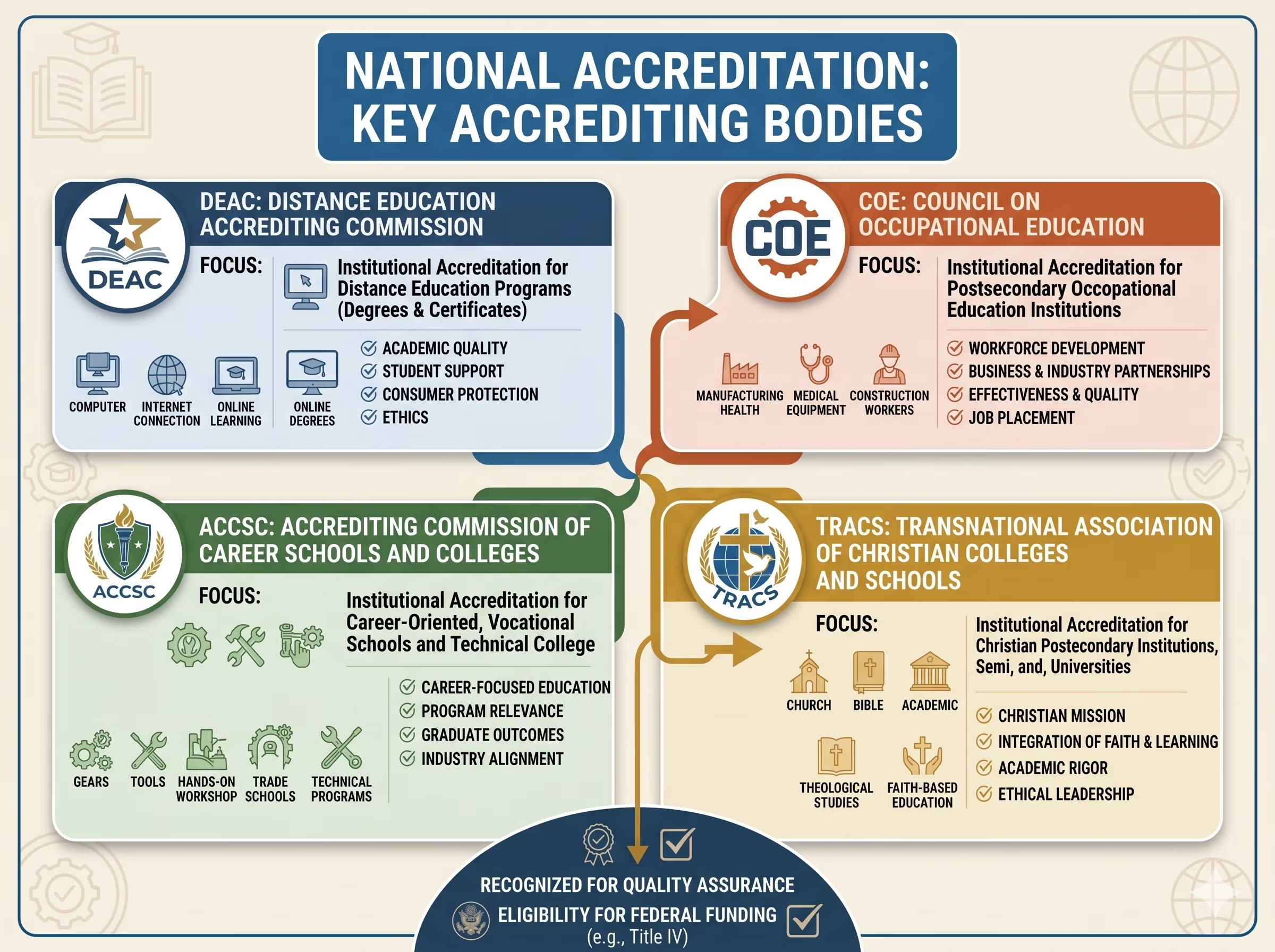
National accreditation is the pathway to institutional credibility and Title IV federal financial aid eligibility for career-focused, distance-education, occupational, and faith-based institutions. The four primary national accreditors recognized by the U.S. Department of Education are DEAC, ACCSC, COE, and TRACS. Expert Education Consultants (EEC), led by Dr. Sandra Norderhaug, has helped 115+ institutions across all 50 states get accredited — and we bring that depth of experience to every engagement.
What Is National Accreditation?
National accreditation is a quality-assurance credential awarded by agencies that evaluate institutions across the entire United States, regardless of region. Unlike the six historically regional accreditors (which served specific state clusters), national accreditors focus on specific institutional types: online schools, career and technical colleges, occupational training centers, and faith-based institutions.
National accreditation matters for three reasons. First, it makes your institution eligible for Title IV federal student aid (Pell Grants, federal loans) — often the biggest driver of enrollment growth. Second, it signals to students, employers, and state regulators that your programs meet recognized quality standards. Third, it provides a structured framework for continuous improvement across every part of your operation.
Although the U.S. Department of Education formally eliminated the “regional” vs. “national” distinction in 2020, the practical differences remain. Historically regional accreditors are still widely considered the gold standard for credit transfer and graduate-school admissions. National accreditation, however, is the faster, more targeted pathway for institutions whose mission aligns with career education, distance learning, or faith-based training — which is why an experienced accreditation consultant can be transformative for new and growing schools.
The Four National Accreditors EEC Works With
Expert Education Consultants provides end-to-end accreditation consulting for all four of the most widely relevant national accreditors. Click any card to read the full guide.
DEAC
Best for online-first colleges and universities where 51%+ of instruction is online. Founded in 1926, DEAC is recognized by USDE and CHEA and accredits certificate through professional doctoral programs. Its 15 standards (effective Jan 2025) cover mission, governance, academic delivery technology, and financial stability.
Read the full DEAC guide →ACCSC
Best for career, trade, and technical colleges with hands-on vocational programs. ACCSC has been the premier career-education accreditor for 50+ years and accredits 650+ institutions. Its Standards (effective July 2025) emphasize employer engagement, graduate employment rates, and program-level outcomes.
Read the full ACCSC guide →COE
Best for occupational and workforce-development institutions, particularly in the southeastern U.S. COE accredits 500+ institutions and is USDE-recognized. Its 2024 Handbook outlines 10 standards spanning mission, programs, outcomes, planning, resources, finances, HR, organizational structure, and student services. Known for its systems-focused approach.
Read the full COE guide →TRACS
Best for faith-based colleges, universities, and seminaries with an evangelical Christian mission. Founded in 1979, TRACS is recognized by USDE and CHEA. Its 2024–2026 Manual includes 17 standards — evaluating institutional quality and alignment with a Christian faith statement. TRACS is the only national accreditor that assesses biblical foundation alongside academic rigor.
Read the full TRACS guide →Side-by-Side Comparison
All four national accreditors open the door to Title IV eligibility, but serve very different institutional profiles. Here’s how they stack up:
| Feature | DEAC | ACCSC | COE | TRACS |
|---|---|---|---|---|
| Focus | Distance / online education | Career & technical schools | Occupational education | Faith-based institutions |
| Recognition | USDE + CHEA | USDE | USDE | USDE + CHEA |
| Degree Levels | Associate – Prof. Doctorate | Diploma – Master’s | Certificate – Associate | Associate – Doctorate |
| Delivery Mode | 51%+ distance required | Campus (online w/ approval) | Campus (online w/ approval) | Campus or online |
| Standards Count | 15 (eff. Jan 2025) | 9 sections (eff. Jul 2025) | 10 (2024 Handbook) | 17 (2024–2026 Manual) |
| Typical Timeline | 12–24 months | 18–30 months | 18–24 months | 18–36 months |
| Reaccreditation | 5 years | 5 years | 6 years | 5–10 years |
| Institutions | 100+ | 650+ | 500+ | 80+ |
| Special Requirement | Majority distance delivery | Employment outcome benchmarks | Advisory committees per program | Evangelical Faith Statement |
Is National Accreditation Right for You?
National accreditation is a powerful credential, but it’s not the right fit for every institution. Use the quick self-assessment below:
- Your institution delivers 51%+ of instruction online (DEAC)
- You operate a career, trade, or technical school (ACCSC / COE)
- Your school has an evangelical Christian mission (TRACS)
- You want the fastest pathway to Title IV eligibility
- Your programs are employment-focused with measurable outcomes
- You’re launching a new institution and want accreditation in 1–3 years
- You serve adult learners, working professionals, or niche populations
- You need maximum credit transferability to state universities
- You plan doctoral research programs requiring regional prestige
- You’re a traditional nonprofit liberal-arts college
- You need accreditation recognized by most graduate schools
- Your state licensing board requires a historically regional accreditor
- You have no campus, labs, or online platform in place yet
- Your mission doesn’t fit any national accreditor’s scope
Which National Accreditor Should You Choose?
Choosing the right accreditor is one of the most consequential decisions you’ll make. Here’s a simplified decision framework:
National Accreditation Timeline Overview
The timeline depends heavily on your institutional readiness, the accreditor you choose, and whether you engage accreditation self-study consultants. Here’s the general process:
National Accreditation Fees
Every national accreditor charges fees at multiple stages. These are accreditor fees paid to the agency, not consulting fees. Verify current amounts on the accreditor’s website.
| Fee Type | DEAC | ACCSC | COE | TRACS |
|---|---|---|---|---|
| Application Fee | $2,000–$5,000 | $3,000–$5,000 | $2,500–$5,000 | $2,000–$5,000 |
| Annual Fee | $2,000–$10,000+ | $3,000–$15,000+ | $2,000–$8,000+ | $2,000–$8,000+ |
| Site Visit Costs | $5,000–$15,000 | $5,000–$20,000 | $5,000–$15,000 | $5,000–$15,000 |
| Substantive Change | $500–$3,000 | $500–$5,000 | $500–$2,500 | $500–$3,000 |
| Est. Total (Initial) | $15,000–$40,000 | $20,000–$50,000 | $15,000–$35,000 | $15,000–$40,000 |
National vs. Regional Accreditation
One of the most common questions we hear: should I pursue national or regional accreditation? The answer depends on your institutional mission and long-term goals.
| Factor | National Accreditation | Regional Accreditation |
|---|---|---|
| Typical Institutions | Career schools, online colleges, trade schools, faith-based institutions | Traditional universities, community colleges, liberal arts colleges |
| Title IV Eligibility | Yes | Yes |
| Credit Transfer | Accepted by nationally accredited schools; limited acceptance by regionally accredited schools | Widely accepted by all accredited institutions |
| Graduate School | Varies; some programs may not accept | Broadly accepted |
| Timeline | Typically 12–36 months | Typically 3–8 years |
| Cost | Lower application and annual fees | Higher fees; longer preparation investment |
| Best For | Focused, career-oriented, online, or faith-based missions | Broad academic missions; maximum portability |
How EEC Helps You Get Nationally Accredited
Dr. Sandra Norderhaug and the EEC team have guided 115+ institutions across 50 states through accreditation. We work with all four national accreditors and tailor every engagement to your situation as your accreditation consultant partner.
Frequently Asked Questions
What does an accreditation consultant do?
An accreditation consultant guides your institution through every step — gap analysis, application strategy, policy and exhibit development, self-study drafting, site-visit prep, and post-decision response. EEC has worked with 115+ institutions across DEAC, ACCSC, COE, and TRACS, so we know what each commission expects and how to avoid common findings that delay accreditation.
What is the difference between national and regional accreditation?
National accreditors evaluate institutions nationwide and focus on specific institutional types (online, career, occupational, or faith-based). Regional accreditors historically served state clusters and accredit traditional universities and community colleges. Both grant Title IV eligibility, but regional accreditation is the gold standard for credit transfer and graduate-school admissions, while national is the faster, more targeted pathway for mission-specific schools.
Is national accreditation legitimate?
Absolutely. National accreditors recognized by USDE and/or CHEA are legitimate, federally recognized quality-assurance agencies. DEAC, ACCSC, COE, and TRACS all hold USDE recognition, making their accredited institutions eligible for Title IV federal student aid.
Can I get financial aid with national accreditation?
Yes. If a national accreditor is USDE-recognized, the institutions it accredits are eligible for Title IV federal student aid (Pell Grants, federal loans). All four national accreditors on this page are USDE-recognized.
Will credits from a nationally accredited school transfer?
It depends on the receiving institution. Nationally accredited schools generally accept credits from both nationally and regionally accredited institutions. However, many regionally accredited schools do not accept transfer credits from nationally accredited ones. If credit transfer to a regional university matters for your students, raise it with EEC during planning.
How long does national accreditation take?
Timelines range from 12–36 months depending on the accreditor and your readiness. DEAC is fastest (12–24 months); TRACS and ACCSC may take 18–36 months. EEC compresses timelines by 30–50%.
How much does national accreditation cost?
Accreditor fees (application, annual, site visit) typically run $15,000–$50,000 over the initial cycle, depending on agency and institution size. EEC’s consulting fees are separate and scoped to your needs. Contact us for a transparent proposal.
How do I prepare for an accreditation site visit?
Site-visit prep is part-logistics, part-readiness drill. EEC runs mock interviews with faculty, staff, and leadership; organizes the evidence room so evaluators find any document in under a minute; coaches your team on common evaluator questions; and stages a dry-run of the visit schedule. Most clients say the site visit feels anticlimactic after the prep — which is the goal.
Can I switch from national to regional accreditation later?
Yes. Some institutions pursue national accreditation first for credibility and Title IV eligibility, then later apply for regional accreditation. This “step-up” strategy works well for institutions that start career-focused or online-first and later expand. EEC advises on timing and feasibility.
Which national accreditor is best for an online school?
DEAC is purpose-built for institutions where 51%+ of instruction is delivered online. If you’re primarily online, DEAC is the natural fit. If you also operate physical campuses with online components, ACCSC or COE may be appropriate with distance-education approval.
Do I need a consultant for national accreditation?
Accreditation is technically DIY, but the complexity of standards, volume of required documentation, and risk of costly errors make professional guidance highly valuable. EEC has guided 115+ institutions to successful outcomes, with clients reporting faster timelines and fewer compliance findings.
Find your accreditor and get moving.
115+ institutions launched across 50 states. We partner with online colleges, career schools, occupational institutions, and faith-based colleges from readiness through grant of accreditation.