

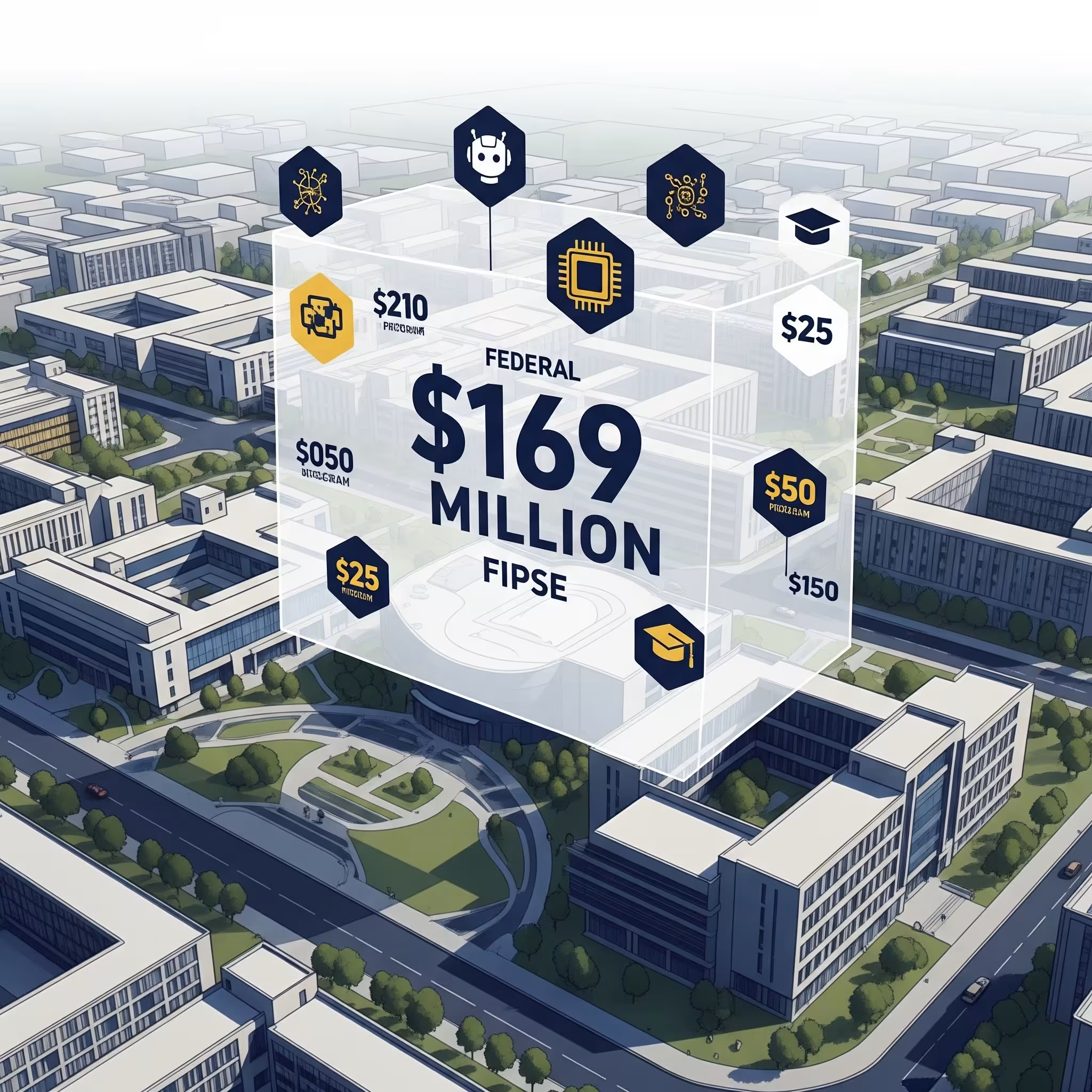
On January 5, 2026, the U.S. Department of Education did something that should have every education investor’s attention: it awarded $169 million through the Fund for the Improvement of Postsecondary Education, with $50 million specifically dedicated to advancing AI in postsecondary education. This is the largest single federal investment targeting responsible AI integration in higher education to date. If you’re building a new institution, this isn’t background noise. It’s a signal flare.
The competition was announced November 10, 2025, with a December 3 application deadline—a timeline that stunned the higher education community. Less than a month to respond to a $167 million grant opportunity. The Department received what it called a “historic number of applications,” and awards were made by early January. That compressed timeline tells you something about both the urgency the administration places on these priorities and the hunger institutions have for AI-related funding.
Let me be direct about what this means for you as a founder or investor. The FIPSE-SP program isn’t just grant money. It’s a policy statement. It tells you where federal education priorities are heading, what the government expects institutions to build, and—critically—what kinds of AI-integrated programs are most likely to receive support going forward. Even if you didn’t apply for this round, understanding this program positions you for future funding cycles, state-level grants, and the broader regulatory landscape that’s taking shape around AI in education.
This is the tenth post in our AI Ready University series, and it builds directly on the governance and compliance foundations we’ve covered in earlier posts. If you’ve been following along, you’ll see how the policy framework, the governance structures, and the accreditation strategies we’ve discussed all connect to this funding landscape.
What FIPSE Actually Is—And Why This Competition Is Different
FIPSE (the Fund for the Improvement of Postsecondary Education) is a discretionary grant program authorized under Section 744 of the Higher Education Act of 1965. It was created by Congress in 1972 to fund innovative projects that improve postsecondary educational opportunities. Unlike formula-based Title IV funding, FIPSE awards are competitive—institutions apply, peer reviewers evaluate, and the Department makes awards based on quality, feasibility, and alignment with stated priorities.
Here’s what makes this particular FIPSE competition different from business as usual. Every administration gets to set its own priorities for FIPSE, and the current administration used this authority to redirect the program’s entire focus. Previous FIPSE competitions funded programs like Basic Needs Grants for community college students, Postsecondary Student Success Grants, and Rural Postsecondary Economic Development. Those programs were paused—or, to be precise, not funded in this cycle—to make room for four new priority areas.
Congress appropriated roughly $171 million for FIPSE in fiscal year 2025 through a year-long continuing resolution. Because that resolution didn’t include specific report language directing funds to particular programs, the administration asserted authority to reprogram the funds through the “Special Projects” provision under Section 744(c)(2) of the HEA. That’s a legal nuance worth understanding: this isn’t new money. It’s existing FIPSE money redirected toward new priorities.
The political context matters if you’re planning to build an institution that will depend on federal funding alignment. This redirection was controversial—some higher education advocates argued it circumvented congressional intent. Whether you agree with that criticism or not, the practical reality is that the awards have been made, the money is flowing, and the priorities it reflects—AI, civil discourse, accreditation reform, and short-term workforce programs—represent the federal government’s current vision for postsecondary innovation. Smart founders pay attention to where the dollars go.
The $169 Million Breakdown: Where the Money Goes
The $50 million for AI is split equally between two priorities. That’s a deliberate design choice. Priority 1 focuses on what happens inside postsecondary institutions—how they integrate AI into teaching, learning, and student success. Priority 2 extends the reach further, linking postsecondary institutions to K–12 systems to build AI and computer science pipelines. If you’re building a school that trains teachers, that second priority is directly relevant to your program design.
The Two AI Priorities in Detail: What the Department Is Looking For
Absolute Priority 1: Advancing AI to Improve Educational Outcomes
This priority targets projects that use AI to enhance academic instruction and student learning. The Federal Register notice lays out two pathways. The first supports integrating AI literacy skills and concepts into teaching and learning, including instruction on responsible AI use and detecting AI-generated disinformation. The second pathway involves partnering with State Educational Agencies (SEAs) or Local Educational Agencies (LEAs) to use AI technology for high-quality instructional resources, tutoring, and college and career readiness.
What the Department is signaling: they want to see institutions embedding AI across the curriculum, not bolting on standalone courses. They want evidence of responsible use frameworks. And they want programs that produce measurable improvements in student outcomes—not just AI adoption for adoption’s sake.
The grant language explicitly references Executive Order 14179 (Removing Barriers to American Leadership in Artificial Intelligence) and Executive Order 14277 (Advancing Artificial Intelligence Education for American Youth). Both EOs frame AI education as a national competitiveness priority. Your application—or your institutional strategy, even if you’re not applying for this specific grant—should reflect that framing.
Absolute Priority 2: Foundational AI and Computer Science Exposure
This priority is about pipeline building. It funds postsecondary institutions that partner with K–12 school systems to expand access to AI and computer science education, including enabling students to earn postsecondary credentials while still in high school. It also targets programs that prepare future educators to teach AI effectively.
For founders building teacher preparation programs, career and technical education schools, or institutions serving dual-enrollment populations, this priority is directly relevant. The federal government is investing in the idea that AI literacy starts before college—and that postsecondary institutions should be active partners in making that happen.
Here’s a practical example from the funded projects: one community college received funding to embed AI tools, AI-supported instructional practices, and AI-related content into high-impact academic programs including nursing and information technology. Another community college in the Southwest received nearly $1.9 million to implement faculty development programs, AI micro-credentials, and K-to-industry pipelines. These are the kinds of projects that illustrate what the Department considers competitive.
Eligibility, Selection Criteria, and Strategic Implications
Who could apply? Institutions of higher education as defined in Section 101 of the HEA, consortia of such institutions, and other public and private nonprofit institutions and agencies. For-profit institutions are eligible if they meet the HEA definition. State higher education agencies are also eligible.
An eligible entity could apply to all four areas of national need as the lead applicant but could submit only one application per area. That means a single institution could potentially have received awards across multiple priority areas.
The application narrative was recommended at 35 pages maximum, and the selection criteria followed standard Department of Education evaluation protocols. Here’s how the scoring worked:
The tiebreaker sequence is revealing: first, highest score for Quality of Project Design; second, highest score for Significance; third, equitable geographic distribution. That first tiebreaker tells you the Department prioritizes well-designed projects over abstract importance—a message for anyone building a future application.
Project periods run up to 48 months. That’s four years of funded activity. For institutions planning AI integration, aligning your institutional timeline with a multi-year federal grant cycle can provide both financial support and external accountability.
Title IV Alignment and Financial Aid Implications
The FIPSE-SP program doesn’t directly modify your Title IV eligibility. But its intersection with Title IV (federal student financial aid programs including Pell Grants and federal student loans) is strategically significant in two ways.
First, the Workforce Pell Grant connection. Absolute Priorities 6 and 7—the short-term program capacity priorities—are explicitly designed to support programs that will qualify for Workforce Pell Grants under the One Big Beautiful Bill Act (Public Law 119-21). Starting in the July 2026 award year, eligible students in accredited programs of 8 to 15 weeks aligned to high-skill, high-wage, or in-demand occupations can receive Title IV grant funding. If you’re building short-term AI credential programs, this is a funding pathway you need to be designing toward.
Second, the institutional capacity signal. When the Department invests $50 million in AI education grants, it’s creating an infrastructure of AI-integrated postsecondary programs that will become the new baseline. Institutions that don’t pursue AI integration—whether through FIPSE funding or through their own investment—risk falling behind the program quality expectations that accreditors and federal reviewers will increasingly apply. Title IV eligibility flows through accreditation, and accreditation increasingly expects AI readiness.
There’s a more practical Title IV consideration as well. Grant recipients must operate in compliance with federal civil rights laws and nondiscrimination requirements—standard conditions for any federal funding. But the grant also includes a provision allowing the Secretary to discontinue an award if determined not to be in the best interest of the federal government. That’s a broader discretion than most federal grants include, and institutions should factor it into their compliance planning.
Reporting Requirements and Accountability Metrics
Grant recipients face structured accountability. At minimum, multi-year awards require annual performance reports providing current performance and financial expenditure data. At the end of the project period, a final performance report including financial information is required. The Secretary can also require more frequent reporting under 34 CFR 75.720(c).
The practical implication: if you’re pursuing a FIPSE-style grant—this round or a future one—your institution needs data infrastructure from day one. You’ll need to track baseline metrics before implementation begins, measure outcomes during the project, and demonstrate improvement at the end. The selection criteria’s emphasis on “Quality of Project Evaluation” (25 points) means reviewers want to see a rigorous evaluation plan, not vague promises about future assessment.
What kinds of metrics should you be prepared to report? Based on the priority language and standard federal grant expectations, plan for student learning outcomes tied to AI literacy competencies, faculty professional development completion and effectiveness measures, technology adoption and usage data, student enrollment and completion rates in AI-integrated programs, partnership outcomes with K–12 or employer partners, and sustainability plans for continuing the work after grant funding ends.
That last item—sustainability—is one that grant applicants frequently underestimate. Federal reviewers want to know that your AI integration efforts will survive beyond the grant period. That means building AI governance frameworks, institutional budget lines, and faculty capacity that don’t depend entirely on federal dollars. Ironically, the institutions best positioned for FIPSE grants are the ones that would pursue AI integration even without the funding.
State-Level Matching Funds and Complementary Programs
The FIPSE-SP program doesn’t require matching funds. But savvy institutional planners layer federal grants with state-level programs to maximize their investment. Here’s where to look.
WIOA Funding. The Department of Labor’s February 2026 AI Literacy Framework signals that WIOA (Workforce Innovation and Opportunity Act) training dollars will increasingly flow toward AI skills programs. If your institution serves workforce development populations, align your AI curricula with the DOL framework’s five content areas and seven delivery principles. State workforce boards are already beginning to allocate governor’s reserve funds for AI training.
State Workforce Development Grants. Several states have established or expanded AI-specific workforce development funds. California, Texas, New York, and Virginia are among the most active. Check with your state’s higher education coordinating board and workforce development agency for current opportunities.
Tech Company Educational Investment Programs. Google, Microsoft, Amazon, and Apple all maintain educational investment programs with AI literacy components. These aren’t direct grant substitutes, but they can provide discounted technology access, curriculum resources, and faculty training that reduce your institutional costs.
NSF and IES Research Grants. For institutions with research capacity, the National Science Foundation and the Institute of Education Sciences fund AI-in-education research. These grants are more competitive and research-focused than FIPSE, but they can complement an implementation grant with a rigorous evaluation component.
The strategic play for founders is to think about AI integration funding as a portfolio, not a single grant application. FIPSE might cover your AI curriculum development. WIOA funds might support your faculty training. A tech company partnership might provide your AI platform licenses at reduced cost. Layering these sources makes your AI integration financially sustainable—which, as we discussed, is exactly what federal reviewers want to see.
One practical note on state-level funding: timing matters. Many state workforce development grants operate on annual cycles that don’t align with the federal fiscal year. Start identifying your state’s grant opportunities now, even if the deadlines are months away. The research and relationship-building you do today will pay off when application windows open. I’ve worked with founders who missed state funding simply because they weren’t monitoring the right channels. Your state higher education coordinating board, workforce development agency, and governor’s office of education are the primary sources to track. Subscribe to their newsletters, attend their webinars, and build relationships with program officers. These connections are invaluable when application deadlines arrive.
Historical Precedents: Lessons from Prior Federal Ed-Tech Investment Cycles
This isn’t the first time the federal government has made a major investment in education technology. Looking at how prior cycles played out provides useful context for what to expect—and what to watch out for.
In the mid-2000s, federal grants through programs like Preparing Tomorrow’s Teachers to Use Technology (PT3) invested hundreds of millions in integrating technology into teacher preparation. The programs that succeeded long-term were the ones that built institutional capacity—faculty expertise, governance structures, curriculum frameworks—rather than just purchasing hardware. The programs that faded after funding ended were typically the ones that bought equipment without building the human infrastructure to use it effectively.
The TAACCCT (Trade Adjustment Assistance Community College and Career Training) grants, which invested nearly $2 billion from 2011 to 2018, provide another instructive precedent. The most successful TAACCCT projects created lasting industry partnerships, stackable credential pathways, and institutional capacity that outlived the grant period. The least successful bought technology platforms that went unused after the grant coordinator left.
The lesson for AI grants is consistent: federal funding is seed capital, not a permanent budget line. Use it to build capacity—governance frameworks, faculty expertise, curriculum design, assessment infrastructure, employer partnerships—that your institution can sustain independently. The Department’s selection criteria, which allocate 25 points to evaluation quality and embed sustainability throughout the project design criteria, reflect this lesson learned.
There’s one more precedent worth noting. Federal education technology investments tend to accelerate institutional stratification. Institutions that are well-positioned to apply—those with grant writing capacity, existing governance structures, and administrative infrastructure—tend to win awards. Institutions that are building from scratch often lack the capacity to compete for the first round. If you’re a startup institution, don’t view the FIPSE awards as a missed opportunity. View them as a preview of where the landscape is heading, and use this cycle to build the institutional capacity that will make you competitive for the next one.
What Funded Projects Actually Look Like: Patterns from the Awards
While the Department hasn’t published a complete list of every funded project as of this writing, the examples it highlighted—plus reporting from organizations tracking the awards—reveal clear patterns that tell you what successful applications looked like.
Community colleges dominated the AI awards. Roughly one-third of the AI-priority grants went to community colleges or two-year systems. That’s significant. It tells you the Department valued practical, workforce-focused AI integration over theoretical research. Community colleges that embedded AI into high-demand programs like nursing, information technology, allied health, and business were strong applicants.
The winning projects connected AI to existing program strengths. A community college in West Virginia received $1.84 million to boost AI-supported instruction in nursing, allied health, business, IT, and general education. A college in Arizona received nearly $1.9 million for faculty development, AI micro-credentials, and K-to-industry pipeline development. These aren’t institutions that reinvented themselves around AI. They took programs they were already good at and added AI integration as a quality enhancement. That’s a model any founder can replicate.
Faculty development was central, not peripheral. Nearly every funded project description I’ve reviewed includes a significant faculty professional development component. The Department clearly values institutional investment in faculty AI readiness—not just student-facing AI tools. If your proposal (or your institutional plan) treats faculty development as an afterthought, you’re missing what reviewers reward.
Partnership models were rewarded. The strongest projects involved partnerships—with K–12 systems, employers, workforce agencies, other institutions, or combinations thereof. A Virginia project partnered colleges to develop an AI-native accreditation platform. Michigan’s seven-college consortium pooled resources to revamp over 20 workforce programs. The lesson: collaboration isn’t just nice to have. For federal grants, it’s a competitive advantage.
Individual award amounts ranged broadly. From approximately $660,000 for smaller community college projects to $4 million for larger institutional initiatives. That range means institutions of almost any size could find a competitive position if the project design was strong. You don’t need to be a large university to win a FIPSE award—but you do need a well-designed project with measurable outcomes.
Positioning Your Institution for Future Federal AI Funding
Whether or not another FIPSE competition materializes in FY 2026 or beyond, the infrastructure you build now has value far beyond a single grant application. Here’s a concrete positioning strategy based on what we know about federal priorities and selection criteria.
Develop a formal AI integration plan. This is a strategic document—separate from your governance policy—that maps how AI will be embedded into your programs, what student outcomes you expect, how you’ll measure success, and what the timeline looks like. Think of it as the executive summary of a future grant narrative. When an opportunity opens, you’ll have the substance ready; you’ll just need to format it.
Build your data infrastructure early. The FIPSE selection criteria allocated 25 points—a full quarter of the total—to evaluation quality. Federal reviewers want to see baseline data, a clear evaluation methodology, performance measures, and evidence-building capacity. Start collecting data now: student AI competency assessments at enrollment, faculty professional development metrics, tool adoption rates, and student outcome measures. The institutions that win grants are the ones that can show data, not just intentions.
Cultivate employer advisory relationships. FIPSE priorities repeatedly reference workforce alignment, employer engagement, and career readiness. Having documented employer advisory board input on your AI curriculum demonstrates market relevance. Employer letters of support are standard components of competitive grant applications. Start building these relationships twelve to eighteen months before you plan to apply for anything.
Invest in grant writing capacity. The 23-day FIPSE application window caught many institutions off guard. Institutions that had grant writing staff or consultants already under contract could respond quickly. Those that didn’t were starting from zero with a calendar that offered no margin. If you’re planning to pursue federal grants, either hire someone with grant writing experience or retain a consulting firm that specializes in education grants. The return on that investment is significant.
Document everything you build. Committee charters, faculty training sign-in sheets, curriculum maps, assessment rubrics, vendor vetting records, student outcome data—all of it becomes evidence in a grant application. The institutions that produce the strongest federal applications are the ones that treat documentation as a habit, not a last-minute scramble. This same documentation serves your accreditation evidence file, so the effort pulls double duty.
One last piece of advice: don’t wait for a federal grant to start your AI integration. The institutions that received FIPSE awards in January 2026 were already doing the work. The grant accelerated and expanded their efforts; it didn’t create them from nothing. If you build genuine institutional capacity—governance, curriculum, faculty expertise, assessment, partnerships—the funding will follow, whether from federal grants, state programs, or your own institutional revenue.
The FIPSE-Accreditation Intersection: Why This Grant Program Matters Beyond the Money
One of the most underappreciated aspects of the FIPSE-SP program is its signal effect on the accreditation landscape. When the federal government dedicates $50 million specifically to AI in postsecondary education, accreditors take notice. The Department’s priorities become part of the ambient expectations that accreditation reviewers carry into site visits and evaluation processes.
The Middle States Commission on Higher Education published formal AI accreditation policy effective July 2025. SACSCOC has addressed AI in its accreditation guidance. The Higher Learning Commission’s revised requirements become effective September 2026. These developments aren’t coincidental—they’re part of the same ecosystem. Federal investment in AI education validates and accelerates accreditor expectations around AI governance and integration.
For founders, this means AI governance and curriculum integration are no longer “nice to have” additions to your accreditation application. They’re rapidly becoming part of what it means to demonstrate institutional effectiveness and program relevance—two concepts at the heart of every accreditation standard. The FIPSE program didn’t create this expectation, but it amplified it significantly.
I’ve observed a direct effect in recent site visits. Accreditation evaluators are increasingly asking specific questions about AI: How does your institution govern AI use? What AI tools are in your tech stack, and how are they vetted? How do you address AI in academic integrity? What AI competencies do your graduates develop? These questions weren’t standard two years ago. They’re becoming routine now. The institutions that answer them confidently—with documented governance frameworks, assessment data, and faculty development evidence—are the ones that sail through review.
Interestingly, one FIPSE-funded project in Virginia is developing an “AI-native accreditation platform” aimed at cutting accreditation preparation time by 40% and reducing review timelines to under nine months. If that project succeeds, it could change the accreditation process itself—making AI not just the subject of accreditation review, but a tool that transforms how accreditation operates. That’s a development worth watching closely.
What This Means for Founders: Five Strategic Moves to Make Now
1. Build your AI governance framework before anything else. The FIPSE competition made it clear that the Department expects institutional readiness—not just aspiration—around AI governance. Your governance framework, your data handling policies, your faculty professional development plan, and your assessment infrastructure are all prerequisites to competitive grant applications. Build them now.
2. Align your programs with Workforce Pell eligibility. The Workforce Pell Grant program launches for the July 2026 award year, and FIPSE Priorities 6 and 7 invested $50 million in helping institutions build qualifying programs. If you’re developing short-term AI credentials—cybersecurity, data analytics, AI-assisted healthcare technology—design them from day one to meet Workforce Pell standards: 8 to 15 weeks, aligned to high-skill/high-wage/in-demand occupations, portable and stackable.
3. Design your programs with measurable AI competency outcomes. FIPSE reviewers awarded 25 points for evaluation quality and 30 for project design. That’s 55% of the total score allocated to “can you show this actually works?” Build assessment rubrics, baseline measures, and data collection systems into your program design from the start. This isn’t just grant strategy—it’s good accreditation practice.
4. Explore K–12 partnership opportunities. Absolute Priority 2 specifically targets postsecondary-K–12 partnerships for AI and computer science exposure. If you’re near school districts that lack AI curriculum capacity, a partnership model could serve both populations and strengthen a future grant application.
5. Watch for future FIPSE cycles—and prepare now. FIPSE competitions can recur. The Federal Register notice states that the priorities will apply to this competition and “any subsequent year in which we make awards from the list of unfunded applications from this competition.” That means there may be additional awards from this same applicant pool. It also means future competitions may use similar or related priorities. The institutions that invest in AI governance, curriculum design, and partnership infrastructure now will be first in line when the next opportunity opens.
I want to add a note of realism here. The future of FIPSE funding is not guaranteed. The President’s fiscal year 2026 budget request proposed eliminating FIPSE entirely. The Senate version of the appropriations bill proposed $146 million; the House version proposed $47.5 million. The political negotiations around these numbers are ongoing. Smart founders plan for the funding environment they have, not the one they hope for. Build your institution to be sustainable without grants, and use grants as accelerants—not lifelines.
Risks and Caveats: What You Should Watch Carefully
No responsible advisor would discuss federal grant opportunities without flagging the risks. Here’s what you need to know.
Political volatility. FIPSE priorities change with each administration. The programs funded in this cycle reflect current policy preferences. A future administration could redirect FIPSE funding toward entirely different priorities. Don’t build your institutional strategy around a single grant program—build it around institutional mission and sustainable program quality.
Accelerated timelines create quality risks. The 23-day application window for a $167 million competition was unprecedented. Institutions that submitted rushed applications may face implementation challenges if their project designs weren’t fully developed. If you’re building institutional capacity for future rounds, invest in thoughtful program design over speed.
The discontinuation clause. Education grants expert Amanda Fuchs Miller has publicly flagged that the FIPSE-SP grant terms give the Secretary authority to discontinue an award if determined not to be in the best interest of the federal government. There are also limits on indirect cost rates and requirements for grantees to certify compliance with the administration’s priorities and interpretation of federal anti-discrimination laws. These are more expansive terms than many federal grant programs include. Institutions should go in with, as Fuchs Miller put it, “eyes wide open.”
Staff capacity at the Department. The Department of Education has undergone significant staffing reductions. The Office of Postsecondary Education, which administers FIPSE, lost a substantial number of staff during the most recent reduction in force. This could affect grant oversight, technical assistance, and the processing of future competitions. Plan for the possibility of limited federal support during your project period.
Indirect cost rate limitations. The FIPSE-SP terms include constraints on indirect cost rates that may affect how institutions budget their grants. If your institution has negotiated a federal indirect cost rate, you may not be able to apply the full rate to a FIPSE award. This affects how much of the grant actually reaches program activities versus overhead. Factor this into your financial planning.
The sustainability challenge. Perhaps the biggest risk isn’t political or administrative—it’s institutional. FIPSE grants fund projects for up to 48 months. What happens in month 49? Institutions that build their AI programs entirely around grant funding face a cliff when the money runs out. The most resilient approach treats grant funding as start-up capital for programs that can sustain themselves through tuition revenue, institutional budgets, and diversified funding sources. I’ve seen institutions build impressive AI programs with federal money, only to watch them wither when the grant ended because no one planned for what came next. Sustainability isn’t a grant reporting requirement—it’s an institutional survival strategy.
I want to be balanced here: the risks are real, but so is the opportunity. The FIPSE-SP program represents a genuine federal commitment to AI in postsecondary education. The awards have been made, the money is flowing, and the institutional capacity being built will shape the sector for years. The key is to engage with clear eyes—understanding both the opportunity and the constraints.
The Bigger Picture: What FIPSE Tells Us About Where Federal Education Policy Is Heading
Step back from the specifics of this grant program and a larger picture emerges. The FIPSE-SP competition, combined with Executive Orders 14179 and 14277, the DOL’s AI Literacy Framework, and the Workforce Pell Grant program, reveals a coherent federal vision for postsecondary education—whether or not you agree with every element of it.
That vision includes several key themes. First, AI literacy as a national competitiveness priority. The executive orders frame AI education explicitly in terms of maintaining American leadership in artificial intelligence. Programs that connect AI education to workforce readiness and economic competitiveness are aligned with this framing. Second, short-term, workforce-aligned credentials as a priority pathway. The combination of Workforce Pell Grants and FIPSE short-term program funding creates a new market for accelerated, career-focused AI programs. This is a genuine opportunity for trade schools, career colleges, and community colleges. Third, accreditation reform as a policy tool. The $7 million for accreditation reform—supporting both institutional accreditor changes and the creation of new accrediting agencies—signals a desire to reshape the accreditation landscape. New institutions should watch this space carefully, as it could create alternative pathways to accreditation in the coming years.
For founders, the takeaway isn’t that you need to chase every federal priority. It’s that understanding where the policy winds are blowing helps you make smarter decisions about institutional design, program development, and market positioning. The institutions that thrive in any regulatory environment are the ones that stay informed, build strong foundations, and maintain the flexibility to adapt when the landscape shifts.
Key Takeaways
1. The $169 million FIPSE-SP award is the largest federal investment specifically targeting AI in postsecondary education. $50 million is dedicated to AI priorities across two absolute priorities.
2. FIPSE is authorized under the Higher Education Act. Eligibility extends to IHEs, consortia, and nonprofit organizations. For-profit institutions meeting the HEA definition are also eligible.
3. The AI priorities emphasize responsible integration, measurable student outcomes, faculty development, and K–12 partnerships—not technology for technology’s sake.
4. Selection criteria weight Quality of Project Design (30 points) and Quality of Project Evaluation (25 points) most heavily. Build assessment and evidence infrastructure from day one.
5. Workforce Pell Grants, launching July 2026, create a Title IV funding pathway for short-term AI credential programs. Design toward eligibility now.
6. FIPSE priorities reflect the current administration’s vision. Future funding is not guaranteed. Build institutional sustainability, not grant dependency.
7. Layer federal grants with state WIOA funds, tech company partnerships, and institutional investment for a sustainable AI integration funding portfolio.
8. Historical precedents from PT3 and TAACCCT show that capacity-building outlasts hardware purchasing. Invest in people, governance, and curriculum—not just platforms.
9. Even if you didn’t apply for this FIPSE cycle, understanding the program positions you for future federal and state funding opportunities.
10. Your AI governance framework is the prerequisite. Institutions that have their governance house in order are dramatically better positioned for every funding opportunity.
Glossary of Key Terms
Frequently Asked Questions
Q: What is FIPSE and how does it differ from other federal education grants?
A: FIPSE—the Fund for the Improvement of Postsecondary Education—is a discretionary grant program under the Higher Education Act designed to fund innovative projects addressing national needs in postsecondary education. Unlike formula-based programs like Title I or Pell Grants, FIPSE awards are competitive: institutions apply, peer reviewers score applications against published criteria, and the Department selects the strongest proposals. Each administration sets its own FIPSE priorities, which is why the FY 2025 competition focused specifically on AI, civil discourse, accreditation reform, and short-term programs.
Q: How much of the $169 million is specifically for AI in education?
A: $50 million is allocated specifically to AI priorities, split evenly between Absolute Priority 1 (advancing AI to improve student outcomes, $25 million) and Absolute Priority 2 (foundational AI and computer science exposure, $25 million). The remaining $119 million funds civil discourse programs ($60 million), accreditation reform ($7 million), and short-term program capacity ($50 million). However, AI integration could be relevant to short-term program proposals as well, particularly for programs building AI-focused workforce credentials.
Q: Who was eligible to apply for the FIPSE-SP competition?
A: Institutions of higher education as defined in Section 101 of the HEA, consortia of such institutions, and other public and private nonprofit institutions and agencies. For-profit institutions meeting the HEA definition were also eligible. State higher education agencies qualified as well. An entity could apply to all four priority areas as lead applicant but could submit only one application per area of national need.
Q: The deadline has passed. Is there any opportunity in future cycles?
A: Potentially, yes. The Federal Register notice states that the published priorities will apply to this competition and any subsequent year in which awards are made from the list of unfunded applications. That means additional awards from the existing applicant pool are possible. Future FIPSE competitions may also use similar or related priorities. The most productive thing you can do now is build the institutional infrastructure—AI governance, curriculum design, assessment systems, partnerships—that will make you competitive when the next opportunity arises.
Q: Can a startup institution that hasn’t yet been accredited apply?
A: Technically, the eligibility requires meeting the HEA Section 101 definition of an institution of higher education, which generally requires accreditation or pre-accreditation status from a recognized accreditor. A brand-new institution in the earliest planning stages that has not yet achieved candidacy would typically not qualify as a lead applicant. However, you could participate as a partner in a consortium led by an eligible institution. More practically, use this period to build the capacity that will make your institution competitive for future federal and state grants once you achieve candidacy or initial accreditation.
Q: How does the Workforce Pell Grant connect to FIPSE?
A: Absolute Priorities 6 and 7 in the FIPSE-SP competition specifically fund the creation and expansion of short-term programs designed to qualify for Workforce Pell Grants under the One Big Beautiful Bill Act (P.L. 119-21). Workforce Pell begins for the July 2026 award year and covers accredited programs of 8 to 15 weeks aligned to high-skill, high-wage, or in-demand occupations. For institutions building AI-focused short-term credentials, the connection is direct: FIPSE helps build the program, Workforce Pell helps students pay for it.
Q: What reporting requirements do FIPSE grantees face?
A: Multi-year award recipients must submit annual performance reports with current performance and financial expenditure data. A final performance report with financial information is required at the end of the project period. The Secretary can require more frequent reporting. Practically, this means grantees need data infrastructure from the start: baseline metrics, outcome tracking, financial accounting, and evidence of progress toward stated goals.
Q: How should we think about the political uncertainty around FIPSE?
A: Pragmatically. FIPSE priorities change with administrations, and the current President’s budget request proposed eliminating FIPSE entirely for FY 2026. Congress may restore some or all funding, but the amounts and priorities remain uncertain. Smart institutional planning treats federal grants as accelerants, not lifelines. Build your AI programs to be sustainable on institutional revenue, and use grants to enhance and expand what you’d do anyway.
Q: What state-level funding complements FIPSE for AI education?
A: Several pathways exist. WIOA (Workforce Innovation and Opportunity Act) training funds are increasingly directed toward AI skills development, especially after the DOL’s February 2026 AI Literacy Framework. Many states have established workforce development grants targeting technology skills. Tech company programs from Google, Microsoft, Amazon, and others provide discounted tools and training resources. And the NSF and IES fund AI-in-education research for institutions with research capacity. The strongest approach layers multiple funding sources.
Q: What were the selection criteria for the FIPSE AI priorities?
A: Applications were scored on four criteria totaling 100 points: Significance (25 points), Quality of Project Design (30 points), Quality of Management Plan (20 points), and Quality of Project Evaluation (25 points). The first tiebreaker was highest score for Quality of Project Design, signaling the Department’s emphasis on well-constructed implementation plans over abstract importance claims.
Q: How does AI governance help position us for future grants?
A: Substantially. Grant reviewers evaluate institutional capacity and organizational readiness. An institution with a documented AI governance framework, vendor vetting processes, faculty development programs, and assessment infrastructure demonstrates readiness that reviewers value. It’s the difference between an application that says “we plan to develop governance” and one that says “here’s our governance framework, here’s how it works, and here’s evidence from its first year of implementation.” The second application scores higher every time.
Q: What can we learn from the types of projects that were funded?
A: The funded projects emphasize practical, measurable AI integration rather than abstract research. Examples include community colleges embedding AI tools into nursing and IT programs, institutions developing AI micro-credentials, schools building faculty development frameworks, and partnerships creating K–to–industry AI pipelines. The pattern is clear: the Department funded implementation and capacity-building, not theoretical exploration.
Q: Are the FIPSE awards one-time or renewable?
A: FIPSE-SP awards under this competition have project periods of up to 48 months. Grantees receive funding for the length of their approved project. Continuation funding within the project period is subject to annual performance review and compliance certification. These are not indefinitely renewable grants—they’re time-limited project investments. Institutions must plan for sustainability beyond the grant period.
Q: What should we budget for AI integration even without a FIPSE grant?
A: Based on our work with institutional launches, budget $50,000 to $120,000 in year one for comprehensive AI integration (governance development, curriculum design consulting, faculty professional development, AI platform licensing, and assessment infrastructure), dropping to $25,000 to $60,000 annually for maintenance, updates, and continued training. These numbers vary significantly based on institutional size and program count. The investment pays for itself through stronger accreditation positioning, improved student outcomes, and enrollment competitiveness.
Q: Will there be another FIPSE competition focused on AI?
A: There’s no guarantee, but the signals are positive. AI in education aligns with multiple executive orders, the DOL AI Literacy Framework, and bipartisan interest in workforce readiness. Future FIPSE competitions, if funded, are likely to include AI-related priorities. State-level grant programs are also expanding in this space. The most productive strategy is to build institutional readiness now and apply when opportunities arise, rather than waiting for a specific announcement.
Current as of February 2026. Federal grant programs, regulatory guidance, and funding levels are subject to change. Consult current sources, the Federal Register, and expert advisors before making institutional decisions.
If you’re ready to explore how EEC can de-risk your AI-integrated launch, reach out at sandra@experteduconsult.com or +1 (925) 208-9037.