

Walk onto any enrollment fair floor today and count the booth banners claiming "AI-powered learning." You won't make it past the first row without losing count. Search "AI-integrated college program" and you'll find pages of results that all say roughly the same things: cutting-edge, innovative, future-ready, AI-enhanced, transformative. It's the same vocabulary repeated until it means nothing.
Here's the uncomfortable truth for anyone building a new educational institution in 2026: having a genuine, well-implemented AI strategy is table stakes. Communicating it effectively so prospective students actually believe you and choose you over the noise? That's the real competitive challenge. And it requires a completely different approach from traditional higher-education marketing.
I've watched a lot of institutions get this wrong over the past two years. Schools with genuinely strong AI programs buried under generic buzzword copy. Schools with mediocre AI integrations spending heavily on "AI leadership" ppersonalized
ositioning that their own faculty would laugh at. And a smaller number of schools that got it exactly right -- built honest, evidence-based stories around real outcomes, avoided the regulatory landmines in ed-tech marketing, and earned enrollment growth that reflected actual program quality.
This post is about how to be in that third category. We'll cover how to cut through competitor noise, build thought leadership that actually moves the needle, use student outcomes as your most powerful marketing asset, optimize for the search terms your prospective students are actually using, and stay on the right side of regulatory lines that many schools don't even know exist.
A note before we dig in: this is post 28 in our AI Ready University series. If you haven't read our earlier posts on AI governance frameworks, accreditation strategy, and FERPA compliance, those will give you important context -- because what you can legitimately say in marketing depends heavily on what you've actually built.
The AI Marketing Bubble: Why Everyone Sounds the Same (And What It Actually Costs You
The problem isn't that institutions are lying about AI. Most of them aren't. The problem is that they're describing the same surface-level things in the same words, which creates a credibility vacuum that affects every school -- including the ones doing genuinely interesting work.
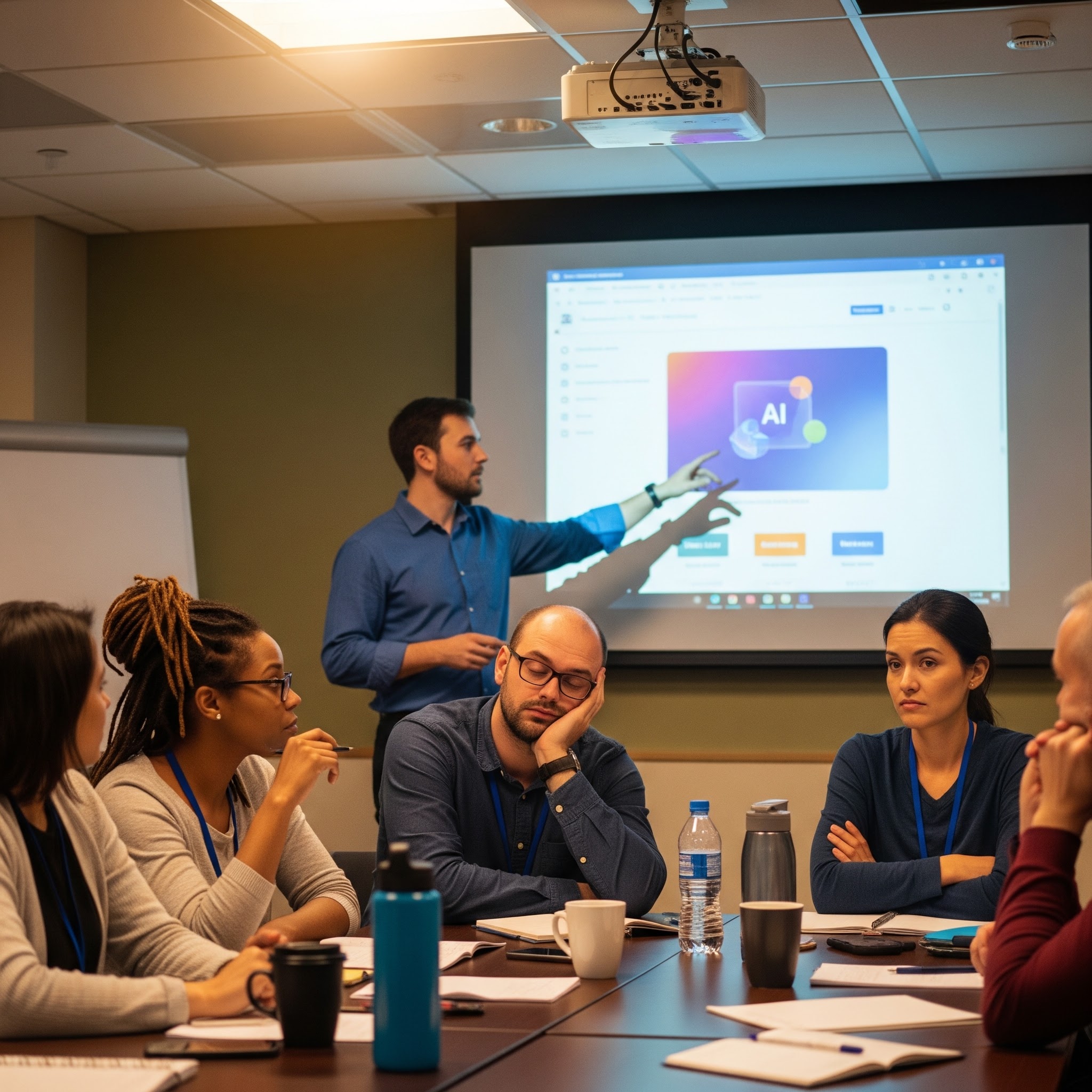
Think about what a prospective adult learner sees when researching programs right now. They Google "AI skills certification programs" or "college with AI curriculum" and they land on pages that all describe AI as "integrated throughout the curriculum," promise students will be "ready for the AI-driven economy," and feature stock photos of people staring meaningfully at holographic interfaces. Within four or five pages, it all blurs together.
This isn't a new problem in education marketing -- it's the same dynamic that once made every school sound identical about "experiential learning" and "student-centered education." But the AI version moves faster and has higher stakes, because the underlying technology is changing rapidly enough that claims made in marketing materials can become outdated or demonstrably false within a year.
The institutions winning enrollment right now aren't the ones spending the most on AI marketing. They're the ones with the clearest answers to the simplest student question: 'What will I specifically be able to do after completing this program that I can't do today?'
There's a compounding problem for new institutions in particular: prospective students have become genuinely skeptical of AI claims. A 2025 survey by Burning Glass Institute found that a growing percentage of adult learners who investigated AI-focused programs said they had difficulty distinguishing between programs with meaningful AI integration and those with superficial AI branding. That skepticism is your marketing problem to solve.
The good news: authenticity and specificity are in short supply. That means the bar for differentiation is actually lower than it appears. You don't need a massive marketing budget to stand out. You need a cleaner, more honest, more specific story than everyone else is telling.
What Actually Differentiates Your AI Story: The Specificity Framework
Differentiation in an AI-saturated market comes down to one principle: specificity beats superlatives every time. "We offer AI-integrated programs" is a superlative claim -- everyone makes it. "Our medical billing graduates reduce claim processing time by an average of 34% using AI-assisted coding tools in their first 90 days" is a specific claim. Specific claims are credible. Superlatives are noise.
Before you write a single line of marketing copy, you need to do the internal work of identifying what is genuinely distinctive about your AI approach. This means answering four questions honestly:
- What specific AI tools and workflows do your students learn, and which industries use those exact tools?
- What measurable outcomes -- placement rates, salary data, employer feedback, performance benchmarks -- can you point to that reflect AI competency?
- How does your AI integration differ from what a student could get by self-studying the same tools at home for free?
- What problem does your AI curriculum solve for a specific type of student -- a career changer, a working parent, a recent high school graduate, an ESL learner?
If you can't answer all four clearly, your marketing team can't either. This is a product strategy problem before it's a marketing problem, and trying to solve it with clever copy is a short-term fix that will hurt you when students arrive and the program doesn't match the promise.
The Three Levels of AI Marketing Specificity
Most institutional AI marketing operates at Level 1, which is the weakest. Here's what the three levels look like in practice:
Level 3 is where enrollment conversions happen. It's also where most institutions can't compete because they haven't built the outcomes tracking infrastructure to support those claims. If you're building from scratch, instrument your program from day one to collect this data. The marketing value of outcome data in an AI-skeptical market is enormous.
One approach I've seen work extremely well for smaller institutions: build a formal employer partnership panel -- even if it's just five to ten local employers -- and collect structured feedback on graduate AI readiness quarterly. That feedback becomes both a curriculum improvement mechanism and genuine marketing content. "According to our employer advisory partners, EEC Healthcare graduates are AI-ready from day one" is a claim that carries weight.
Content Marketing and Thought Leadership That Actually Attracts Enrollment
Content marketing in education has always worked on a simple principle: demonstrate expertise before asking for a commitment. In the AI education space, this principle is more powerful than ever because the genuine expertise gap is so wide. Most institutions are stumbling through AI integration themselves. An institution that can speak authoritatively about what works, what doesn't, and why earns outsized credibility with exactly the students you want to recruit.
Thought leadership for an AI-integrated institution needs to live at the intersection of two things: the specific industries your programs serve, and the specific AI transformations happening in those industries. Generic "AI is changing everything" content is almost useless. Specific content like "How AI is reshaping medical coding workflows in 2026 -- and what MA programs aren't teaching" reaches exactly the person searching for your program and establishes your institution as the credible source before they even look at your enrollment page.
Content Formats That Work for AI Education Marketing
Not all content formats perform equally for an AI education audience. Based on what we've seen across multiple institutional marketing campaigns in 2025 and 2026, here's the honest performance breakdown:
The free AI literacy assessment format deserves special mention because it's both a genuine service and an exceptional lead capture mechanism. Build a short assessment -- ten to fifteen questions that evaluate a prospective student's current AI knowledge and workplace readiness. Deliver personalized results with clear messaging about which of your programs would address their specific gaps. This converts at dramatically higher rates than a standard contact form because it delivers immediate value before asking for anything.
On the thought leadership side: one founder I advised in late 2025 started a modest blog series walking through exactly how her institution was building its AI curriculum -- what they were choosing, what they were rejecting, and why. It wasn't polished content marketing. It was transparent, honest documentation of a process. Within four months, it was generating more qualified enrollment inquiries than any paid channel. The authenticity was the differentiator.
Building an AI Thought Leadership Calendar
Content marketing only works with consistency. For a new or growing institution, the minimum viable content calendar for AI thought leadership looks like this: two to three substantive blog posts per month tied to your specific program areas, one employer or alumni feature per month, and a quarterly deep-dive on a regulatory or workforce trend affecting your student population. That's achievable without a large marketing team and provides enough content surface area to build organic search traction within six to twelve months.
The most important discipline is tying content topics to actual search behavior. Use Google Search Console, Google Trends, and tools like Semrush or Ahrefs to understand what your prospective students are actually typing. "How to get an AI job without a CS degree" gets searched hundreds of thousands of times per month. "AI healthcare administration certification" is a much smaller but far more conversion-oriented query. Know the difference between top-of-funnel brand-building content and bottom-of-funnel enrollment-conversion content, and produce both.
Student Testimonials and Outcome-Based Storytelling: Your Most Powerful Asset
Here's something counterintuitive: in a market flooded with institutional claims about AI, the most persuasive marketing voice is your students. Not because students are inherently more credible than institutions -- they're not -- but because student stories can contain the specific, human detail that institutional marketing copy almost never does.
A student who says "I went from being afraid of AI tools to using them in my job every day -- and I got a 22% salary bump because of it" is worth ten institutional claims about AI integration. The specificity, the personal transformation, and the concrete outcome combine to create something that resonates with a prospective student in a way that marketing copy simply can't.
The challenge is collecting these stories in ways that are both authentic and legally compliant. A few principles that hold up in practice:
Building Your Student Story Infrastructure
Don't wait until you need a testimonial to ask for one. Build story collection into your program from the first cohort. This means routine outcome check-ins at graduation, at the three-month post-graduation mark, and at six months. Keep the questions specific: not "How was your experience?" but "What specific AI tasks are you now doing in your job that you couldn't do before completing this program?" and "Has your compensation or role changed since graduation, and do you attribute any of that to your AI training?"
The medium matters too. Written testimonials have lower friction to collect but lower conversion power. Short video testimonials -- even shot on a smartphone -- convert significantly better for programs with a visual AI component. The visual proof of a student walking through an AI workflow they learned in your program is something no written quote can replicate.
Outcomes Data as Marketing Content
Beyond individual stories, aggregated outcomes data is among your strongest marketing assets. Placement rates, average starting salaries, employer satisfaction scores, time-to-employment data -- all of this, presented honestly and specifically, does heavy lifting in an environment where prospects are skeptical of claims.
There's a critical discipline here: only publish outcomes data you can substantiate. This isn't just best practice -- it's a legal requirement under FTC guidelines and, for Title IV institutions, under Department of Education regulations governing misrepresentation. More on the regulatory side shortly. For now, build your outcomes tracking from day one with the goal of having clean, defensible data within two cohorts.
The most common marketing mistake we see from new AI-focused institutions: claiming outcomes before they have data to support them. Vague language like 'graduates are ready for AI-driven careers' seems harmless, but it sets expectations that the first cohorts may not meet -- and disappointed students are the loudest negative marketers you'll ever have.
One approach that works particularly well for new institutions without longitudinal outcomes data yet: partner with established employers and collect their endorsements of your curriculum before your first cohort graduates. An employer advisory board member who says "This is exactly the AI training we need new hires to have" is a powerful marketing signal that doesn't require outcomes data you don't yet have.
SEO and Digital Strategy for AI-Related Program Pages
Search engine optimization for AI education programs has changed significantly in the past eighteen months, and not just because the competitive landscape got more crowded. The rise of AI-powered search tools -- Google's AI Overviews, Bing's Copilot integration, and third-party AI assistants like Claude and ChatGPT -- has created a new traffic channel that most educational institutions haven't optimized for at all.
Traditional SEO for education focused on ranking in Google's standard blue-link results. That still matters, and it still drives the majority of organic traffic for most institutions. But a growing percentage of prospective students, particularly adult learners, are now starting their research with AI assistants rather than direct search. They're asking questions like "What's the best AI skills certification for a nurse who wants to advance into healthcare administration?" and getting synthesized answers. If your content isn't structured to be cited by AI systems, you're invisible in that channel.
Optimizing for Traditional Search
For conventional Google SEO, the fundamentals haven't changed but the competitive context has intensified. For AI education programs, the highest-converting keywords are typically long-tail and intent-specific rather than broad category terms. Here's why: "AI training programs" gets enormous search volume but is dominated by massive players like Coursera, LinkedIn Learning, and Google's own certificate programs. You won't compete there. But "AI skills certification for medical assistants in [city]" or "short-term AI credential for career changers" is winnable territory for a well-structured, locally-focused institution.
Program pages should be structured to answer the specific questions a prospective student would type into a search bar at the moment they're ready to inquire. This means clear, specific information about what the program teaches (not vague language about "AI competencies"), who it's designed for, how long it takes, what it costs, and what outcomes graduates have achieved. Each of these elements corresponds to a search query someone is likely to type.
The AI Referral Opportunity
Answer Engine Optimization -- sometimes called AEO -- is the emerging practice of structuring content to be cited by AI search tools. For educational institutions, this represents a significant opportunity because the competition for AI referrals is currently much lower than for traditional search rankings.
The core principle: AI systems prefer structured, specific, authoritative content that directly answers questions. FAQ sections, clearly structured comparison tables, numbered step-by-step processes, and concrete data with clear attribution all perform well. Content that's vague, jargon-heavy, or structured more like a sales pitch than an informational resource tends not to get cited.
For your program pages and blog content, this means writing in a way that anticipates specific questions and answers them directly. A section titled "What AI tools will I learn in this healthcare administration program?" followed by a specific list of tools and their industry applications is far more likely to be cited by an AI assistant than a paragraph of prose about being "at the forefront of AI integration in healthcare education."
One detail that matters more than most institutions realize: the URL structure of your program pages affects both traditional SEO and AI referral likelihood. A URL like yourschool.edu/ai-healthcare-administration-certificate is significantly more effective than yourschool.edu/programs/prog142. It signals to both search engines and AI systems exactly what the page is about. Get this right in your initial site architecture -- restructuring URLs later is technically painful and can temporarily harm rankings.
Avoiding Regulatory Risk in Your AI Marketing Claims
This is the section most educational marketers skip, and it's the one that creates the most institutional risk. Marketing claims about AI capabilities and outcomes in education are subject to multiple overlapping regulatory frameworks, and the enforcement environment has tightened significantly in 2025 and 2026.
Let me be direct: the Department of Education's misrepresentation regulations under 34 CFR Part 668 are not optional guidelines. They prohibit institutions participating in Title IV federal financial aid programs from making any false, erroneous, or misleading statements about the nature of their educational programs, the employability of graduates, or outcomes data. The FTC Act applies to all institutions regardless of Title IV status and prohibits unfair or deceptive advertising practices. State consumer protection laws add additional layers.
For AI marketing specifically, the risk areas fall into three categories:
Outcome Claims
Claiming that your AI program will result in specific employment outcomes, salary levels, or career advancement is the highest-risk marketing category. Any specific claim -- "Our graduates earn 30% more after completing this prodigital marketing
gram" -- must be substantiated by data from your own graduates. Not industry data, not competitor data, not projections. Your data.
Many new institutions make the mistake of borrowing national statistics (from sources like the Bureau of Labor Statistics or industry reports) and implying they apply to the institution's own graduates. The Department of Education has specifically flagged this as a misrepresentation risk. You can say "AI skills command a wage premium of 56% in the current job market, according to PwC's 2025 Global AI Jobs Barometer" -- as long as you're citing an external source and not claiming those numbers apply to your graduates specifically.
Until you have two or three cohorts of outcome data, your safest approach is to cite external market data with clear attribution while describing your program's design and the competencies it builds, rather than making specific graduate outcome claims.
Technology Claims
Be careful about claims that involve specific AI tools or technologies, particularly around what those tools can do. AI capabilities are changing fast enough that marketing copy written in early 2026 may be materially inaccurate by mid-2026. Build review cycles into your marketing calendar -- quarterly at minimum for any copy that describes specific AI capabilities or tools.
Avoid superlative claims about technology that you can't substantiate. "The most advanced AI learning platform in healthcare education" invites challenge. "A purpose-built AI learning platform that includes hands-on practice with clinical decision support tools used by over 200 hospitals nationwide" is specific, verifiable, and far more persuasive.
Accreditation and Authorization Status Claims
This is where I see some genuinely dangerous marketing practices. Claiming accreditation status you don't have, implying regulatory approvals that are pending, or suggesting Title IV financial aid eligibility before it's established are all serious violations with severe consequences -- loss of operating authority, civil penalties, and reputational damage that can end an institution.
Be precise about your actual status. If you're a candidate for accreditation, say that. If you're state-authorized but not yet accredited, say that. If you're building toward Title IV eligibility, be honest about where you are in that process. Prospective students can handle accurate information about a school's development trajectory -- what they can't forgive is discovering that marketing materials misrepresented the school's legal status.
We've helped multiple founders clean up marketing copy that contained technically inaccurate claims about their regulatory status. Every time, the founder was surprised -- they thought they were just describing their aspirations, not making misrepresentations. The Department of Education and FTC see it differently.
Building an Enrollment Marketing Strategy Around AI: The Long Game
Marketing an AI-integrated institution requires thinking in longer time horizons than traditional enrollment marketing, because the most powerful assets -- outcomes data, alumni success stories, employer endorsements, and genuine thought leadership -- all take time to build.
In the first year, your marketing should focus heavily on the story of why your institution was built the way it was, the expertise of your faculty and founders, your employer relationships, and the specifics of how your program is designed. This is the foundation. It won't drive massive enrollment in month one, but it establishes credibility that compounds over time.
By year two, you should have first-cohort outcome data, early alumni stories, and initial employer feedback to layer on top of that foundation. This is when marketing can shift toward outcome-based claims and start moving the enrollment needle more significantly.
One pattern I've seen consistently: institutions that try to shortcut this timeline by buying leads and making aggressive outcome claims in year one tend to attract students who are disappointed when the program is still in its early development phase. The mismatch between marketing promise and program reality drives poor completion rates and negative word-of-mouth that can haunt an institution for years. Slower, more honest growth in year one is a better investment than rapid enrollment at the cost of student outcomes.
Paid Marketing in an AI Context
Paid search and paid social work differently for AI education programs than for general program marketing. The audience is sophisticated -- adult learners specifically seeking AI skills are typically doing more research and comparing more options before enrolling than traditional students. This means paid campaigns need to drive traffic to high-quality content and detailed program information rather than straight to application pages.
The most effective paid funnels we've seen for AI education programs use a three-step approach: a top-of-funnel content piece (blog post, free assessment, or webinar) to establish credibility and capture contact information, a middle-of-funnel nurture sequence that delivers specific, useful information about program outcomes and design, and a bottom-of-funnel retargeting campaign to close with students who have already engaged. Skipping steps one and two and going straight to "Apply Now" ads produces expensive, low-quality leads.
What Actually Happened: Lessons from the Field
The Allied Health School That Won on Specificity
A startup allied health institution in a mid-size Southwestern city launched in 2025 with a medical assisting program that had built AI-assisted clinical workflow training directly into its curriculum. Their competition -- several established career schools in the same market -- had all added vague "AI integration" language to their marketing that year.
Instead of competing on the same abstract terrain, this institution built its entire marketing strategy around two specific claims: their students trained on three exact AI platforms used by the largest regional health system, and their employer advisory board had reviewed and endorsed the curriculum before a single student enrolled. Both claims were verifiable and neither competitor could make them.
Their program page was structured as a detailed FAQ answering exactly the questions a prospective medical assistant would ask: what tools they'd learn, what a typical day of AI-integrated clinical training looked like, and what the regional health system had said about the program's design. Their blog featured quarterly posts by the founding clinical director walking through how AI was actually being used in local clinics.
First-cohort enrollment beat projections by 31%. The founder told me it wasn't because they spent more on marketing -- they spent less than competitors. It was because they were the only institution in the market that could answer the specificity question.
The Online Institution That Learned the Hard Way About Outcome Claims
This one is a cautionary tale. An online IT and business school launched in late 2024 with aggressive marketing claims about AI program outcomes. Their ads quoted national salary data for AI-related roles and implied these applied to their own graduates. They recruited heavily based on those implied outcomes.
Their first cohort graduated in mid-2025. Actual placement in AI-relevant roles was lower than the national statistics they'd been citing, and several graduates were vocal on social media about the gap between what marketing promised and what the program delivered. An FTC inquiry -- initiated after a graduate complaint -- resulted in a consent agreement requiring the institution to revise its marketing materials and implement an outcomes tracking system.
The cost: legal fees, marketing overhaul, enrollment decline in the following two recruitment cycles, and ongoing heightened regulatory scrutiny. The lesson is one I repeat to every founder: market what you have, not what you aspire to have.
Key Takeaways
1. Specificity beats superlatives in AI education marketing. "Our medical billing graduates use AI tools used by 150+ regional employers" beats "AI-integrated curriculum" every time.
2. Outcome-based marketing is your most powerful asset -- but only once you have verified data. Until then, cite external market research with clear attribution.
3. Thought leadership content that demonstrates genuine expertise converts better than paid lead campaigns. Build it consistently, not just when you need enrollment.
4. Student stories with specific, measurable outcomes outperform all other marketing formats for enrollment conversion. Build your story collection infrastructure from day one.
5. Optimize for AI referral search tools (AEO) as well as traditional SEO. Structure content with direct Q&A, specific data, and clear attribution.
6. Department of Education misrepresentation regulations and FTC guidelines apply to all your AI marketing claims. Review all copy with this lens before publishing.
7. Never claim accreditation, Title IV eligibility, or outcomes data you don't have. The regulatory consequences are severe and the reputational damage is lasting.
8. Build toward outcomes data over two to three cohorts, then let that data drive your marketing. Authentic stories about real graduate success are worth more than any advertising campaign.
Frequently Asked Questions
Q: How soon after launch should we invest in paid marketing?
A: Wait until you have at least one cohort's outcomes data and genuine student testimonials before investing heavily in paid channels. Paid campaigns that drive traffic to content-light, outcome-free program pages produce expensive, low-quality leads. Use your first year to build the content foundation -- outcomes tracking, employer endorsements, thought leadership content -- that makes paid campaigns effective. Most institutions waste significant budget on premature paid marketing that would have been better spent building content infrastructure.
Q: Can we use competitor salary data in our marketing?
A: You can cite external market data -- from Bureau of Labor Statistics, PwC, LinkedIn, Burning Glass, or other credible sources -- as long as you clearly attribute it and don't imply it applies to your own graduates. What you cannot do is take national salary data for AI-related roles and present it as typical outcomes for your graduates. That's the specific misrepresentation risk that regulators look for. Always use language like 'Industry data shows AI-skilled workers earn a wage premium of X%, according to [source]' rather than implying those figures reflect your graduates' experience.
Q: What's the most cost-effective marketing channel for a new AI-focused institution?
A: Organic content marketing -- specifically, in-depth blog posts and FAQ content structured for both traditional search and AI referral tools -- delivers the best long-term ROI for most new institutions. The upfront investment is primarily time and expertise rather than media spend, and content compounds in value over time as search authority builds. Pair this with a free AI literacy assessment as a lead capture mechanism and a structured employer relationship program that generates endorsements and co-marketing opportunities. This approach costs significantly less than paid campaigns and produces higher-quality leads.
Q: How do we handle the fact that our AI tools and curriculum will change as technology evolves?
A: Build your marketing around durable competencies rather than specific tools. 'Our graduates leave with the ability to evaluate AI-generated content critically, use AI tools in clinical workflows, and adapt to new tools as they emerge' is a marketing claim that holds even as specific tools change. Name specific tools in program descriptions where accuracy is important, but anchor your value proposition in the competency outcomes rather than the tool inventory. Set a quarterly review cadence for any marketing copy that names specific tools or capabilities.
Q: What does AEO (Answer Engine Optimization) actually look like in practice?
A: AEO means structuring your web content so AI search assistants can easily extract, understand, and cite it when responding to related queries. Practically, this means writing in clear, direct prose that answers specific questions; using explicit FAQ sections with question-and-answer formatting; including structured data like tables and numbered lists; citing your data sources clearly; and avoiding jargon-heavy marketing language in favor of informative, specific content. A page structured as 'What AI tools will I learn in the medical billing program? [Specific list with context]' is more likely to be cited by an AI assistant than a page of promotional prose about being a leader in AI education.
Q: How do we differentiate our AI marketing in a local market where competitors have similar claims?
A: Local differentiation almost always comes down to employer relationships and community specificity. Name the specific local employers whose tools, workflows, and hiring needs your program addresses. Feature testimonials from local employers and local graduates. Write blog content about AI adoption trends in your specific regional industry context. Prospective students who are choosing a program in your market are often choosing between similar-sounding national options and a local institution that clearly understands their local job market. Lean into that specificity.
Q: What should our program pages include to maximize both SEO performance and enrollment conversion?
A: Effective AI program pages for both SEO and conversion include: a specific description of what AI tools and competencies students will develop (not vague language); a clear 'Who this is for' section that speaks to a specific student type; a program structure overview with enough detail to feel credible; outcomes data or employer endorsements with specific attribution; a student or alumni story with concrete detail; an FAQ section that addresses the specific questions your target student would ask at the research stage; and a clear, low-friction call to action. Avoid generic stock photography; real photos of students working with actual AI tools in your facility are far more effective.
Q: Are there specific FTC rules we should know about for education marketing?
A: The FTC's guidelines on endorsements and testimonials, updated in 2023, apply directly to student testimonials used in marketing. Key requirements: testimonials must represent typical results, not exceptional ones -- if you feature an outlier success story, you must clearly disclose that results are not typical. Any material connection between a testimonial provider and your institution (beyond the student relationship) must be disclosed. Compensation for testimonials -- even small gifts -- must be disclosed. Review the current FTC Guides Concerning the Use of Endorsements and Testimonials, and consult an attorney before publishing testimonial-based advertising. State consumer protection laws may impose additional requirements.
Q: How do we communicate AI integration to prospective students who are nervous about AI?
A: A significant portion of adult learners -- particularly career changers in their 30s and 40s -- are simultaneously interested in AI skills and nervous about their ability to master them. Your marketing needs to acknowledge both emotions. Avoid language that assumes tech savvy; instead, frame AI training as 'learning to work with tools that are now standard in your field' rather than 'mastering cutting-edge technology.' Feature testimonials specifically from students who came in with limited AI experience and built competency through the program. A 'From Zero to AI-Ready' narrative is one of the most persuasive frameworks for this audience.
Q: How should we handle negative reviews related to AI marketing claims?
A: Take them seriously and respond with specifics, not defensiveness. If a student says your program didn't deliver on the AI skills they expected, investigate whether the marketing set accurate expectations and whether the program actually delivered on its design. A pattern of similar complaints is a product problem, not a marketing problem, and trying to manage it with better PR will backfire. Respond publicly to reviews with specific information about what the program covers and what outcomes it's designed for -- this both addresses the reviewer and provides useful information to prospective students reading the exchange.
Q: What role should social media play in our AI education marketing strategy?
A: Social media works best for AI education marketing when it showcases real, specific moments: a student working through an AI workflow exercise, an employer partner visiting campus, a faculty member demonstrating a new AI tool, a graduate update about using AI in their job. Platform selection matters: LinkedIn is the strongest channel for adult learner programs targeting career advancement, Instagram for visual programs with younger student populations, and YouTube for programs that can produce demonstration content. Avoid the common mistake of using social media primarily for promotional posts about your program's general features -- that performs poorly everywhere. Show the work; don't just describe it.
Q: How do we market AI integration for a trade or vocational program without overpromising?
A: The most honest and persuasive approach: show how AI is actually being used by practitioners in the trades your program serves, and describe how your program teaches students to work alongside those tools. An HVAC program that trains students on AI-powered diagnostic equipment used by regional commercial contractors has a concrete, credible story. Name the specific equipment and the contractors who use it. Trade school marketing performs best when it's honest about what the program is -- hands-on, workplace-relevant training with AI as a component -- rather than positioning AI as the primary selling point. Your prospective student chose a trade program because they want a career in that trade, not because they want to study AI.
Glossary of Key Terms
Current as of March 2026. Regulatory guidance, FTC enforcement priorities, and platform algorithms evolve continuously. Consult current sources and qualified legal and marketing advisors before making institutional marketing decisions.
If you're ready to explore how EEC can de-risk your AI-integrated launch, reach out at sandra@experteduconsult.com or +1 (925) 208-9037.