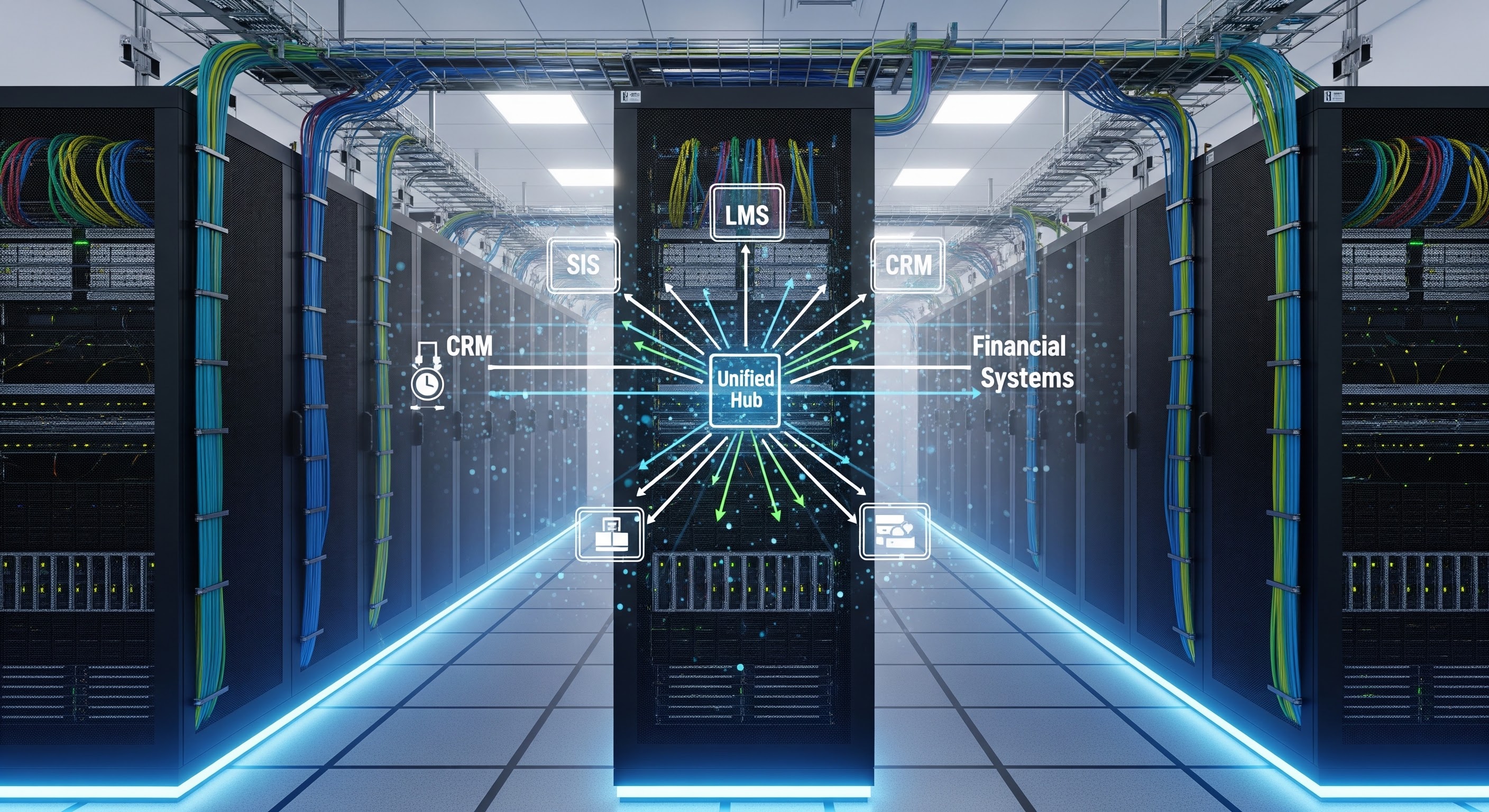


Nobody wants to be the one who asks the uncomfortable question at the strategy retreat. So let me ask it here, where you can think it through without anyone watching: what happens to your institution if the AI bubble deflates?
This isn't a fringe concern. As of early 2026, AI-focused ed-tech companies have collectively raised tens of billions of dollars in venture capital over the past three years. Valuations for many of these companies are premised on growth trajectories that would require transforming the entire higher education market in less than a decade. Some of them will succeed. History suggests a significant number will not.
I've been watching technology cycles in education for over two decades. The dot-com era decimated a generation of ed-tech companies that schools had built curricula and IT infrastructure around. The MOOC bubble of 2012-2014 left institutions that had made significant instructional commitments to platforms that later pivoted or folded. The question for anyone building an educational institution in 2026 isn't whether to use AI. It's how to use AI in a way that doesn't leave you stranded when the market corrects.
Let me walk you through the financial risk landscape, the most likely disruption scenarios, and the strategic hedges that separate institutions that will weather a correction from those that won't.
The Current State of AI Ed-Tech Investment: Optimism With Some Warning Signs
To understand the risk, you need to understand the investment environment. AI education technology has attracted extraordinary capital in the 2023-2026 period. According to industry data, global ed-tech investment in AI-specific applications exceeded $8 billion in 2024, with early 2026 showing continued strong deal flow despite broader technology market volatility. Several AI tutoring and adaptive learning platforms have achieved unicorn valuations based primarily on user growth metrics rather than profitability.
The warning signs embedded in that picture: most major AI ed-tech platforms are not yet profitable. Their business models depend on continued venture capital or strategic investment to fund operations while they pursue scale. Some have burn rates that give them 18-24 months of runway at current investment levels. And their pricing models — often aggressively subsidized to drive adoption — aren't necessarily sustainable at commercial rates.
For institutions that have built curriculum dependencies around specific platforms, this creates a straightforward risk: if your platform partner runs out of money, pivots its business model, or gets acquired by a company with different educational priorities, you're holding a dependency with no viable alternative ready to go.
In one institution I advised, the founding team had built their entire adaptive learning curriculum around a single AI platform whose enterprise contract included an aggressive pricing increase clause in year three. The vendor had been acquired by a private equity firm between the contract signing and year two. By year three, the pricing had increased 340%. They renegotiated, but it cost them months of leadership attention and a painful budget reallocation.
Lessons from the Dot-Com Era: What Higher Education Actually Learned
The late 1990s dot-com boom produced a generation of ed-tech investments that, by 2001-2003, had largely collapsed. Platforms like eCollege, Fathom, and Caliber Learning attracted significant institutional investment and curriculum commitments before the market corrected. The institutions that recovered fastest shared a common characteristic: they had maintained institutional capability alongside their platform dependencies. They hadn't outsourced their entire approach to teaching a subject to a vendor they didn't control.
The ones that struggled had made deeper commitments: curriculum designed specifically around platform-specific features, faculty trained exclusively on tools that were suddenly unavailable, assessment systems tied to proprietary data formats that became inaccessible. The transition costs were enormous — not just financially, but in terms of faculty morale, student experience, and institutional credibility.
The MOOC boom produced a similar pattern a decade later, though less dramatic. Coursera, edX, Udacity, and their peers attracted hundreds of millions in investment and hundreds of institutional partnerships. When the market corrected around 2014-2015 and several of these platforms pivoted from free/open models to fee-based ones, institutions that had publicized partnerships found themselves explaining why a prominently marketed initiative was being scaled back or redirected.
The structural lesson from both episodes: technology market cycles in education follow the same patterns as broader technology markets, but the institutional consequences are often more severe because educational commitments — to students, to accreditors, to faculty — are harder to walk back than typical business relationships.
Venture Capital Trends and the AI Startup Sustainability Question
Understanding VC dynamics helps you assess vendor risk. The AI ed-tech investment environment in 2025-2026 has several characteristics that warrant careful attention.
Concentration Risk in Core Infrastructure
A small number of foundational AI companies — primarily OpenAI, Anthropic, Google DeepMind, and Meta AI — provide the underlying models that most AI ed-tech platforms are built on. If any of these foundational providers changes its pricing, restricts API access, or shifts its business focus, the downstream effect on ed-tech platforms can be immediate and severe. In 2023, several ed-tech startups built on early OpenAI API pricing found their unit economics shattered when API costs increased. The platforms that survived had either built proprietary models or had negotiated enterprise agreements that protected their cost structure.
For institutions: ask every major AI vendor about their foundational model dependencies. If they're built entirely on a single third-party API with no proprietary model development and no enterprise agreement protecting their costs, that's a meaningful vulnerability.
Burn Rate Transparency
Most AI ed-tech companies are privately held, which means you're rarely getting fully transparent financial information. But there are signals you can evaluate: funding history and timing (a company that last raised capital 18+ months ago is more exposed to market shifts), pricing models (deeply subsidized pricing relative to market rates is often funded by VC runway, not sustainable unit economics), and staffing patterns (rapid executive turnover often signals financial stress).
Before signing a multi-year contract with any AI platform vendor, ask directly for information about their financial runway and their path to profitability. A vendor that can't answer this question clearly is a vendor you should be cautious about building curriculum dependencies around.
The Acquisition Risk
Some AI ed-tech companies won't go bankrupt — they'll get acquired by private equity or strategic buyers with different priorities. This can be equally disruptive. When a PE firm acquires an AI tutoring platform, the typical result is pricing pressure (rates go up), feature rationalization (popular but expensive features get cut or paywalled), and support degradation (customer success teams get restructured). The educational mission that attracted you to the platform in the first place often takes a backseat to EBITDA optimization.
Contract provisions that protect against acquisition risk: change-of-control clauses that allow contract termination at original terms if the vendor is acquired, price protection provisions that cap increases for contract duration regardless of ownership changes, and explicit commitments that acquired entities will honor existing educational terms.
Institutional Budgeting and Sunk-Cost Exposure: The Hidden Risk
Here's the risk that most founders underestimate because it develops gradually: sunk-cost exposure in AI investments. Over time, as you invest in curriculum designed around specific AI tools, faculty training on proprietary platforms, IT infrastructure built to integrate with particular vendors, and marketing built around specific AI capabilities, the cost of transitioning away from any of those commitments grows. What started as a vendor relationship becomes a dependency, and the dependency becomes a strategic constraint.
I've watched this play out in institutional planning at multiple client sites. The pattern is consistent: in year one, the vendor relationship is evaluated rationally — is this tool producing good outcomes? In year two, after significant curriculum investment, the evaluation shifts — can we afford to switch even if outcomes are disappointing? By year three, after full faculty training and deep LMS integration, the honest answer is often: not without major disruption.
The Full Cost of AI Investment: What Most Budgets Miss
The number that doesn't appear in this table is transition cost — what you spend if you need to migrate away from a platform, retrain faculty on a replacement, and rebuild curriculum around different tools. Based on client experience, these costs typically run 50-150% of your original implementation costs. That's the sunk-cost exposure that builds up invisibly over time.
Enrollment Disruption: When AI Becomes the Competition
There's a second risk scenario that's less discussed but potentially more significant: not vendor failure, but competitive displacement. What happens to enrollment if sophisticated AI learning platforms become a credible substitute for formal education, not just a tool within it?
This isn't a distant scenario. Khan Academy's Khanmigo, Synthesis, and several other AI-powered learning platforms are already demonstrating that specific subjects can be taught effectively through AI-mediated instruction with minimal human oversight. As the quality and scope of these tools improves, the question becomes: for which learner types, in which subject areas, will they become a preferred alternative to enrollment in a formal institution?
The most vulnerable segment: working adults with narrow, specific skills gaps who are highly price-sensitive. If an AI platform can help a working adult pass a professional certification exam in eight weeks for $200, the value proposition of a semester-long course at $3,000+ comes under real pressure for that specific learner in that specific context.
This doesn't mean formal education is doomed — it isn't. But it does mean that institutions built primarily around delivering information and structured exposure to content are more vulnerable to AI displacement than institutions built around community, mentorship, practical application, accreditation, and career credentialing. The latter set of value propositions is much harder to replicate through an AI platform.
The Credential-Protection Moat
The strongest protection against AI competitive displacement is the credential itself — specifically, credentials that employers and licensing bodies require and that can only be obtained through accredited programs. Nursing licensure. Teaching certifications. Accounting designations. Legal licenses. These credentials require formal education through accredited institutions, and AI platforms can't grant them.
For founders: build your value proposition around credentialing, accreditation, and outcomes that require formal institutional validation. Use AI as a tool within that framework, but make sure the fundamental reason students enroll isn't something an AI platform can offer independently. This is both good institutional strategy and good risk management.
Scenario Planning: Three Futures and How to Prepare for Each
Effective risk management requires thinking through specific scenarios rather than just acknowledging general uncertainty. Here are three plausible futures and the strategic implications of each.
Scenario 1: Gradual Consolidation (Most Likely)
The AI ed-tech market doesn't crash — it consolidates. Three to five major platforms survive and grow, while dozens of smaller players are acquired or shut down. Prices for surviving platforms increase as competition decreases. Some innovative tools disappear; others get absorbed into larger platforms with reduced feature sets.
Institutional preparation: Avoid deep dependencies on sub-scale vendors. Focus procurement on platforms with demonstrated financial sustainability. Negotiate strong data portability and pricing cap provisions. Maintain the institutional capability to deliver core educational functions without any single vendor. Review your AI vendor portfolio annually and proactively manage vendor risk.
Scenario 2: Rapid Market Correction (Moderate Probability)
A significant VC pullback — triggered by broader market conditions, a high-profile AI safety incident, or regulatory action — causes rapid contraction in AI ed-tech investment. Several significant platforms become unavailable within a 12-24 month window. Institutions with deep dependencies face real disruption.
Institutional preparation: Maintain human-delivered alternatives for all critical instructional functions. Don't eliminate faculty positions based on AI tool deployments — AI tools can disappear; faculty expertise can't be immediately recreated. Build your AI integration around augmentation rather than replacement. Maintain IT infrastructure that can function independently of third-party AI tools.
Scenario 3: Transformative Disruption (Lower Probability, High Impact)
AI-delivered instruction becomes genuinely superior to human instruction for a significant subset of subjects and learner types. Enrollment in traditional programs for those subjects declines materially. Institutions that haven't built differentiated value propositions beyond content delivery face enrollment crises.
Institutional preparation: This scenario requires the most fundamental strategic response: invest heavily in the aspects of educational experience that AI genuinely cannot replicate — community, mentorship, hands-on practical training, credentialing, career networks. If your institution's primary value proposition is 'we teach you X,' consider how that proposition holds up if AI can teach X effectively. If the honest answer is 'it doesn't hold up,' that's a signal to reframe your value proposition now.
Strategic Hedges: What Financially Resilient Institutions Do Differently
The good news: the risk management strategies for AI vendor exposure are well-established. They're the same strategies that have protected institutions through every previous technology market cycle. The challenge is that implementing them requires some discipline against the current enthusiasm for deep AI integration.
The 30% Rule for Core Curriculum Dependencies
A useful heuristic: no more than 30% of any core curriculum unit should be dependent on a single AI vendor's platform. This isn't a hard regulatory requirement — it's a risk management discipline. If a single platform disappears, 30% dependency means disruption; 80% dependency means crisis. Document your current dependency ratios for every AI tool in your curriculum and flag any that exceed this threshold.
Build Institutional AI Literacy, Not Just Platform Proficiency
There's a meaningful difference between faculty who can use Platform X effectively and faculty who have genuine AI literacy — who understand how AI works at a conceptual level, can evaluate different tools, and can adapt when the specific tool they're using changes. The latter are resilient to vendor disruption; the former are not.
Your faculty professional development investment should prioritize AI literacy over platform proficiency. Teach faculty how to think about AI, evaluate AI outputs, and design AI-integrated learning experiences — in ways that are transferable across platforms. Platform-specific training should be a small component of a larger AI literacy program.
Multi-Vendor Architecture
Don't build your AI infrastructure around a single vendor relationship. Use different tools for different functions — AI tutoring from one vendor, analytics from another, content generation tools from a third. This is more complex to manage than a single-vendor approach, but it dramatically reduces your exposure to any single vendor's financial health or business decisions.
Contract Protections That Actually Matter
- Data portability provisions: Your data leaves with you in a portable format on 30 days' notice, at no cost to you.
- Change-of-control clauses: You have the right to terminate the contract at original terms within 90 days of any acquisition.
- Price caps: Annual price increases capped at a specified percentage (3-5%) for the contract term regardless of ownership changes.
- Service continuity guarantees: Vendor commits to 12 months' notice before any service discontinuation, with data export support.
- Escrow provisions for critical tools: Source code or model weights held in escrow, accessible to institution if vendor ceases operations.
Most vendors will push back on some of these provisions. How hard they push back — and which provisions they won't accept at all — is useful information about their business intentions and their confidence in their own sustainability.
The Investment Thesis That Actually Holds Up
Here's my honest assessment for investors building new educational institutions in 2026: the AI tools that represent the safest institutional investments are those that enhance what you're already good at, rather than those that substitute for capabilities you're still building.
A new institution that uses AI to give students faster feedback on writing assignments, to provide additional practice opportunities in clinical simulation, or to help faculty identify students who are struggling early enough to intervene — that's a sensible use of AI that creates value regardless of which specific platform is used. The underlying educational function survives vendor disruption because it's built on institutional capability, not vendor dependency.
A new institution that has built its entire instructional model around a specific AI platform, eliminated traditional faculty-student interaction in favor of AI-mediated learning, and based its financial projections on AI-driven cost reductions — that institution is exposed in ways that a modest market correction could make very painful.
The distinction isn't about being pro-AI or anti-AI. It's about being strategically disciplined in how you build institutional dependencies. The institutions that will thrive across the coming years — whatever the technology market does — are the ones that used AI to strengthen their core educational mission rather than substitute for it.
Key Takeaways for Investors and Founders
1. AI ed-tech market concentration and unsustainable valuations create real vendor risk for institutions with deep platform dependencies. Acknowledge this risk explicitly in your strategic planning.
2. Historical technology market cycles in education — dot-com, MOOC boom, LMS consolidation — consistently show that institutions with maintained institutional capability recover faster from vendor disruptions than those with deep dependencies.
3. Build multi-vendor architecture for AI tools. No single vendor should control more than 30% of a core curriculum function.
4. Faculty AI literacy (transferable across platforms) is more resilient than platform proficiency (specific to one tool). Invest accordingly in professional development.
5. Contract provisions matter: negotiate data portability, change-of-control clauses, price caps, and service continuity guarantees before signing any multi-year AI vendor agreement.
6. Enrollment disruption risk is real but manageable: build your value proposition around credentialing, community, mentorship, and practical application — things AI platforms can't replicate.
7. Scenario planning for three futures (gradual consolidation, rapid correction, transformative displacement) should inform your current strategic choices about AI investment depth.
8. The safest AI investments augment what you're already good at rather than substitute for capabilities you're still building.
Glossary of Key Terms
Frequently Asked Questions
Q: How do I evaluate whether an AI vendor is financially sustainable before signing a multi-year contract?
A: Several signals are accessible even for privately held companies. Review the vendor's funding history — when did they last raise capital, and from whom? Top-tier institutional investors (not just unnamed seed funders) provide some validation. Ask directly about runway, path to profitability, and enterprise contract terms. Check whether the vendor's pricing model makes commercial sense without subsidy — deeply discounted rates relative to market are often funded by VC runway, not sustainable unit economics. Get references from institutions that have been customers for 2+ years and ask specifically about pricing stability. And always consult your attorney about financial representations in vendor agreements.
Q: What specific contract provisions should I prioritize when negotiating with AI vendors?
A: In rough order of importance: data portability provisions that allow you to export your institution's data in a portable format on short notice at no cost; change-of-control clauses giving you termination rights at original terms if the vendor is acquired; price caps that limit annual increases regardless of ownership; service continuity guarantees requiring 12 months' notice before discontinuation; and escrow provisions for critical tools holding source code or model access in trust. Most vendors will push back on some of these. How they respond tells you something about their business intentions and confidence in their own sustainability.
Q: Is it realistic to maintain human-delivered alternatives for all AI-enhanced courses?
A: Full redundancy isn't the goal — that would eliminate the efficiency benefits of AI integration entirely. What you're maintaining is capability: faculty who know how to teach the subject matter effectively without AI tools, and instructional designs that don't rely exclusively on specific platform features. In practice, this means ensuring your faculty professional development builds genuine subject-matter depth alongside AI tool proficiency, and that your course designs maintain human-instructable components even in heavily AI-integrated programs. If an AI platform becomes unavailable tomorrow, you want to be scrambling to adjust, not facing a curriculum crisis.
Q: How should I think about the competitive displacement risk from AI learning platforms?
A: Focus on what's genuinely hard to replicate. AI platforms can deliver information effectively and increasingly can provide personalized feedback. What they can't replicate: the social and professional networks students build in formal educational settings; the mentorship relationships that shape career trajectories; hands-on practical training in physical environments; the credential that employers and licensing bodies require; and the campus experience that many students value for its own sake. Institutions that anchor their value proposition in these elements are far more resilient to AI competitive displacement than those whose primary value is 'we teach you X,' where X is something AI can also teach.
Q: What's a reasonable AI investment budget for a new institution, given these risks?
A: For a new institution in 2026, budget $50,000 to $150,000 in year one for core AI integration (platform licenses, IT infrastructure, initial curriculum development, and faculty training) depending on program count and scope. But here's the risk management piece: plan for 20-30% higher costs if you need to migrate platforms in years two to four, and build that scenario into your financial projections. Also budget for governance infrastructure — the AI committee time, policy maintenance, and vendor management that's often treated as 'free' because it's absorbed by existing staff time, but is actually a real institutional cost. Institutions that budget for governance alongside tools consistently report smoother implementations.
Q: Should I avoid AI tools with heavy VC funding because of bubble risk?
A: Not categorically — some of the best-designed tools in the market are VC-backed. What you're assessing is whether the vendor has a credible path to sustainable unit economics, not whether they've taken venture capital. The questions to ask: Is the pricing model realistic at commercial rates, or is it subsidized by investor capital? Does the vendor have enterprise customers paying full commercial rates? What's their plan for profitability, and what does that imply for pricing? A well-funded startup with a credible business model is not inherently more risky than a bootstrapped company — and may be significantly more capable of developing and maintaining its tools.
Q: How has the dot-com era's impact on higher education actually shaped current practices?
A: Institutional memory from the dot-com collapse shaped two enduring practices in higher education technology procurement: greater emphasis on vendor due diligence and financial stability evaluation, and stronger contract protections including data portability provisions. Ironically, some of that institutional memory has faded in the current AI enthusiasm, with institutions making vendor commitments that would have seemed imprudent 15 years ago. The pattern repeating itself is the combination of genuine technological capability (AI is genuinely powerful, as internet technologies genuinely were) with business model speculative excess (current AI valuations in many cases exceed what sustainable unit economics justify, as internet company valuations did in 1999).
Q: What happens to students if an AI platform we're using goes bankrupt mid-semester?
A: This is a continuity-of-education question that your operational risk planning needs to address explicitly. If a platform you're using for core instructional delivery becomes unavailable suddenly, you need an immediate response plan: what do you do in the next 48 hours, the next week, and the next semester? For accreditation purposes, you also need to be able to demonstrate that you can maintain educational continuity for enrolled students regardless of vendor status. Build this contingency into your institutional continuity planning, and make sure it's documented. Accreditors increasingly ask about technology continuity as part of institutional effectiveness review.
Q: What's the relationship between AI vendor risk and accreditation?
A: Accreditors are increasingly attentive to institutional dependencies on third-party technology. If your accreditor reviews your institution and finds that your AI tools are central to your instructional model but you have no continuity plan if those tools become unavailable, that's a finding — not a fatal one, but a compliance gap. The SACSCOC, HLC, and WSCUC standards all require institutions to demonstrate that they can maintain educational quality and continuity for enrolled students. Building AI vendor risk management into your institutional effectiveness plan isn't just good business — it's an accreditation requirement.
Q: Is there a 'safe' AI investment strategy for a new educational institution?
A: 'Safe' is relative, but the risk management principles are clear: use AI to augment human educational capability rather than substitute for it; maintain the institutional capability to deliver core functions without any single vendor; diversify across multiple vendors with strong contract protections; invest more in portable skills (faculty AI literacy) than platform-specific training; and anchor your value proposition in what AI genuinely can't replicate — credentialing, community, mentorship, and hands-on practical training. Following these principles won't insulate you from all market disruption, but it will dramatically reduce the consequences of vendor failures or market corrections.
Current as of March 2026. Ed-tech market conditions, vendor financial positions, and regulatory frameworks evolve rapidly. Consult current sources and qualified advisors before making institutional investment decisions.
If you're ready to explore how EEC can de-risk your AI-integrated launch, reach out at sandra@experteduconsult.com or +1 (925) 208-9037.