

QUICK ANSWER
The Florida CIE application process is a six-phase regulatory review that moves an applicant institution from initial Commission inquiry to a printed Provisional License in roughly four to six months.
The process is governed by Chapter 1005, Florida Statutes, and Chapter 6E, Florida Administrative Code. The Commission for Independent Education votes on applications at bimonthly meetings. No surety bond is required, but fees scale by enrollment and degree level.
If you are planning to open a private college, university, or career school in Florida, the Florida CIE application process is the gate you have to pass through before you can advertise a single program, enroll a single student, or hold a single class. This walkthrough takes you through that process step by step — what gets filed, when, with whom, and at what cost — using only the rules published by the Florida Department of Education and the Commission for Independent Education.
This post is a companion to our broader CIE new institution application pillar guide. Where that guide explains what the CIE is and why Florida structures licensure the way it does, this post is focused on the process itself: the six phases, the documents, the meeting cycle, the fee schedule, and the most common reasons new applications get sent back. Expert Education Consultants has guided 115+ institutions through state authorization, including dozens of CIE Provisional License approvals, and the patterns below are drawn directly from current Florida statute and the published Rule 6E framework.
The Florida CIE Application Process at a Glance
The Florida CIE application process is the state-mandated review by which a new nonpublic postsecondary institution obtains its initial Provisional License to operate in Florida. The Commission for Independent Education, an independent body housed within the Florida Department of Education, administers the process under Chapter 1005, Florida Statutes, and Chapter 6E, Florida Administrative Code.
There are three license tiers in Florida, and every new school enters at the bottom of the ladder:
Two facts about this process surprise most new founders. First, accreditation is not a prerequisite for licensure — many Florida institutions hold a Provisional License before they have any accreditor relationship. Second, the Commission does not vote on applications on a rolling basis. It votes at six scheduled meetings per year, which means the application deadline you miss decides the meeting you wait for.
The Six Phases of the Application
The Florida CIE application moves through six phases, from pre-filing consultation to printed Provisional License. The phases are sequential, not parallel — each one must be substantially complete before the next begins.
- Pre-filing consultation (months -6 to -4). Under Rule 6E-2.001, representatives of a new institution must confer with Commission staff at least six months prior to the desired opening date. This is the inquiry stage. You contact CIE, signal intent, and get oriented on the forms, the fee structure, and the meeting cycle.
- Application package preparation (months -4 to -1). You assemble the full Form 101 package — corporate documents, personnel forms, criminal background submissions, organizational chart, program outlines, financial statements, the institution catalog, the enrollment agreement, the lease for your physical location, and any board-of-nursing or other regulatory pre-approvals that some programs require. This is where most new applicants spend the bulk of their preparation time.
- Submission and intake review (week 0 to week 4). You submit the completed package to the Commission at 325 West Gaines Street, Suite 1414, Tallahassee, FL 32399-0400 (or via the CIEInfo mailbox for electronic submission). A program specialist is assigned, and the intake review begins. If the package is incomplete, you receive a deficiency letter and the clock effectively pauses.
- Approved Applicant status (weeks 4 to 12). Once the application is deemed complete, the institution is placed on Approved Applicant status, as defined under Rule 6E-2.001. Important: Approved Applicant status is not a license. You still cannot advertise, recruit, accept fees, or hold classes. You are simply in the queue, on track for a Commission vote.
- Commission vote (the next scheduled meeting). The Commission meets six times a year — January, March, May, July, September, and November. Your application is placed on the agenda for the next meeting your file is complete in time for. The Commission grants approval, conditional approval, deferral, or denial. A school representative should attend the meeting to address questions.
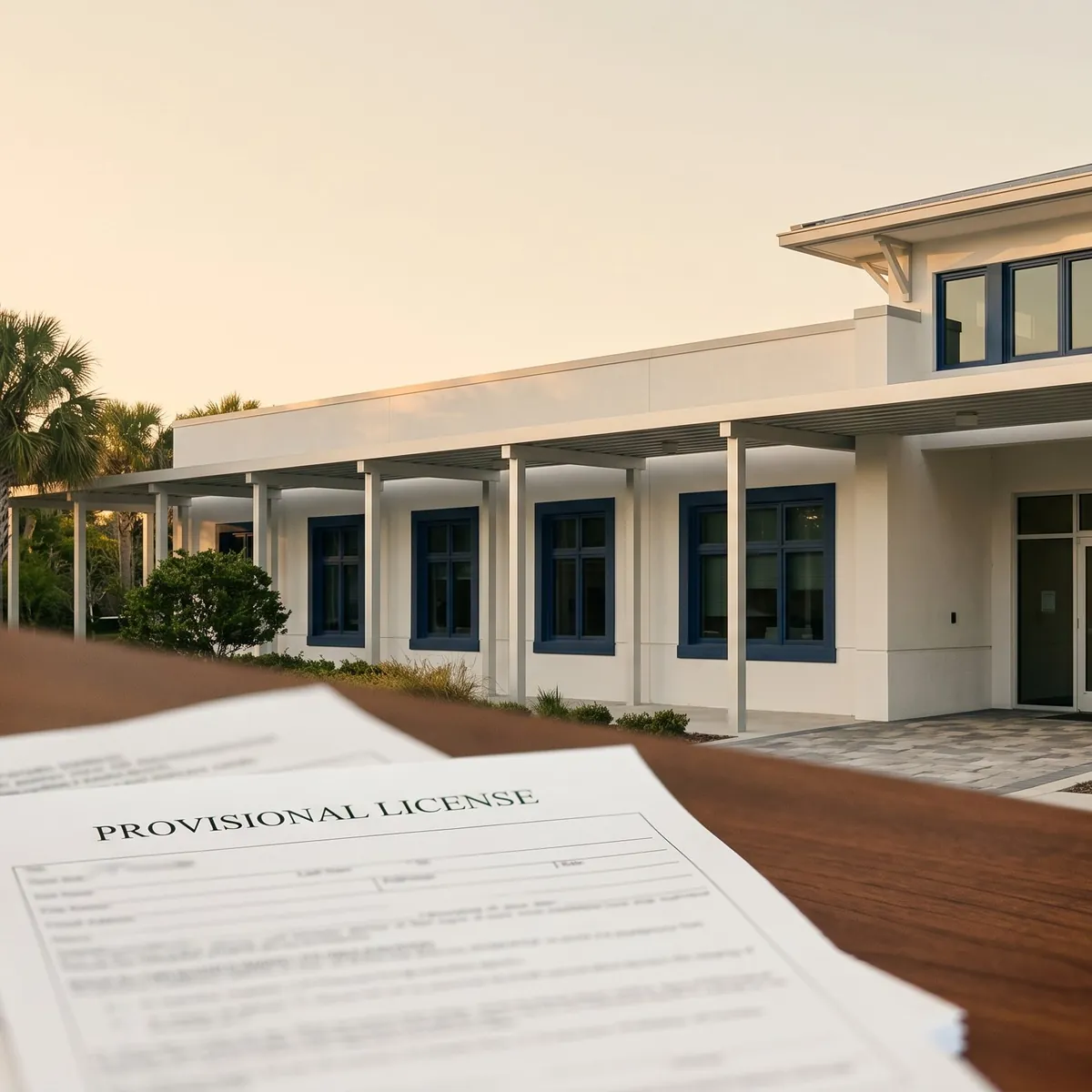
- Issuance of the printed Provisional License. Following an approval vote, the Commission issues the printed Provisional License. As the Florida Department of Education states plainly: an institution may not advertise, recruit students, accept any fees or tuition monies, or hold classes until the printed Provisional License is received. The moment that paper arrives, your operating clock starts.
For a deeper view of what the Provisional License actually authorizes — and what it doesn't — see our Florida CIE Provisional License playbook.
What You Must Submit (Document Checklist)
The Florida CIE application package is anchored by Form 101 (Application for Provisional License) plus a defined set of supporting documents. The standards by which the application is evaluated are primarily Rule 6E-1.0032 (Fair Consumer Practices) and Rule 6E-2.004 (Standards and Procedures for Licensure).
The core enclosures required under Form 101 are:
- Secretary of State documentation — proof of active corporate status and fictitious name registration with the Florida Department of State.
- Form 402 (Instructional and Administrative Personnel Form) — one for each owner, administrator, and instructor.
- Transmittal of Criminal Justice Information Fee Form — required for each owner and administrator.
- Organizational chart — one copy of the institution's structure.
- Program Outline — one for each proposed program.
- Form 401 (Faculty Listing) — Director of Education plus every faculty member who will deliver instruction, with credentials matching the catalog.
- Institution Catalog — covering general information, admissions, academic policies, satisfactory academic progress, financial services, refund policy, student services, student rights, calendar, tuition and fees, faculty and administrative personnel, and distance education policies if applicable.
- Enrollment Agreement — the binding contract that mirrors the catalog.
- Financial Statement — current and projected, demonstrating the institution can operate through the Provisional period.
- Lease agreement — for the physical location where the institution will operate.
- Board or regulatory agency approvals — for any program that requires additional state board sign-off (for example, Florida Board of Nursing approval for nursing programs).
Nontraditional institutions — primarily distance education programs — must additionally meet Rule 6E-2.0041, which adds requirements specific to online delivery, student verification, and learner support.
CIE Fees, Costs, and the Student Protection Fund
Florida CIE fees are calibrated to institutional scale, not flat. The two main categories are the Base Fee and the Workload Fee, both set under Rule 6E-4.001 of the Florida Administrative Code.
The Base Fee is assessed at one of six levels based on anticipated Florida enrollment for new institutions, or actual enrollment for existing ones. According to Rule 6E-4.001, the Base Fee schedule runs from $500 at Level 1 (0–100 students) up through $5,000 at Level 6. New institutions are assessed based on projected first-year Florida enrollment, which you declare in the application package.
In addition to the Base Fee, several other charges apply:
- Provisional License fee — $2,000 base for nondegree institutions; $3,000 base plus $200 per program for new degree-granting institutions, per the current Rule 6E-4.001 schedule.
- Annual Licensure of Recruiting Agents — $200 per agent (nontransferable).
- Criminal Justice Information Investigation — $50 per owner or administrator background screening.
- Student Protection Fund — Initial — $500 payment from nondegree institutions before the initial Provisional License is issued, under Rule 6E-4.005.
- Student Protection Fund — Annual — for nondegree institutions, an annual assessment equal to .0005 of Florida-generated tuition revenue.
One thing Florida does not require: a surety bond. Unlike California (BPPE) and several other state regulators, the CIE relies on the Student Protection Fund and the Institutional Assessment Trust Fund rather than per-institution bonds. For founders modeling total launch cost, that absence matters. For broader budget context, our breakdown of the cost to open a university walks through the full project economics beyond licensure.
Specific EEC engagement pricing is a separate conversation. What we will say here is that the Florida CIE filing fees themselves are a small fraction of total launch cost; the larger investment is in the catalog, the program outlines, the financials, and the personnel documentation that the filing fees attach to.
The Commission Meeting Cycle and Application Deadlines
The Commission for Independent Education meets six times a year, and every application is reviewed at a scheduled meeting — never on a rolling daily basis. Per the Commission's published agendas, the 2026 meeting dates and corresponding application deadlines are:
What this cycle means in practice: missing a deadline by a single day pushes your Commission vote two full months, and your operating start potentially three or four months. Founders who treat the deadline as soft routinely lose a planned fall start to a deferred winter Commission meeting. The deadline is the deadline.
Commission meetings are open to the public and are broadcast live on the Florida Department of Education's webcast. School representatives should attend their scheduled meeting and be available to answer Commission questions on the record.
What Triggers a Denial — and How to Avoid It
Most Florida CIE applications are not denied outright — they are deferred, deficient, or sent back for additional information. The pattern of avoidable problems is consistent enough to map. The most common reasons applications fail to advance on first review include:
- Incomplete personnel documentation. Missing Form 402s, mismatched credentials between the Form 401 faculty list and the catalog, or unsigned Criminal Justice Information Fee forms for any owner or administrator.
- Catalog that doesn't meet Rule 6E-2.004 standards. Missing refund policy, missing student rights statements, missing academic calendar, or distance education policies absent in a program that includes distance learning.
- Financial statements that don't demonstrate operating capacity. Projections that don't account for the Provisional period, missing source-of-funds documentation, or pro forma figures that the Commission staff finds non-credible.
- Program outlines that don't justify the credential awarded. Clock-hour or credit-hour calculations that don't align with the credential level claimed, or curricula that don't map to the stated occupational or academic outcomes.
- Failure to secure required board-level approvals before filing. Most often this involves nursing (Florida Board of Nursing), allied health, or other professionally licensed fields where program approval is a precondition the Commission expects to see referenced in the file.
- Missing the pre-filing consultation. Rule 6E-2.001 requires applicants to confer with Commission staff at least six months before the desired opening date. Skipping this step is rarely fatal on its own, but it tends to correlate with the other deficiencies above.
The Florida market rewards prepared applicants. Florida is the best state to open a new university for several reasons — favorable demographics, strong international student pipelines, an established religious-exemption pathway, and a Commission that is firm but consistent. The flip side is that the documentation standards are real. Schools that arrive prepared, with a complete catalog, current financials, and a clean personnel file, generally clear the cycle in 4–6 months. Schools that file thin packages can sit in deficiency status for two cycles or more.
After Provisional License Approval
Once the printed Provisional License is in hand, the institution may begin operating — but operating under a Provisional License is different from operating under an Annual License. Under Rule 6E-2.002(f), a Provisional License holder may advertise, recruit students, accept tuition, and hold classes. However, the institution may not implement any substantive change (such as a change of ownership, a change in credential level, or a relocation greater than 45 miles) until it transitions to Annual License or License by Means of Accreditation status. Newly degree-granting institutions also may not award the new degree credential during the Provisional period.
The first year of operation under the Provisional License is a working audit. The Commission monitors compliance, reviews data submissions, and assesses whether the institution is ready to move to Annual License status. Founders who treat the Provisional year as just "operating" — rather than as a structured compliance demonstration — are the ones who get extended, deferred, or downgraded.
For a practical, week-by-week look at what to prioritize once the Provisional License lands, see our companion post: "CIE provisional license — now what?".
Frequently Asked Questions
What is the Florida CIE application process?
The Florida CIE application process is the regulatory review by which a new nonpublic postsecondary institution obtains its initial Provisional License to operate in Florida. It is administered by the Commission for Independent Education within the Florida Department of Education, governed by Chapter 1005, Florida Statutes, and Chapter 6E, Florida Administrative Code. The process takes approximately 4–6 months from a complete application package to a Commission vote.
What is state authorization for colleges?
State authorization is the legal authority a postsecondary institution must hold from the state in which it physically operates or delivers programs. In Florida, that authority is the CIE license issued under Chapter 1005, Florida Statutes. Without state authorization, an institution cannot lawfully advertise, enroll students, accept tuition, or grant credentials in that state. State authorization is also a prerequisite for federal Title IV financial aid eligibility and for participation in interstate distance-education reciprocity through NC-SARA.
How is state authorization different from accreditation?
State authorization is granted by a state agency (such as the Florida CIE) and authorizes the institution to legally operate in that state. Accreditation is granted by a private, U.S. Department of Education–recognized accreditor and certifies that the institution meets nationally accepted academic and operational standards. State authorization is mandatory; accreditation, while not legally required for licensure in Florida, is required for federal financial aid eligibility, for SEVP certification to issue I-20s, and for License by Means of Accreditation status. Most institutions pursue both, in sequence.
Do online colleges need state authorization in every state?
Online colleges generally need state authorization in their home state and must comply with the authorization or reciprocity rules of every other state where they enroll students. The standard mechanism for interstate compliance is participation in the National Council for State Authorization Reciprocity Agreements (NC-SARA). Florida is an NC-SARA member state, and Florida-licensed institutions in good standing may apply to operate distance education programs across other NC-SARA states without separately seeking authorization in each. Institutions enrolling students in non-SARA states (currently California, for example) must comply with that state's rules separately.
What is a religious exemption?
A religious exemption, in the Florida context, is a Letter of Exemption issued under Section 1005.06(1)(f), Florida Statutes, that allows a qualifying religious institution to grant religious degrees without holding a CIE license. To qualify, the institution must restrict its programs to religious instruction and use religious modifiers in the titles of degrees it confers. Religious exemption is a narrow pathway, not a general workaround for CIE licensure, and the application process is administered separately by the Commission's Religious Institutions Page.
Ready to begin?
For more information about how to navigate the Florida CIE application process for your new institution, contact Expert Education Consultants (EEC) at +1 (925) 208-9037 or email sandra@experteduconsult.com
.webp)