

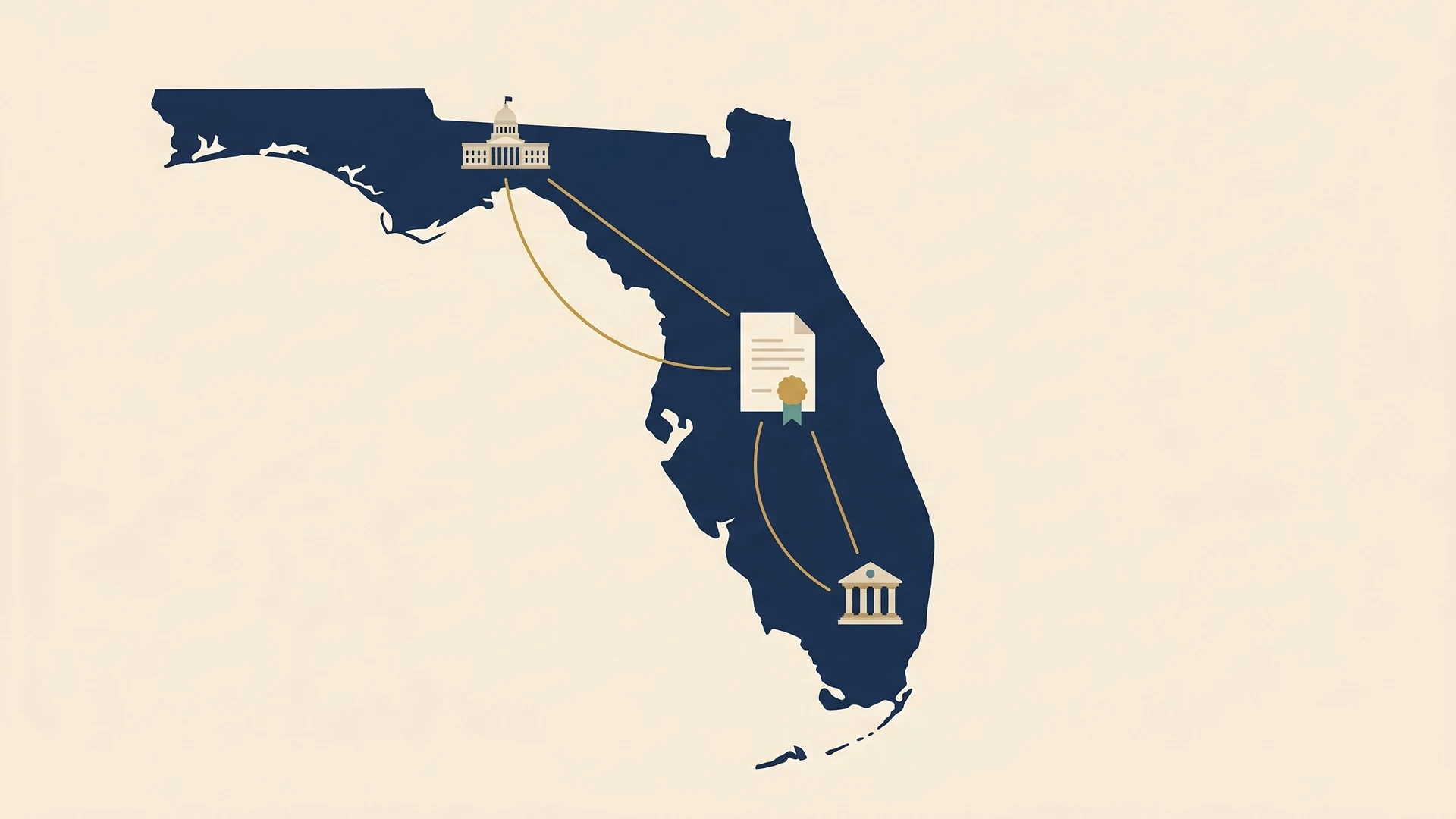
To open a college in Florida, you must obtain a license from the Florida Commission for Independent Education before you enroll students, advertise, or hold classes. Most new institutions begin with a Provisional License, then move to an Annual License or a License by Means of Accreditation. The Commission reviews your corporate structure, finances, facility, programs, and faculty against Chapter 1005, Florida Statutes — a process that typically runs six to twelve months.
Introduction
Florida is one of the most active states in the country for launching a private college or university, and for good reason: a clear statutory framework, a single state regulator, and steady demand from working-adult and online learners. If you are weighing your options, our breakdown of why Florida is the best state to open a new university covers the market case in detail. This guide handles the next question: the actual process.
Every legal step you take to open a college in Florida runs through one agency — the Commission for Independent Education, established by the Florida Legislature in 2001 and housed within the Florida Department of Education. It is the body that licenses nonpublic postsecondary institutions under Chapter 1005, Florida Statutes. You cannot advertise, recruit, accept tuition, or hold a single class until it has authorized you to operate.
The good news is that the path is well-mapped. Expert Education Consultants has guided more than 115 institutions through state authorization and launch, and the sequence below is the same one we walk founders through. Here are the steps, the costs, the realistic timeline, and the mistakes that quietly add months.
What It Takes to Open a College in Florida
Opening a college in Florida means satisfying one state regulator across five areas: corporate standing, finances, facility, programs, and people. The Commission for Independent Education evaluates each against the standards in Chapter 6E, Florida Administrative Code, before it grants a license to operate.
Two points reframe how most founders plan. First, licensure is not optional and not retroactive — you secure it before you operate, not after. Second, a Florida license is not accreditation; they are separate authorizations from separate bodies, and you will eventually want both. We cover that distinction below. The steps that follow move in the order the Commission expects to see them.
Step 1: Choose Your Institution Type and Legal Structure
Decide first whether you are opening a degree-granting institution or a non-degree institution, and whether you will operate as for-profit or nonprofit. These two decisions shape every form, fee, and standard that follows.
The degree vs. non-degree choice determines which licensure standards apply and how programs are reviewed. The for-profit vs. nonprofit choice affects governance, tax treatment, and how investors or a board participate — and it is difficult to unwind later, so make it deliberately. Our guide to opening a for-profit or not-for-profit university walks through the trade-offs. Whichever you choose, you must register the entity with the Florida Department of State and secure active corporate status and a fictitious-name registration before you apply.
Step 2: Apply for Your Florida CIE License
New institutions apply for a Provisional License — the first level of licensure and the gateway to operating in Florida. The Commission grants it when it finds the applicant in substantial compliance with its standards, and it allows you to advertise, recruit students, accept tuition and fees, and hold classes.
A Provisional License is typically granted for one year and may be extended for one additional year if you are making a good-faith effort to comply. The application packet is detailed: proof of corporate status and fictitious-name registration with the Florida Department of State, documentation of your facility lease or ownership, evidence of zoning compliance, instructional and administrative personnel forms for owners and faculty, and the required fee transmittal. Missing any one of these is the most common reason an application stalls.
This is the most procedurally dense step in the entire launch, and the place where experienced help pays for itself. The Florida CIE provisional license playbook details the standards behind each requirement, and our walkthrough of the CIE new institution application maps the packet form by form.
Florida issues three license types, and your institution moves through them as it matures:
Step 3: Meet CIE's Financial, Bond, and Facility Requirements
Plan to demonstrate financial responsibility and post a surety bond before licensure — these are not formalities the Commission waives. The agency wants evidence that your institution can deliver the education students pay for and protect tuition if it cannot.
Licensure fees are not a single flat number. They depend on factors such as your anticipated enrollment, the number of programs you offer, and whether you are degree or non-degree, with the basic fee schedule set under Rule 6E-4.001, Florida Administrative Code. You will also need a physical facility that meets local zoning, documented through your occupational license or an equivalent zoning-compliance record. Budget realistically here; underestimating the financial documentation and the bond is one of the surest ways to delay approval.
Step 4: Build Programs, Catalog, and Faculty to CIE Standards
Your programs, institutional catalog, and faculty credentials are reviewed against the Commission's minimum standards, so build them to that bar from the start. The agency does not write your curriculum, but it does verify that your programs, faculty qualifications, facilities, and student services meet the requirements in Chapter 6E, Florida Administrative Code.
In practice that means a published catalog with accurate program descriptions and policies, faculty whose credentials map to the level and content of what they teach, and student services appropriate to your model — advising, library or e-resources, and support for online and working-adult learners. Assembling this while simultaneously preparing the license application is the heaviest lift of the launch, which is why founders sequence Steps 2 through 4 in parallel rather than one at a time.
Licensure vs. Accreditation: Why You'll Need Both
A Florida license and accreditation are two separate authorizations issued by two separate bodies for two separate purposes — and conflating them is the single most expensive misunderstanding in this process. Your CIE license is state authorization to operate. Accreditation is a quality recognition granted by an independent, federally recognized accreditor.
You will need both if you intend to participate in federal Title IV student aid, enroll international students on F-1 visas, or compete on credibility with established institutions. According to the U.S. Department of Education, Title IV participation requires three things at once: state authorization, accreditation by a Department-recognized accreditor, and certification by the Department itself. Licensure gets you legally operating; accreditation unlocks federal funding and transferability. Our guide on how to become an accredited university covers what comes after your state license is in hand.
How Much It Costs and How Long It Takes
Expect the licensing process to run several months and your budget to scale with the size and complexity of your institution. There is no single sticker price, because the Commission sets fees by the variables that define your school.
On timeline, sources differ, and we flag it honestly: the Department of Education's own annual report describes provisional licensure as normally taking six to twelve months, while NC-SARA's agency profile describes a four-to-six-month processing window after a specialist is assigned. The gap usually comes down to how “start” is defined — the day you begin assembling the application versus the day a complete packet lands with a reviewer. Plan for the longer figure and treat anything faster as upside.
Common Mistakes That Delay a Florida College Launch
Most delays are self-inflicted and avoidable. The five below account for the majority of stalled applications we see:
- Operating before you're licensed. Advertising, recruiting, or holding classes before the Provisional License is issued is a compliance problem, not a head start.
- Treating licensure and accreditation as the same thing. They are different authorizations on different timelines. Planning for only one leaves you unable to access Title IV aid.
- Underestimating the finances. The surety bond and financial documentation are gating requirements, not afterthoughts.
- Submitting an incomplete packet. Missing zoning records, personnel forms, or corporate documents sends the application back and resets the clock.
- Building programs that don't map to the standards. A catalog and faculty assembled without Chapter 6E in mind get reworked under deadline pressure.
After 115+ institutional launches, Expert Education Consultants has learned that the founders who move fastest are the ones who sequence these steps in parallel and build every document to the Commission's standard the first time.
Frequently Asked Questions
What is the Florida CIE application process?
The Florida CIE application process begins with a Provisional License application submitted to the Commission for Independent Education. You file proof of corporate status, facility and zoning documentation, personnel forms, financial evidence, and the required fees; a program specialist reviews the packet; and once it is complete, you are scheduled to appear before the Commission for approval. The Department of Education describes this as normally taking six to twelve months.
How much does it cost to open a college or university?
There is no single fixed cost to open a college or university in Florida, because the Commission sets licensure fees according to your anticipated enrollment, number of programs, and degree or non-degree status under Rule 6E-4.001, Florida Administrative Code. Beyond state fees, budget for a surety bond, a compliant facility, program and catalog development, and qualified faculty. Total launch cost varies widely with the size and ambition of the institution.
How long does it take to open a college?
The Florida Department of Education states that obtaining a Provisional License normally takes six to twelve months for a new applicant. NC-SARA's agency profile cites a shorter four-to-six-month window once a program specialist is assigned to a complete application. The difference largely reflects how much preparation precedes a complete filing, so the most reliable way to shorten the timeline is to submit a complete, standards-aligned packet the first time.
Can I open a college in the US as a foreigner?
Yes — foreign nationals and foreign-owned entities can own and open a college in the United States, including in Florida, provided the institution itself meets all state licensure requirements. Ownership nationality does not bar licensure; the Commission evaluates the institution's corporate standing, finances, facility, programs, and faculty regardless of who owns it. Foreign founders should plan early for U.S. entity formation and any separate federal certifications.
Do I need accreditation to start a school?
No — you do not need accreditation to obtain a Florida license and begin operating; a Provisional License from the Commission for Independent Education is sufficient to enroll students and hold classes. Accreditation is a separate, later step. You will, however, need accreditation from a U.S. Department of Education–recognized accreditor to access federal Title IV student aid, so most institutions pursue licensure first and accreditation soon after.
Ready to Open Your College in Florida?
Opening a college in Florida is a sequence, not a single filing — and the institutions that launch cleanly are the ones that build every document to the Commission's standard from day one. For more information about how to open a college in Florida and navigate the full Commission for Independent Education licensing process, contact Expert Education Consultants (EEC) at +19252089037 or email sandra@experteduconsult.com.
.webp)