

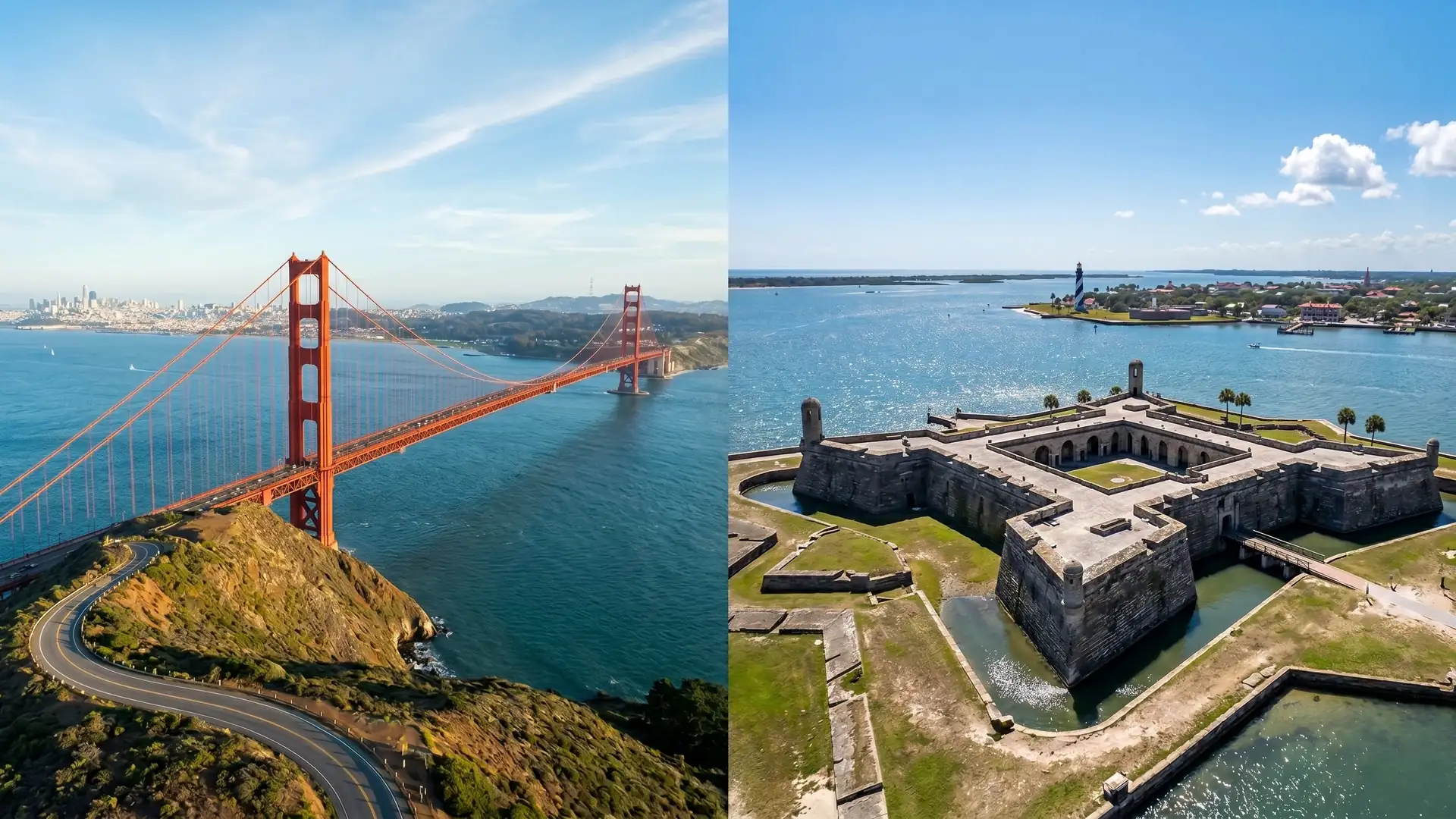
QUICK ANSWER
Florida’s Commission for Independent Education (CIE) and California’s Bureau for Private Postsecondary Education (BPPE) are both state authorization agencies, not accreditors — but they sit in different departments and run different application paths. Florida CIE operates under the Department of Education and starts new schools on a Provisional License. California BPPE operates under the Department of Consumer Affairs and issues an Approval to Operate with a $5,000 application fee. Neither one grants accreditation.
Introduction
If you are choosing where to launch a new college, two states dominate the conversation: Florida and California. Both run mandatory state licensing through a dedicated agency, and both decide whether your institution can legally enroll students, charge tuition, and grant credentials. The agencies are not interchangeable. Florida’s Commission for Independent Education and California’s Bureau for Private Postsecondary Education differ in where they sit in government, what they charge, how they review applications, and what they require after approval. Before you commit a dollar to a lease or a curriculum, read the Florida CIE provisional license guide so you understand the credential Florida actually issues first.
The stakes are real. Choosing the wrong state can add months to your timeline and tens of thousands of dollars in fees, deficiency responses, and rework. This comparison lays out exactly how Florida CIE and California BPPE differ — structure, application path, fees, financial protection, and ongoing reporting — so you can decide which fits your model. Expert Education Consultants has guided 115+ institutions through state authorization in both states, and the differences below are the ones that change real launch decisions.
Florida CIE vs. California BPPE: What Each Agency Actually Regulates
Both agencies grant state authorization — the legal permission to operate a postsecondary institution — and neither grants accreditation. The Florida Commission for Independent Education is housed within the Florida Department of Education and regulates nonpublic postsecondary institutions under Chapter 1005, Florida Statutes, and Rule 6E of the Florida Administrative Code. The California Bureau for Private Postsecondary Education is a unit of the California Department of Consumer Affairs and operates under the California Private Postsecondary Education Act of 2009, codified in the Education Code beginning at Section 94800, with regulations in Title 5 of the California Code of Regulations.
The distinction between licensing and accreditation matters because founders routinely confuse the two. The California Bureau states plainly that an approval to operate is not accreditation, and that institutions approved by BPPE must still obtain accreditation separately from a U.S. Department of Education–recognized agency for their students to access federal financial aid. Florida treats the relationship the same way. If you want a fuller primer on the licensing layer itself, our overview of state authorization for your institution walks through how it fits alongside accreditation and federal eligibility.
Side-by-Side Comparison: Florida CIE vs. California BPPE
Here is the head-to-head on the factors founders ask about most. Every figure below comes from the governing statute or agency rule, not industry estimates.
How the Florida CIE Application Process Works
Florida starts every new school on a Provisional License, and the Commission for Independent Education votes on the application at one of its regularly scheduled meetings. Under Rule 6E-2.002, an institution holding a Provisional License may advertise, recruit students, accept tuition, and hold classes — but a new degree-granting institution cannot award the new degree until it advances beyond provisional status. Commission staff review the application, itemize any deficiencies, and present a recommendation; the Commission can attach conditions that must be met before the license is granted.
Florida also offers a faster lane for established schools. Under Section 1005.32, Florida Statutes, an institution may apply for Licensure by Means of Accreditation once it has operated legally in the state for at least five consecutive years and holds institutional accreditation from a CIE-approved agency. Florida’s consumer-protection rules also cap nonrefundable admission and registration fees for Florida students at $150. For the full document-by-document walkthrough, see our guide to the CIE new institution application.
How the California BPPE Approval to Operate Works
California requires an Approval to Operate before any private institution can advertise or teach in the state, and the Bureau runs two distinct application paths. A non-accredited institution files the Application for Approval to Operate an Institution Non-Accredited and undergoes BPPE’s full review. An institution that already holds recognized accreditation may apply by means of accreditation, an abbreviated path. Under Education Code Section 94887, the Bureau grants approval only after it independently verifies the application — including through a site visit — and confirms the applicant meets the minimum operating standards.
California’s fees are set by statute. Education Code Section 94930.5 sets a $5,000 application fee for a new approval to operate, $750 for approval by means of accreditation, and $3,000 to add a branch. Renewal runs $3,500 for a main campus and $500 for an institution approved by means of accreditation. On top of those, each institution pays an annual fee equal to 0.55 percent of its California gross tuition revenue, with a floor of $2,500 and a ceiling of $60,000. If your model is California-first, our walkthrough on how to open a private California university details the documents BPPE expects.
Fees, Financial Protection, and Annual Reporting Compared
The biggest financial difference is structural: California charges flat statutory fees plus a revenue-based annual fee, while Florida uses a base-plus-workload fee framework under Rule 6E-4.001 that scales with institution type and program count. A small single-program school can pay less in Florida; a larger multi-program institution should model both carefully.
Student protection also works differently. California requires participation in the Student Tuition Recovery Fund under Education Code Section 94923 — a fund that reimburses California-resident students for losses if a school closes. The Bureau reduced the STRF assessment to $0 per $1,000 of institutional charges in 2024, and it remains $0 under the current regulations; even so, approved institutions must still file quarterly STRF reporting forms. Florida does not run an equivalent statewide recovery fund for CIE-licensed schools; instead it relies on a financial-responsibility review at licensure and ongoing fair-consumer-practice rules. Both states require an annual report — California under Education Code Section 94934, Florida under CIE rules — and missing those filings is one of the most common ways approved schools fall out of compliance.
Which State Is Right for Your Institution?
Choose based on your physical footprint, your model, and your timeline — not on which agency is “easier,” because neither is. If you will have a campus and staff in Florida, CIE is your path; if you will have a physical presence in California, BPPE is yours. Online-first founders should remember that licensing is triggered by physical presence and by enrolling that state’s residents, so many institutions end up authorized in more than one state over time.
A few practical guideposts:
- Pick Florida CIE if you want a base-plus-workload fee structure that scales with your size and a defined Provisional License you can launch on while you build toward an Annual License or Licensure by Means of Accreditation.
- Pick California BPPE if you are based in California or recruiting California residents, and budget for the $5,000 application fee plus the revenue-based annual fee.
- If you already hold recognized accreditation, both states offer an abbreviated by-means-of-accreditation path — $750 in California, and Florida’s LBMA after five years of legal operation.
Comparing states early protects your timeline and your budget. For a wider view of where new institutions are launching now, our analysis of the best states to open a college puts Florida and California in national context. Expert Education Consultants helps founders model both states side by side before a single application is filed.
Frequently Asked Questions
What is the Florida CIE application process?
The Florida CIE application process begins with a Provisional License application reviewed by Commission for Independent Education staff and voted on by the seven-member Commission at a regular meeting. Staff itemize deficiencies and may attach conditions that must be met before the license is granted. While provisional, an institution may advertise, recruit, accept tuition, and hold classes under Rule 6E-2.002.
How do I open a school in California under BPPE?
To open a school in California under BPPE, you file an Application for Approval to Operate with the Bureau for Private Postsecondary Education and pay the $5,000 application fee set by Education Code Section 94930.5. The Bureau independently verifies your application, including through a site visit, before granting approval under Education Code Section 94887. Accredited institutions may use an abbreviated by-means-of-accreditation path for a $750 fee.
What is state authorization for colleges?
State authorization is the legal permission a state grants a postsecondary institution to operate, enroll students, and award credentials within its borders. In Florida it comes from the Commission for Independent Education; in California it comes from the Bureau for Private Postsecondary Education. State authorization is mandatory and is separate from accreditation, which is a voluntary review by a recognized accrediting agency.
How is state authorization different from accreditation?
State authorization is government permission to operate, while accreditation is a voluntary quality review by a U.S. Department of Education–recognized agency. The California Bureau states directly that its approval to operate is not accreditation, and that approved institutions must still pursue accreditation separately for students to qualify for federal financial aid. A school can be state-authorized without being accredited, but generally needs both to access Title IV funds.
Do online colleges need state authorization in every state?
Online colleges generally need state authorization wherever they have a physical presence and, depending on the state, wherever they enroll residents. A California-physical-presence institution needs BPPE approval, and a Florida-based one needs CIE licensure. Many online institutions also join the State Authorization Reciprocity Agreement (SARA) to cover distance education across member states, though SARA does not replace the licensing required in a school’s home state.
For more information about how to compare Florida CIE and California BPPE licensing for your institution, contact Expert Education Consultants (EEC) at +19252089037 or email sandra@experteduconsult.com.
.webp)