


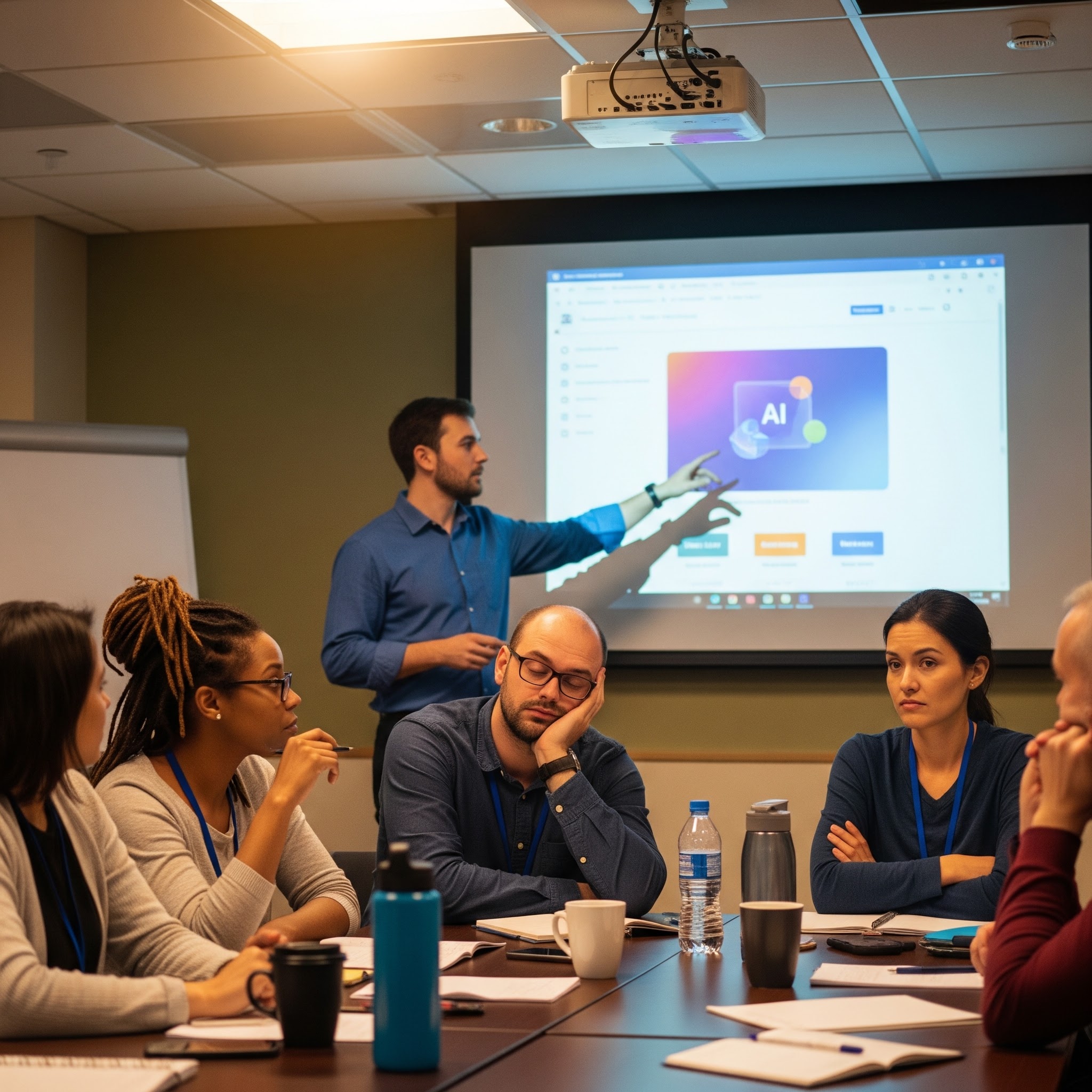
I got a call last month from a founding dean at a career college that launched in 2024. She’d been one of the most enthusiastic AI adopters I’d worked with—the kind of leader who piloted three AI platforms before her first cohort graduated, pushed faculty to attend every AI workshop she could find, and built “AI-integrated learning” into every marketing piece. Now she was telling me something I’m hearing more and more often: “Sandy, my faculty are done. They don’t want to hear the word ‘AI’ anymore. I’ve got two instructors threatening to quit if I roll out one more platform.”
She isn’t alone. After roughly two years of relentless AI adoption pressure—new tools every quarter, constant PD sessions, shifting expectations about what students should and shouldn’t be allowed to do with generative AI—a growing number of faculty, staff, and even students are hitting a wall. The enthusiasm that fueled early adoption is giving way to exhaustion, skepticism, and in some cases, outright resistance.
This isn’t a rejection of AI itself. It’s what happens when any organization pushes change too fast, with too many tools, too little support, and not enough space for people to absorb what they’re learning before the next wave hits. In the technology adoption literature, researchers call it technostress—the stress and anxiety caused by the introduction and use of new technologies in the workplace. In plain language, your people are burned out, and if you don’t address it, your AI strategy will stall regardless of how good your tools are.
For education investors building or running institutions in 2026, this is a critical issue. AI fatigue doesn’t just slow adoption—it poisons the institutional culture around technology. Faculty who feel overwhelmed stop experimenting. Staff who feel unheard stop engaging. Students who feel like guinea pigs for every new tool start pushing back. And once that resistance calcifies, it’s extraordinarily expensive to reverse.
Let me walk you through what AI fatigue actually looks like, why it happens, and—most importantly—how to manage it without losing the progress you’ve made.
A clarification before we go further: when I say “AI fatigue,” I’m not talking about people who never wanted AI in the first place. I’m talking about people who were genuinely willing to engage—who attended the training, tried the tools, redesigned their courses—and have hit a point where their capacity for change has been exhausted. These are often your best people. They’re the ones who cared enough to try, and now they’re the ones most at risk of burning out. Losing their engagement is far more damaging than never having had it, because it signals to everyone else that effort isn’t rewarded and enthusiasm leads to exhaustion.
Recognizing the Signs: What AI Fatigue Actually Looks Like on Campus
AI fatigue manifests differently depending on who you’re watching. Here’s what I’ve observed across the institutions I advise:
Faculty Fatigue Signals
Passive non-adoption. The most common sign isn’t loud protest—it’s quiet disengagement. Faculty attend the AI training session, nod politely, and then never log into the platform again. Usage data tells the story: you rolled out a new AI grading assistant, 90% of faculty completed the onboarding, and four months later, 15% are actively using it. That gap between onboarding and adoption is your fatigue indicator.
The “what’s the point?” response. When faculty start saying things like “We just learned the last tool and now there’s another one?” or “How is this different from what we already have?”, they’re not asking genuine questions. They’re signaling overwhelm. The cognitive load of continuously learning new systems—on top of teaching, advising, grading, and service obligations—is simply too high.
Retreat to familiar practices. Fatigued faculty default to what they know. They stop experimenting with AI-enhanced assessments and go back to traditional exams. They abandon the AI tutoring platform and return to email-based office hours. This isn’t technophobia—it’s self-preservation. When the cognitive demands of new technology exceed a person’s available bandwidth, retreating to established routines is a perfectly rational response.
Increased cynicism about vendor promises. After two years of hearing that every new AI tool will “revolutionize education,” faculty develop a healthy—and sometimes unhealthy—skepticism. Research on technostress confirms that excessive technology introduction produces anxiety, fatigue, and reduced professional efficacy among educators. When your most experienced faculty start rolling their eyes at PD announcements, you’ve got a fatigue problem.
Staff Fatigue Signals
Administrative staff often experience AI fatigue differently than faculty. They’re typically not choosing whether to use AI—they’re being told to use it. When the admissions team is mandated to adopt an AI-powered application screening tool, the registrar’s office is shifted to AI-assisted degree auditing, and the financial aid team is expected to implement AI fraud detection—all within the same year—the result is what change management experts call “change saturation.” People can only absorb so much organizational change at once, and when you exceed that capacity, performance and morale both suffer.
Watch for increased error rates (rushing through new systems without fully understanding them), rising help desk tickets, and a general sense of resignation in team meetings. One admissions director I spoke with described it this way: “I feel like I’m being asked to build the airplane while flying it, and also learn a new language at the same time.”
Student Fatigue Signals
Students are the constituency institutions think about least when it comes to AI fatigue, but they’re affected too. Students who encounter a different AI tool in every course—a different platform, a different set of rules about what’s allowed, a different login—experience their own version of tool overload. The EDUCAUSE 2026 Students and Technology Report documented that 46% of students encountered cybersecurity threats during the past academic year, a reminder that students’ relationship with campus technology isn’t uniformly positive.
When students start expressing frustration about “another AI thing,” complaining about inconsistent AI policies across courses, or pushing back against AI-integrated assignments, those are fatigue signals. They’re not anti-AI—they’re anti-chaos.
Why AI Fatigue Happens: The Disillusionment Cycle
Understanding why fatigue sets in helps you design strategies to manage it. The Gartner Hype Cycle is the most commonly cited framework here, and while it’s overused, the basic pattern holds: technologies go through a peak of inflated expectations followed by a trough of disillusionment before reaching a plateau of productivity. Most institutions are currently somewhere between the peak and the trough with AI.
But the hype cycle alone doesn’t explain why higher education is particularly vulnerable to AI fatigue. Several institutional dynamics amplify the problem:
Tool proliferation. For the 2023–24 school year, K–12 school districts accessed an average of 2,739 distinct edtech tools, an 8% increase over the prior year. Higher education numbers are comparable. The sheer volume of tools that faculty and staff are expected to navigate is staggering—and AI tools are piling on top of an already overwhelming technology stack. Every new AI tool isn’t just learning one more system; it’s adding one more login, one more workflow, one more set of notifications to an already overflowing plate.
Inadequate change management. Most institutions deploy AI tools with a training webinar and a PDF guide, then wonder why adoption stalls. Effective technology adoption requires sustained change management: clear communication about why the change matters, adequate training that includes practice time, ongoing support after deployment, and opportunities for feedback that actually influences the implementation. BCG research has found that targeted training and coaching can increase AI adoption by 14–19 percentage points—but most institutions aren’t investing at that level.
Unrealistic timelines and expectations. When leadership announces that AI will be “integrated across all programs by next semester,” that’s not a strategy—it’s a mandate that doesn’t account for the human pace of change. Faculty need time to experiment, fail safely, adapt their pedagogy, and internalize new practices before they’re ready to implement effectively. Rushing that process produces surface-level compliance without genuine adoption.
The accountability mismatch. Faculty are being asked to adopt AI tools and redesign their teaching—often without reduced course loads, additional compensation, or meaningful recognition for the effort. When the institutional reward structure doesn’t acknowledge the cognitive and time costs of AI adoption, faculty rightfully feel that the burden is unfair. This isn’t whining—it’s a legitimate governance concern that shared governance bodies should address.
The moving goalpost problem. AI tools update constantly. The platform your faculty learned in September is materially different by January. The AI policy you drafted in spring needs revision by fall because new tools have emerged that don’t fit the existing categories. This constant change is exhausting even for enthusiastic adopters, and it’s paralyzing for cautious ones.
The Historical Parallel: What Happened When Campuses Went Online
If this all sounds familiar, it should. Higher education went through a remarkably similar cycle during the rapid shift to online learning, both the gradual migration of the 2010s and the forced acceleration during COVID-19. Faculty who had been teaching in classrooms for decades were suddenly expected to master LMS platforms, video conferencing tools, digital assessment systems, and online pedagogy—often with minimal training and minimal time.
The result was predictable: initial enthusiasm (or at least compliance), followed by frustration, followed by burnout. Many institutions lost talented faculty during the 2020–2022 period specifically because technology demands overwhelmed their capacity. The research on faculty burnout from that era is sobering. A 2025 review of 20 studies found that emotional exhaustion, depersonalization, and reduced professional efficacy were widespread among university faculty, driven by overwhelming workloads and administrative demands related to technology integration. The AI adoption cycle is reproducing this pattern—but faster and on top of the technology burden that online learning already created.
What makes the AI cycle particularly dangerous is that it’s layered on top of unresolved technology fatigue from the pandemic era. Many faculty never fully recovered from the forced digital transition. They adapted, they survived, but they didn’t arrive at 2024 refreshed and ready for the next wave of technological disruption. They arrived depleted. And then generative AI landed, and the cycle started all over again—except this time, the expectations were even higher and the tools were changing even faster.
The institutions that managed the online learning transition best were the ones that invested in sustained support, respected faculty autonomy, provided realistic timelines, and didn’t pretend that mastering a new teaching modality was trivial. Those same principles apply to AI adoption. We don’t need to reinvent the change management wheel—we just need to actually apply what we’ve already learned.
Sustaining Momentum Without Exhausting Your People: A Strategic Framework
Managing AI fatigue isn’t about slowing down permanently. It’s about adopting a sustainable pace that your institution can maintain over years, not months. Here’s the framework I’ve developed through work with institutions at every stage of AI adoption.
Strategy 1: Fewer Tools, Deeper Implementation
This is the most counterintuitive recommendation for founders who want to be cutting-edge, but it’s the most important. Resist the urge to deploy every promising AI tool that crosses your desk. Instead, select 2–3 AI platforms that align directly with your highest-priority institutional goals, and invest heavily in making those work before adding more.
I call this the “depth over breadth” principle. An institution that has deployed one AI adaptive learning platform deeply—with thorough faculty training, clear learning outcome integration, robust assessment evidence, and genuine student engagement—is in a vastly stronger position than one that’s superficially deployed five tools that nobody fully understands.
When one career school I advise adopted this tiered approach, their faculty satisfaction with AI initiatives jumped from 2.8 to 4.0 on a 5-point scale within two semesters. The dean’s explanation was simple: “We stopped asking them to learn everything at once and started giving them time to actually get good at one thing.”
There’s a practical dimension to this that’s easy to overlook. Every AI tool you deploy creates downstream obligations: training materials need developing, help desk support needs staffing, usage needs monitoring, vendor contracts need managing, and compliance documentation needs updating. Multiply those obligations by five or six tools, and you’ve created a significant administrative burden that competes for the same staff time that should be going to teaching and student support. Fewer tools, deeply implemented, means fewer of those hidden obligations consuming your institutional bandwidth.
I’ll push this further with a concrete recommendation: before deploying any new AI tool, require the sponsoring department to answer three questions in writing. First, what specific problem does this tool solve that existing tools don’t? Second, what’s the total cost of ownership including training and support time? Third, what existing tool or process will this replace or eliminate? If the answer to the third question is “nothing—it’s additive,” that’s a red flag. Every additive tool increases cognitive load without reducing it somewhere else.
Strategy 2: Set Realistic Expectations and Counter Hype Internally
Leadership sets the tone for how AI is perceived across the institution. If the president is talking about AI as if it will transform everything overnight, faculty will either drink the Kool-Aid (and be disappointed when results are incremental) or tune out entirely (because the claims don’t match their experience).
Here’s the language shift I recommend:
Honest communication isn’t weakness—it’s credibility. Faculty who feel respected and accurately informed are far more likely to engage with AI initiatives than those who feel they’re being sold something. I’ve watched this play out repeatedly: the institutions with the highest AI adoption rates are the ones where leadership is most honest about what AI can and can’t do.
Strategy 3: Build Faculty and Staff Voice Into Adoption Pacing
AI fatigue gets worse when people feel that decisions are being made to them rather than with them. This is where shared governance—the practice of collaborative decision-making between administration and faculty—becomes essential.
Your AI governance committee (and if you don’t have one yet, this is the nudge to create it) should include faculty representatives who have genuine influence over the pace and direction of AI adoption. Not token representation—actual decision-making authority. When a committee that includes faculty recommends deploying one new AI tool per semester instead of three, and leadership honors that recommendation, you’ve built trust that pays dividends for years.
Practical mechanisms for incorporating voice include regular AI satisfaction pulse surveys (5 questions, quarterly), faculty advisory panels that evaluate and recommend new AI tools before procurement, “office hours” where faculty can raise concerns about AI implementation informally, and student technology advisory groups that provide input on the student experience with AI tools. The key is that feedback must be visibly acted upon. If you survey faculty, you need to share the results and explain what you’re doing differently based on what you heard. Collecting feedback and then ignoring it is worse than not asking at all.
Strategy 4: Create Space for Recovery and Reflection
This one is hard for action-oriented leaders, but it’s critical. After a major AI deployment, build in a deliberate “absorption period”—typically 8–12 weeks—where no new AI tools are introduced and the institutional focus shifts to mastering what’s already been deployed.
During absorption periods, the emphasis shifts from “learn this new thing” to “get better at the thing you’re already using.” Offer advanced training for faculty who want to deepen their skills, create peer learning communities where early adopters share tips with colleagues, and explicitly communicate that this is a consolidation phase, not a pause in progress.
I recommended this approach to one small university that had deployed four AI tools in 10 months. The provost was initially reluctant—she worried about “losing momentum.” But after a 10-week absorption period, faculty proficiency with the existing tools improved measurably. More importantly, faculty morale around technology recovered. When the institution was ready to introduce its next AI initiative, it was met with curiosity rather than dread. The provost told me afterward: “The pause wasn’t a loss of momentum. It was what made real momentum possible.”
Strategy 5: Celebrate Wins and Share Failure Honestly
Fatigue thrives in environments where effort feels invisible. When a faculty member spends 30 hours learning an AI tool and redesigning her course, and nobody acknowledges that investment, the message is clear: this isn’t valued.
Build recognition into your AI adoption culture. Highlight faculty AI innovations in campus communications. Create an annual “AI in Action” showcase where instructors present what they’ve tried and what they’ve learned. Tie AI adoption to promotion and tenure criteria where appropriate—or at minimum, to annual evaluation recognition. One institution I work with created a modest “AI Innovation Stipend” of $1,500 per faculty member who completed a structured AI integration project and shared their results. The cost was minimal. The impact on faculty engagement was significant.
Equally important: normalize failure. Not every AI experiment will succeed. Not every tool will deliver on its promises. When leadership can stand in front of faculty and say, “We tried this tool, it didn’t work as well as we hoped, here’s what we learned, and here’s what we’re doing instead,” that honesty builds institutional trust far more effectively than pretending everything is going perfectly.
Strategy 6: Protect Faculty Time With Concrete Trade-Offs
This is the strategy that separates institutions that talk about valuing faculty from institutions that actually do. If you’re asking faculty to invest significant time learning and implementing AI tools, something else in their workload needs to give. You can’t add 5–10 hours per week of technology learning and implementation to a faculty member’s plate and expect everything else to stay the same.
Practical trade-offs I’ve seen work: reduce committee service obligations for faculty who are leading AI pilot implementations. Provide course release time for faculty redesigning curricula around AI integration. Adjust expectations for scholarly output during the first year of major AI implementation. Offer summer stipends for faculty who complete substantial AI training and course redesign projects.
These aren’t luxuries—they’re investments in sustainable adoption. A faculty member who has adequate time to learn an AI tool properly will implement it more effectively, persist through initial difficulties, and become a genuine advocate. A faculty member who’s cramming AI training into an already-overloaded schedule will cut corners, get frustrated, and become a vocal critic. The cost of a course release or summer stipend is trivial compared to the cost of replacing a faculty member who leaves because the workload became unsustainable.
One institution I advised created what they called an “AI Implementation Semester” for each faculty cohort—a single semester where participating instructors received a one-course reduction specifically to focus on AI integration. The reduced teaching load cost the institution approximately $4,500 per faculty member in adjunct replacement costs. The result was genuine, measured adoption that persisted well beyond the implementation semester. Compare that to the alternative: mandatory adoption with no workload adjustment, resulting in surface-level compliance that collapses the moment oversight lapses.
Change Management Best Practices That Actually Work in Education
Corporate change management frameworks—Kotter’s 8-step process, ADKAR, Prosci—are well-established but often fail in academic settings because they don’t account for higher education’s unique culture: shared governance, academic freedom, decentralized decision-making, and the reality that faculty are neither employees in the corporate sense nor fully autonomous professionals. They occupy a unique middle ground that requires adapted change management approaches.
Here’s what I’ve found works in practice:
Lead with “why,” not “what.” Before introducing any AI tool, articulate the specific problem it solves. “We’re adopting this because 23% of our students in developmental math fail to complete the course, and this adaptive platform has shown a 12-point improvement in completion rates at comparable institutions” is infinitely more compelling than “We’re rolling out AI to stay competitive.” Faculty are intellectuals—they respond to evidence and reasoning, not edicts.
Phase your rollouts. Never deploy institution-wide on day one. Start with volunteer early adopters (you’ll have 15–20% of faculty who are genuinely excited about AI), learn from their experience, refine the implementation, and then expand. Each phase should include 4–6 weeks of supported adoption before moving to the next group. This gives you internal champions who can advocate to their peers from personal experience—far more persuasive than any vendor pitch.
Invest in ongoing support, not just launch training. The training-on-day-one-and-you’re-on-your-own model is a recipe for abandonment. Provide ongoing support: drop-in help sessions, a dedicated AI support contact (even if it’s part of someone’s existing role), a shared Slack or Teams channel where faculty can ask questions and share tips, and quarterly refresher sessions that address advanced features and common problems. Budget 40–60 hours of professional development per faculty member in year one, with ongoing quarterly refreshers.
Measure and communicate progress. Share results publicly and regularly. “In the first semester of using the AI adaptive platform, course pass rates in sections using the tool were 7 percentage points higher than sections without it” is the kind of data that converts skeptics. If you’re not measuring outcomes (and we covered that in depth in Post 48 of this series), you can’t communicate progress, and without visible progress, change fatigue sets in.
Respect the pace of your people. This is the hardest one for ambitious founders. Your institution cannot adopt AI faster than your people can absorb the change. Trying to force the pace doesn’t accelerate adoption—it creates resistance that slows everything down. The sustainable adoption rate for most institutions is one major AI initiative per semester, with continuous improvement on existing tools between launches.
Build AI champions, not AI mandates. The most effective adoption strategy I’ve seen isn’t top-down mandates—it’s peer influence. Identify your 3–5 most enthusiastic and respected faculty members and invest disproportionately in their AI development. Give them early access to tools, extra training, and opportunities to present their work to colleagues. When Professor Martinez, whom everyone respects, stands up at a department meeting and says “This tool saved me four hours a week on grading and here’s what I did with that time,” it’s worth more than any vendor demo or administrative directive. People trust their peers more than they trust their bosses, and they trust their bosses more than they trust salespeople.
Don’t conflate resistance with incompetence. This is a trap I see leaders fall into regularly. When a faculty member pushes back on an AI tool, the instinct is to assume they just don’t understand it and send them to more training. Sometimes that’s true. But often, resistance reflects legitimate concerns—about pedagogical impact, about workload, about data privacy, about the tool’s actual effectiveness. The 2026 EDUCAUSE Top 10 report emphasized this point directly: AI’s impact depends not on the technology itself but on how people apply ethical reasoning, contextual judgment, and interdisciplinary creativity. Faculty who insist on understanding a tool’s impact before adopting it aren’t being difficult—they’re being professional. Treat their resistance as data, not as a problem to overcome.
The Cost of Ignoring AI Fatigue vs. Managing It Proactively
The ratio here is roughly 1:6 or worse. For every dollar you invest in proactive fatigue management, you’re avoiding six to ten dollars in reactive costs. And that doesn’t account for the hardest-to-quantify cost: the opportunity cost of an institution where nobody wants to try anything new because the last three technology rollouts burned them.
What This Looks Like in Practice: Two Composites
The School That Pushed Too Hard
A proprietary college in the mid-Atlantic launched in 2024 with an aggressive AI strategy. Within its first year, the school deployed an AI-powered LMS, an AI tutoring platform, an AI chatbot for student services, an AI-driven assessment tool, and an AI-assisted clinical simulation system for its allied health programs. Five major AI tools in twelve months, across a founding faculty of sixteen instructors.
By the end of year one, two faculty members had resigned—both citing “unsustainable technology demands” in their exit interviews. The chatbot had been abandoned after students complained it couldn’t answer basic questions about course schedules. The assessment tool was being used by only three instructors because the rest couldn’t figure out how to integrate it with their grading rubrics. The founding dean estimated that faculty spent an average of 8 hours per week on technology issues—time that wasn’t going to teaching, advising, or course improvement.
When the school’s accrediting body (ABHES) conducted its initial visit, evaluators asked about the AI strategy. The school could show tool purchases but couldn’t demonstrate measurable outcomes. The evaluators noted a “gap between technology investment and evidence of impact on student learning.” The institution received a recommendation to develop a more structured approach to technology assessment—an accreditation finding that could have been avoided entirely.
The School That Paced It Right
A career school in the Southeast took a different approach. They launched with a single AI tool—an adaptive learning platform integrated into their two highest-enrollment programs. They gave faculty four months of training and supported experimentation before expecting full adoption. They ran a formal pilot with volunteer faculty, collected baseline data, and measured outcomes at 90 days and 6 months.
When results showed an 8-point improvement in practice exam scores, they presented the data to all faculty at a half-day workshop. Faculty who hadn’t been part of the pilot could ask questions, see the evidence, and hear directly from their colleagues about what worked and what didn’t. Enrollment in the next training cohort was voluntary—and 85% of remaining faculty signed up.
After that first tool was solidly adopted—about 9 months into operation—the school introduced its second AI initiative: an automated compliance reporting system for their accreditation documentation. By the end of year two, they had two AI tools deeply embedded in institutional practice, both with measurable outcomes, and a faculty culture that was curious about what might come next rather than dreading it.
The total AI spending for the first two years was actually lower than the first institution’s, because they weren’t paying for tools nobody used. Their accreditation evaluators cited the AI integration as a strength.
The Long View: What Sustainable AI Adoption Actually Looks Like
Here’s what I want every education investor to understand about AI fatigue: it’s not a one-time problem you solve and move past. It’s an ongoing management challenge that requires continuous attention, because the AI landscape itself is continuously changing. New tools will keep emerging. Existing tools will keep updating. Faculty who felt competent last semester will feel behind next semester. The work of managing adoption pace, supporting your people, and maintaining institutional energy around AI never ends—it just becomes part of good leadership.
The institutions that will thrive over the next five to ten years aren’t the ones that adopt AI fastest. They’re the ones that adopt AI most sustainably. That means building institutional muscle around three capabilities that have nothing to do with technology: listening to your people, pacing change to match human capacity, and telling the truth about what’s working and what isn’t.
I worked with a university system president last year who put it this way during a strategic planning session: “Our AI strategy needs to be a marathon pace, not a sprint. We’re going to be integrating AI for the rest of this institution’s life. If we burn out our faculty in the first two years, we’ll spend the next five recovering.” That’s the right frame. Your AI strategy is a permanent commitment, not a project with an end date. Design your adoption approach accordingly.
For founders specifically, this means building AI adoption pacing into your institutional culture documents, your faculty handbooks, and your strategic plan—not as a technology initiative, but as a change management philosophy. When you hire a new dean, they should inherit not just a list of AI tools but a documented approach to how the institution introduces, supports, evaluates, and retires technology. That’s the infrastructure that prevents fatigue from becoming a chronic institutional condition.
The schools that win the AI adoption race won’t be the ones that deployed the most tools. They’ll be the ones that kept their people engaged, supported, and willing to keep learning.
Key Takeaways
For investors and founders building new educational institutions in 2026:
1. AI fatigue is real and widespread. Ignoring it will undermine your AI strategy regardless of how good your tools are.
2. Watch for the signals: passive non-adoption, cynicism about vendor promises, retreat to familiar practices, rising error rates among staff.
3. Fewer tools, deeper implementation. Select 2–3 mission-critical AI platforms and invest in genuine adoption before expanding.
4. Set realistic expectations. Honest, evidence-based communication about what AI can and can’t do builds far more trust than hype.
5. Build faculty and staff voice into adoption pacing through shared governance, advisory panels, and pulse surveys that influence decisions.
6. Create absorption periods (8–12 weeks) after major deployments where no new tools are introduced and the focus shifts to mastery.
7. Celebrate wins and normalize failure. Recognition sustains motivation; honesty builds trust.
8. Phase every rollout. Start with volunteer early adopters, learn, refine, then expand.
9. Budget for ongoing support, not just launch training. 40–60 hours of PD per faculty member in year one.
10. Proactive fatigue management costs $15,000–$38,000 annually. Ignoring fatigue costs $100,000–$375,000+ in turnover, wasted spending, and accreditation risk.
Frequently Asked Questions
Q: How do I tell the difference between healthy skepticism and AI fatigue?
A: Healthy skepticism sounds like “I’d like to see evidence that this works before I commit my time.” That’s a reasonable request from an intellectually engaged professional. AI fatigue sounds like “I don’t care what it does—I’m done.” The difference is engagement versus disengagement. Skeptics are willing to be convinced; fatigued faculty have stopped listening. If you’re seeing rising absenteeism from PD sessions, declining usage rates over time, or faculty openly expressing resentment about technology demands, those are fatigue indicators, not skepticism.
Q: We’re a new institution that hasn’t launched yet. Can we prevent AI fatigue entirely?
A: You can’t prevent it entirely—some degree of technology adoption stress is inherent in any significant change. But you can dramatically reduce its severity by building your AI strategy around the tiered deployment model, hiring faculty who are AI-curious (not just AI-tolerant), budgeting adequate training time, and establishing absorption periods as part of your institutional calendar from day one. Founders who plan for sustainable pacing from the start avoid the costliest forms of fatigue.
Q: My faculty are already fatigued. How do I recover without abandoning our AI strategy?
A: Start with a listening tour. Survey faculty about their AI experiences—what’s working, what’s not, what they need. Then take visible action based on what you hear. If faculty are overwhelmed by five tools, consolidate to two or three. If training has been inadequate, invest in deeper support. If the pace has been too fast, declare an explicit absorption period. The key is demonstrating that you’ve heard the feedback and are willing to adjust. Recovery typically takes one to two semesters of deliberate, faculty-centered recalibration.
Q: How many AI tools is too many for a small institution?
A: For an institution with under 500 students and fewer than 20 faculty, more than 3–4 AI tools in active use at any time is almost certainly too many. A better target: 1–2 tools deeply integrated into instruction, plus 1–2 for administrative efficiency. Add new tools only after existing ones are adopted, measured, and proven. Scale tool count with institutional capacity, not ambition.
Q: Should we involve students in decisions about AI adoption pacing?
A: Yes—but appropriately. Students shouldn’t determine your AI strategy, but they can provide valuable feedback on their experience with AI tools. A student technology advisory group that meets quarterly and provides input on usability, consistency across courses, and learning impact gives you data you can’t get any other way. Students are the end users of many of your AI investments; their experience matters for both quality and retention.
Q: How do we handle faculty who are genuinely resistant to any AI adoption?
A: Distinguish between resistance rooted in fatigue (which is manageable) and resistance rooted in principled disagreement (which deserves respectful engagement). Some faculty have legitimate concerns about AI’s impact on learning, academic integrity, or data privacy. Those concerns should be heard and addressed through your governance process. A well-designed tiered AI use policy (covered in Post 2 of this series) gives individual faculty the authority to limit AI in their courses while maintaining institutional standards. What you can’t accommodate is a refusal to engage with AI governance—every faculty member has a professional obligation to understand AI’s role in their field, even if they choose to limit its use in their teaching.
Q: What’s the role of the AI governance committee in managing fatigue?
A: Your AI governance committee should be the institutional body that monitors adoption health, not just policy compliance. Include adoption metrics (usage rates, satisfaction scores, fatigue indicators) as a standing agenda item. The committee should have the authority to recommend pausing or scaling back AI initiatives when evidence shows the pace is unsustainable. This gives faculty a formal channel for influencing pacing—which is far healthier than informal resistance or quiet abandonment.
Q: How do we balance AI adoption pressure from the market with the need to manage fatigue internally?
A: This is the core tension, and the answer is sequencing. You can’t ignore the market—students and employers increasingly expect AI-integrated programs, and competitors are moving. But you can be strategic about which AI capabilities you develop first and how fast you expand. Focus on the 2–3 AI integrations that deliver the most visible student and market value (adaptive learning, AI-integrated hands-on training, AI-enhanced career services) and defer the nice-to-haves until your people can absorb them. Marketing an AI-forward brand doesn’t require implementing every tool simultaneously.
Q: Is AI fatigue worse at proprietary institutions than at traditional universities?
A: In my experience, it manifests differently but isn’t inherently worse. Proprietary institutions often have smaller faculty bodies, faster decision-making cycles, and less formal shared governance—which means AI adoption can be pushed faster, but faculty have fewer channels to push back. Traditional universities have more robust governance structures that slow adoption but also provide pressure-relief valves for faculty frustration. The key factor isn’t institution type—it’s whether leadership respects the human pace of change.
Q: How do we measure whether our fatigue management is working?
A: Track four indicators quarterly: AI tool usage rates (are they stable or declining?), faculty satisfaction with AI initiatives (pulse survey), voluntary participation in AI PD opportunities (is it increasing or decreasing?), and faculty turnover specifically related to technology demands (exit interview data). If usage and satisfaction are stable or improving, participation in PD is voluntary and robust, and you’re not losing people over technology stress, your fatigue management is working.
Q: Should we pause AI adoption during accreditation preparation?
A: Not entirely, but this is a natural absorption period. In the 6–12 months before an accreditation visit, focus on documenting and demonstrating the AI initiatives you’ve already implemented rather than launching new ones. Accreditors want to see evidence of thoughtful implementation and measured outcomes, not a long list of recent deployments you can’t yet evaluate. Use the pre-visit period to strengthen your assessment evidence and institutional effectiveness documentation around existing AI tools.
Q: What resources can we point fatigued faculty toward for their own development?
A: Direct faculty to structured, self-paced resources that let them learn at their own speed: EDUCAUSE’s Teaching with AI course, AAC&U’s Institute on AI, Pedagogy, and the Curriculum, and discipline-specific AI resources from their programmatic accrediting bodies. Peer learning communities—small groups of 3–5 faculty who meet biweekly to share AI experiments and challenges—are often the most effective support structure because they combine learning with mutual support. The worst thing you can do is send fatigued faculty to another full-day vendor webinar.
Q: How do we prevent AI fatigue in students specifically?
A: Consistency is the antidote. Work toward standardizing the AI tools used across your institution (or at least within programs) so students aren’t learning a different platform in every course. Ensure your AI use policy is clear and consistently applied. And design AI-integrated assignments that explain why the AI tool is being used and how it supports learning—students accept technology more readily when they understand the pedagogical rationale, not just the mechanics.
Glossary of Key Terms
Current as of April 2026. Regulatory guidance, accreditation standards, and technology platforms evolve rapidly. Consult current sources and expert advisors before making institutional decisions.
If you’re ready to explore how EEC can de-risk your AI-integrated launch, reach out at sandra@experteduconsult.com or +1 (925) 208-9037.