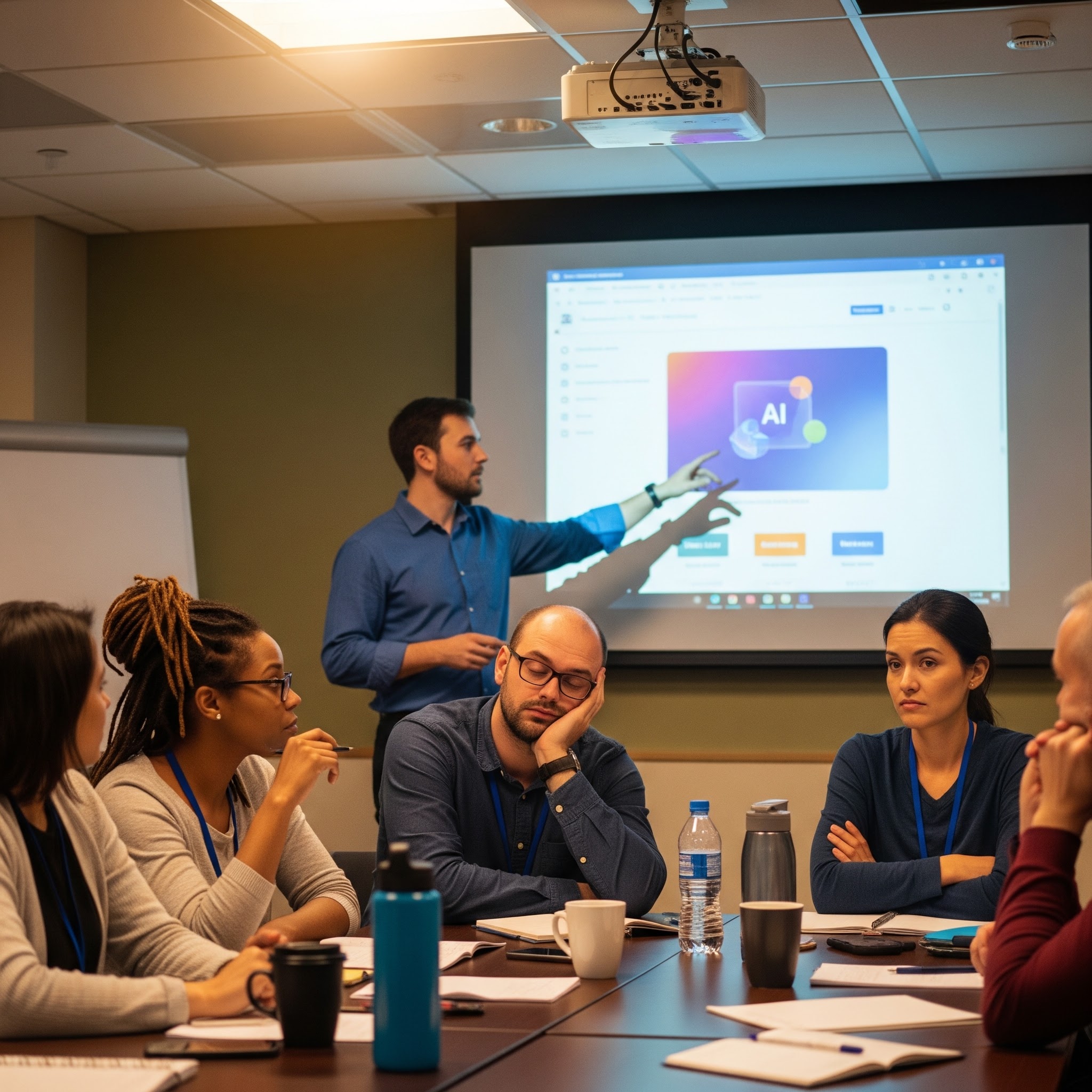


Here’s the uncomfortable truth nobody tells you during orientation planning: your incoming students already have an AI policy. They just made it up themselves.
Some are using ChatGPT to draft every assignment and never disclosing it. Others are terrified to touch any AI tool because their high school teacher said it was cheating. A handful are prompting Claude to generate study guides, rewrite notes, and summarize readings with genuine skill. And a surprising number have never used generative AI at all—they’ve heard of it, sure, but they’ve never actually opened a chat window and typed a prompt.
A 2025 survey from the UK’s Higher Education Policy Institute found that 92% of undergraduate students were using AI tools, up from 66% the previous year. But “using AI” covers an enormous range of behavior—from asking it to explain a chemistry concept to wholesale submitting AI-generated essays as original work. What’s missing isn’t access. It’s shared expectations.
If you’re founding a new college, university, trade school, or career program, this gap is your single biggest opportunity to build culture from day one. And I mean literally day one—orientation week, the first time students walk through your doors or log into your LMS. Because here’s what I’ve learned from helping launch over two dozen institutions: the norms you establish in the first 72 hours stick. The ones you try to enforce in week six don’t.
This post is your playbook for building responsible AI use into your student onboarding process—from the pre-arrival communications through the first-week programming and into the ongoing support structures that make it all sustainable. I’ll cover what to assess, what to teach, how to structure the agreements, and why peer mentoring might be the most underrated tool in your AI governance arsenal.
Why AI Onboarding Can’t Wait Until “Later”
Let me share something I watched happen at a small proprietary college in Georgia in early 2025. The school had a solid AI governance policy—we’d helped them build it the previous year. Tiered use framework, clear disclosure requirements, faculty training, the works. What they didn’t have was an onboarding plan to actually communicate those policies to incoming students.
Within six weeks of fall enrollment, the academic dean was fielding a dozen integrity cases. Not because the policy was unclear—it was well-written and publicly available—but because nobody had actually walked students through it. The enrollment agreement referenced the AI policy by name, but students signed it the same way they sign every other form during registration: without reading it.
The dean told me, “Our students aren’t trying to cheat. They genuinely don’t know where the lines are.” She was right. When we surveyed those students mid-semester, 68% said they weren’t confident they understood their institution’s AI use expectations. Almost a third thought using AI for brainstorming required formal disclosure. Another quarter thought submitting AI-generated text with a citation was always acceptable, regardless of the assignment.
The problem isn’t that students are ignoring your AI policy. It’s that nobody taught them what it means in practice. Onboarding is your one shot to close that gap before the first grade dispute lands on your desk.
That school spent the spring semester running remedial workshops and reworking their integrity process. Total cost of the reactive response—including the consulting time, the lost goodwill, and the faculty hours spent adjudicating cases that shouldn’t have happened—was roughly $28,000. The proactive onboarding module they built for the following fall cost $4,500 to develop and about three hours of orientation time to deliver.
The math makes itself.
Assessing Incoming Student AI Literacy Levels
Before you can teach responsible AI use, you need to know what your students already know—and, just as importantly, what they think they know. The variance is enormous, and it’s growing.
A multinational study published in early 2025 assessed AI literacy across 1,465 university students in Germany, the UK, and the US. The findings revealed that most students had a foundational level of AI literacy, but the range was striking. Students with prior coursework or self-directed learning scored dramatically higher than those without. Nationality, academic discipline, and degree level all influenced results—but age and gender didn’t show significant effects.
What does this mean for your onboarding? You can’t assume a baseline. A 32-year-old career changer entering your nursing program might know less about generative AI than an 18-year-old fresh out of a tech-forward high school—or vice versa. You need data, not assumptions.
Building a Pre-Arrival AI Literacy Assessment
The most effective approach I’ve seen uses a brief, validated self-assessment administered during the enrollment process—ideally after the student has committed but before orientation begins. This isn’t a placement test. It’s a diagnostic tool that serves three purposes: it gives you aggregate data on your incoming cohort, it helps you tailor orientation content, and it signals to students that your institution takes AI literacy seriously.
Researchers have developed a validated 10-item AI literacy test—the AILIT-S—that can be administered in under five minutes. While that instrument is designed for research-level assessment, you don’t necessarily need that level of rigor for onboarding purposes. What you do need is a simple, honest gauge of where students stand.
Here’s a framework I’ve used with multiple client institutions. It takes about eight minutes and covers five dimensions:
The results typically cluster into three groups. About 20–25% of incoming students are what I’d call AI-confident—they’ve used tools extensively, can articulate how they work, and have opinions about responsible use. Another 40–50% are AI-aware—they’ve tried a tool once or twice, have a fuzzy understanding of what it does, and aren’t sure what’s allowed. The remaining 25–35% are AI-unfamiliar—limited or no experience, and often significant anxiety about the technology.
These proportions shift depending on your student population. Trade schools and career colleges serving adult learners tend to have more AI-unfamiliar students. Programs attracting younger, tech-savvy demographics skew toward AI-confident. The point is: you need to know your mix before you design your onboarding, because a one-size-fits-all approach will bore the confident students and overwhelm the unfamiliar ones.
AI Orientation Modules and First-Week Programming
Orientation is your golden window. Students are paying attention, they’re forming habits, and they’re looking for signals about what kind of institution they’ve joined. Use that window wisely.
I’ve seen institutions try to cram AI orientation into a 15-minute segment during a four-hour marathon of policy presentations. That doesn’t work. By the time you get to “AI expectations,” students have already mentally checked out from hearing about the parking policy, the campus emergency plan, and Title IX. Your AI programming needs to be distinct, interactive, and memorable.
The Three-Session Model
The most effective onboarding structure I’ve helped design uses three sessions spread across the first week. Not three hours of lectures—three focused, interactive engagements that build on each other.
Session 1: “What AI Can and Can’t Do” (60–90 minutes, Day 1 or 2)
This is the foundation. It’s not a policy lecture—it’s a hands-on demo. Start by giving students access to a generative AI tool (if your institution has licensed one, use that; if not, a free-tier tool works for demonstration purposes). Walk them through three exercises: asking the AI a factual question in their field of study and checking whether it’s right; asking the AI to write a paragraph on a topic and identifying what’s missing, wrong, or generic; and asking the AI something it can’t do well—like provide a source it didn’t actually read.
The goal isn’t to impress students with AI. It’s to ground them in its limitations. Every student who leaves Session 1 should understand that AI tools are prediction engines, not knowledge engines. They generate plausible-sounding text based on patterns—they don’t “know” anything. I’ve found that this single insight prevents more integrity violations than any honor code language ever written.
Session 2: “Your School’s AI Expectations” (45–60 minutes, Day 2 or 3)
Now you introduce your responsible-use framework. But don’t just read the policy aloud. Use scenario-based learning. Present students with five realistic situations and ask them to determine whether each one complies with your policy:
A student uses AI to brainstorm thesis topics, then writes the paper entirely on their own. A student pastes an entire assignment prompt into ChatGPT and submits the output with minor edits. A student asks AI to explain a concept they don’t understand, then writes about it in their own words. A student uses an AI grammar checker on their final draft. A student asks AI to generate practice quiz questions to study for an exam.
Walk through each scenario using your institution’s tiered use framework. This is where students learn the difference between Tier 1 (unrestricted, like grammar checkers), Tier 2 (permitted with disclosure), Tier 3 (instructor-controlled), and Tier 4 (prohibited). The scenario format makes abstract policy language concrete and memorable. I’ve tested this approach with over a dozen cohorts, and retention of policy details is dramatically higher than with traditional policy review.
Session 3: “Building Your AI Skills” (60–90 minutes, Day 4 or 5)
The final session shifts from compliance to competency. This is where you teach students to be effective, responsible AI users in their specific programs. The content should be discipline-specific: nursing students work through an AI-assisted patient triage scenario; business students evaluate an AI-generated market analysis; ESL students use AI translation tools and compare outputs to human translations; trade school students explore how AI is used in their industry for scheduling, diagnostics, or quality control.
Session 3 is also where you introduce any AI tools that are formally integrated into your curriculum—adaptive learning platforms, AI-assisted coding environments, AI-powered study aids. Walk students through how to access them, how data is handled, and what’s expected of them as users.
Student-Facing AI Use Agreements and Honor Code Updates
Every student at your institution should sign an AI use agreement. Not buried in the enrollment contract—a standalone document that’s reviewed during orientation and acknowledged separately. This isn’t about creating legal armor (though your attorney will appreciate it). It’s about establishing a social contract.
What Your AI Use Agreement Should Include
I’ve drafted these for institutions ranging from 80-student trade schools to 3,000-student online universities. The effective ones share five elements:
1. Plain-language summary of your AI policy. Not the full policy—a one-page summary written at a tenth-grade reading level that explains your tiered use framework in clear terms. “Here’s what’s allowed, here’s what requires disclosure, here’s what’s up to your instructor, and here’s what’s never allowed.”
2. Disclosure expectations. Spell out exactly how students should disclose AI use in their work. Provide a template. If you want them to include an “AI Use Statement” at the end of assignments, show them what a good one looks like. “I used Claude to generate an initial outline for this essay. I rewrote all sections in my own words, verified the factual claims against course materials, and added my own analysis.” That’s the kind of transparency that builds trust.
3. Data privacy acknowledgment. Students need to understand that anything they type into an AI tool may be stored, processed, or used for model training depending on the platform. Your agreement should name the specific tools your institution has approved, explain why those tools were chosen (hint: FERPA-compliant data handling), and warn students about the risks of using unapproved platforms with personal or institutional information.
4. Consequences framework. Reference your academic integrity code and summarize the graduated sanctions for AI-related misconduct. First offense? Typically a grade penalty and mandatory remediation. Repeat offense? Course failure. Egregious violation? Academic suspension. Students should know the stakes before the first assignment is due, not after.
5. Acknowledgment signature. Physical or electronic, collected during orientation and filed in the student record. This eliminates the “I didn’t know” defense entirely.
Integrating AI into Your Honor Code
Your existing academic integrity code almost certainly needs updating for AI. If it was written before 2023, it definitely does. The key additions:
Define AI-assisted work explicitly. Your code should distinguish between using AI as a tool (permitted, with varying levels of disclosure depending on the tier) and submitting AI-generated work as your own (prohibited). The line between these categories needs to be clear, because it genuinely isn’t obvious to many students.
Address AI fabrication. Students using AI to generate citations, invent data, or create fictional sources should face the same consequences as fabricating data through any other means. This needs to be stated explicitly, because some students genuinely believe that if AI produced a citation, it must be real.
Include a syllabus integration requirement. Every course syllabus should reference the institutional AI policy and specify instructor-level rules (Tier 3). This gives faculty the authority to restrict or expand AI use within their courses, provided they communicate those expectations clearly and in writing at the start of the term.
Hands-On AI Literacy Workshops for Incoming Students
The orientation sessions I described above plant the seeds. But if you want responsible AI use to actually take root, you need to reinforce it with hands-on workshops during the first few weeks of the term. These aren’t mandatory policy sessions—they’re practical skills workshops that students actually want to attend because the content is immediately useful.
Workshop Design Principles
I’ve helped design workshop series at seven institutions over the past year, and the ones that succeed follow four principles.
Keep them short and focused. Sixty minutes maximum. Cover one topic per session. Students won’t block two hours on a Thursday afternoon to learn about AI, but they’ll give you an hour if the topic is “How to Use AI to Study Smarter (Without Cheating).”
Make them discipline-relevant. A workshop on “AI in Healthcare” for nursing students lands differently than a generic “Intro to AI.” Work with program directors to customize examples and scenarios for each field of study. A trade school workshop might focus on AI-assisted job searching and resume building. An allied health workshop might focus on AI-powered study tools for certification exam prep.
Require production, not consumption. The worst AI workshops are lectures. The best ones ask students to actually do something: write a prompt, evaluate an output, compare an AI-generated answer to a textbook answer, or use an AI tool to complete a low-stakes practice assignment. Active engagement cements the learning in ways that PowerPoint slides never will.
Offer multiple modalities. Not every student can attend in person. Record sessions. Offer an asynchronous online version through your LMS. Create a “quick start” guide for AI tools that students can reference on their own time. The goal is to meet students where they are, not where you wish they were.
A Sample Workshop Series for the First Month
Peer Mentoring and Student Ambassador Programs for AI
This is the section I’m most passionate about, because it’s the piece most institutions miss entirely—and it’s the one that makes the biggest long-term difference.
Faculty can teach responsible AI use. Orientation can establish expectations. But the students who actually shape the culture are other students. Peer influence drives behavior far more powerfully than institutional policy, especially for incoming students who are still figuring out the social norms of their new environment.
Why Peer Mentoring Works for AI Culture
There’s solid evidence behind this. A growing body of research on peer education interventions in higher education consistently shows that students are more likely to adopt new behaviors when they see peers modeling those behaviors—and when peers, not authority figures, explain why those behaviors matter. This holds true for everything from study habits to health behaviors, and it applies directly to AI use norms.
Think about it from a student’s perspective. When a dean stands at a podium and says “you must disclose your AI use,” that sounds like a rule. When a second-year student sits with a first-year student and says “hey, here’s how I use AI for my lab reports—I always include a use statement, and my professor actually likes that I’m transparent about it,” that sounds like advice. One creates compliance. The other creates culture.
Building an AI Ambassador Program
Here’s a model we developed with a mid-sized career college in 2025 that’s since been adapted by three other institutions:
Recruit 8–12 AI ambassadors from your returning student body (or, if you’re a brand-new institution, from your pilot cohort after the first term). Look for students who are genuinely interested in AI, not just the most tech-savvy. You want critical thinkers, not evangelists. Diversity of background and program is essential—your ambassadors should represent the range of your student body.
Train them intensively. A weekend training (8–12 hours total) covers your AI policy, prompt engineering techniques, common integrity scenarios, active listening skills, and how to refer students to faculty or academic support when questions exceed the ambassador’s scope. This training doubles as professional development the ambassadors can put on their resumes.
Deploy them during orientation. Ambassadors co-facilitate the orientation sessions alongside staff. They run the small-group discussions. They lead the hands-on exercises. Their presence transforms orientation from “the institution telling you the rules” to “your peers showing you the ropes.”
Maintain them as an ongoing resource. After orientation, ambassadors hold regular drop-in hours (physical and virtual) where students can get help with AI tools, ask questions about the policy, or work through an AI-related assignment challenge. Think of it as tutoring for AI literacy. Some institutions integrate ambassadors into their academic resource centers; others create a standalone “AI Help Desk” staffed by peers.
Compensate them fairly. This is work. Pay your ambassadors—either hourly wages, stipends, or tuition credits. Unpaid ambassador programs have high turnover and send the message that AI literacy isn’t valued. Budget $5,000–$12,000 per academic year depending on program size and local wage rates.
The career college I mentioned saw a 40% reduction in AI-related integrity cases in the first full semester after launching its ambassador program. The dean attributed it not to stricter enforcement, but to the culture shift: students started seeing responsible AI use as the norm rather than the exception, because their peers were modeling it.
One detail that surprised us: the ambassador program also surfaced issues the institution hadn’t anticipated. Ambassadors reported that several students in the medical billing program were using AI tools to generate practice insurance claims—which inadvertently included realistic-looking patient identifiers. Nobody had thought to address the intersection of AI use and HIPAA training during orientation. The ambassadors flagged it within the first three weeks, and the program director added a five-minute HIPAA-AI segment to the next cohort’s clinical orientation. That’s the kind of real-time intelligence an ambassador program provides that no policy document can replicate.
What Actually Happened: Lessons from the Field
The ESL Program That Made AI Onboarding a Competitive Advantage
An ESL academy in a competitive metro market—twelve other language schools within a 15-mile radius—decided to make AI onboarding central to its value proposition. The founding director understood that ESL students were already heavy users of AI translation tools. Rather than pretending those tools didn’t exist, the school built orientation around teaching students the difference between using AI as a scaffold (encouraged) and using AI as a substitute (prohibited).
During the first-week orientation, every student worked through a translation exercise: they translated a passage using Google Translate, then using a generative AI tool, then on their own. The facilitator walked the class through the differences—where the AI was accurate, where it missed cultural nuance, where it produced grammatically correct but contextually wrong output. Students were genuinely surprised at how often the AI got things subtly wrong.
The school’s AI use agreement was available in six languages. Their assessment design reflected their policy: oral proficiency exams, in-class writing under observation, and portfolio assessments where students documented their revision process—including when and how they used AI assistance. First-year enrollment exceeded projections by 18%, and the accrediting body’s evaluator specifically cited the AI onboarding process as “among the most thoughtful I’ve reviewed at a program this size.”
The Trade School That Learned Timing Matters
A vocational school offering HVAC and electrical technology programs opened in late 2024 with a comprehensive AI policy but no formal onboarding process. The founders assumed their students—mostly adults in career transitions—wouldn’t be using AI much in hands-on technical programs. They were wrong.
By week four, two students had been caught submitting AI-generated safety compliance reports for their shop exercises. The instructor was frustrated, the students were confused (“I thought using AI for paperwork was fine”), and the academic dean had no documented evidence that the policy had ever been explained to the students. The enrollment agreement referenced the AI policy, but nobody had walked students through what it actually meant in the context of their program.
The school pivoted hard. They brought us in to design a condensed AI onboarding module that could be delivered during the first week of each new cohort cycle—about 90 minutes of interactive, hands-on orientation focused specifically on AI use in trades contexts. They showed students how AI is used in the industry (predictive maintenance, automated scheduling, energy modeling), then walked through the institutional expectations for academic work. The key insight: they used trade-relevant scenarios rather than generic academic examples. “If you use AI to draft a work order summary, that’s Tier 2—permitted with disclosure. If you use AI to generate answers on your NEC code quiz, that’s Tier 4—prohibited.” The specificity made all the difference.
Six months later, the school had zero additional AI integrity cases. The academic dean told me the investment—about $5,000 in module development and facilitator training—was the best money they’d spent outside of equipment.
Beyond Orientation: Sustaining AI Literacy Throughout the Student Experience
Onboarding isn’t a single event. It’s the beginning of a continuous process. The institutions that get this right build AI literacy touchpoints throughout the student lifecycle, not just during the first week.
First-Year Experience Integration
If your institution offers a first-year experience course—and for new institutions seeking accreditation, I strongly recommend it—embed an AI literacy module directly into the curriculum. This isn’t a standalone lesson; it’s woven into the broader conversation about academic success, study skills, and institutional expectations. Devote at least two class sessions to AI: one focused on responsible use and one on practical skills relevant to the students’ programs.
One approach I’ve seen work particularly well: assign a “responsible AI reflection” as a first-year experience assignment. Students use an AI tool to help them with a real academic task—drafting an email to a professor, generating study questions for an upcoming exam, or outlining a short paper—and then write a 500-word reflection on what the AI did well, what it got wrong, what they changed, and what they learned about their own thinking in the process. Faculty who’ve used this assignment report that it produces some of the most thoughtful metacognitive work they’ve seen from first-year students.
Mid-Semester Check-Ins
Around week six or seven, run a brief “AI confidence pulse” survey. Ask students three questions: Are you clear on your institution’s AI use expectations? Have you used AI tools in your coursework? If so, did you feel confident in your disclosure? The results will tell you where your onboarding message stuck and where it faded. Use the data to target follow-up programming.
I recommend sharing the aggregate results with students. When students see that 85% of their peers understand the AI policy and 70% are using AI tools with disclosure, it normalizes responsible use. Transparency about the data reinforces the culture you’re building. It also gives you a powerful narrative for accreditation purposes—evidence of institutional assessment driving improvement.
Program-Level AI Milestones
Work with program directors to identify at least one assessment per term that explicitly requires responsible AI engagement. This might be a portfolio-based project where students document their AI-assisted process, an assignment that asks students to compare their own analysis with an AI-generated analysis, or a capstone that includes an AI use reflection component. The key is that students practice responsible AI use repeatedly, in context, with feedback.
For career and technical programs, consider integrating AI milestones into externship or clinical placement requirements. Students who can demonstrate responsible AI use in a workplace setting—and articulate how they navigate AI tools within professional and regulatory boundaries—are exactly the graduates employers are looking for. One allied health program I’ve worked with added an “AI in the clinical setting” journal entry to their externship documentation. Students reflect on what AI tools they encountered in their placement site and how professionals used (or didn’t use) them. Employer partners have responded enthusiastically.
The Five Most Common Onboarding Mistakes—and How to Avoid Them
I’ve watched enough institutions stumble through this process to identify patterns. Here are the mistakes I see most often:
Mistake 1: Treating AI onboarding as a compliance exercise. If your entire AI orientation is a policy recitation, you’ve already lost. Students tune out compliance lectures. Make it interactive, make it hands-on, and lead with skills before rules. The policy matters, but it matters more when students understand why it exists.
Mistake 2: Assuming all students start from the same place. I cannot overstate how wide the AI experience gap is among incoming students. A student who grew up using AI daily alongside a student who’s never typed a prompt—they need different things from onboarding. Assess first, then differentiate your programming.
Mistake 3: Front-loading everything into Day 1 and then going silent. The institutions that report the lowest AI integrity violation rates are the ones that mention AI throughout the first semester—not just during orientation. Repetition matters. Reinforcement matters. If AI expectations disappear from the conversation after week one, students assume they weren’t that important.
Mistake 4: Excluding faculty from the onboarding design. Your faculty are the ones who will enforce the AI use expectations in their courses. If they weren’t part of designing the onboarding message, they’re likely to deliver a different message in their syllabi. Alignment between institutional onboarding and course-level expectations is non-negotiable.
Mistake 5: Forgetting the non-traditional students. Adult learners, transfer students, students enrolled mid-term, fully online students—they all need AI onboarding, but they may not attend a traditional orientation. Build asynchronous alternatives that cover the same content, and ensure every student completes them before beginning coursework.
What It Actually Costs: AI Onboarding Budget for a New Institution
For an investor-founder, the numbers matter. Here’s what I’ve seen institutions spend on comprehensive AI onboarding programs in 2025–2026:
Compare these figures to the reactive costs I mentioned earlier. One well-publicized integrity scandal can cost $30,000–50,000 in crisis management alone. A comprehensive onboarding program pays for itself within the first academic year—and the reputational value is incalculable.
One thing worth noting: these costs can be partially offset. If your institution is positioned to apply for FIPSE grants, WIOA-funded workforce development programming, or state-level AI education initiatives, many of these onboarding components qualify as eligible expenses. Several institutions I’ve worked with have successfully incorporated AI onboarding development into their grant budgets. The investment isn’t just defensible from a compliance perspective—it’s fundable.
What Accreditors Want to See in Your Student Onboarding
If you’re pursuing initial accreditation—whether through a regional body like SACSCOC, HLC, or WSCUC, or a national or programmatic accreditor like ABHES, ACCSC, or COE—your student onboarding process is part of your institutional effectiveness story.
Accreditors don’t yet have explicit standards requiring AI-specific onboarding. But they do require evidence that your institution communicates academic expectations clearly to students, that students understand institutional policies before beginning coursework, that academic integrity standards are disseminated and enforced consistently, and that your institution assesses and responds to student needs.
A well-designed AI onboarding program checks every one of those boxes. In the last three accreditation site visits I supported, the AI onboarding documentation was specifically mentioned as a strength by the peer review teams. One evaluator told the founding president, “This is exactly the kind of proactive planning that demonstrates institutional readiness.”
Document everything. Keep your pre-arrival assessment data. Save your orientation agendas and sign-in sheets. Archive your AI use agreements. Track your ambassador program outcomes. All of this becomes evidence of institutional effectiveness—and accreditors eat it up.
Key Takeaways
For investors and founders building new educational institutions in 2026:
1. Students arrive with wildly different AI experience levels. Assess before you teach—one-size-fits-all onboarding fails.
2. The first 72 hours set the culture. Build AI orientation into your first-week programming, not a mid-semester afterthought.
3. Use a three-session model: what AI can and can’t do, your institutional expectations, and hands-on skills for their program.
4. Standalone AI use agreements—separate from enrollment contracts—establish a clear social contract with incoming students.
5. Update your honor code for AI. Define AI-assisted work, address fabrication, and require syllabus-level specificity from faculty.
6. Hands-on workshops beat lectures every time. Keep them short, discipline-relevant, and production-oriented.
7. Peer mentoring is the most underrated tool in your AI governance arsenal. Students model responsible use more effectively than policy documents.
8. AI ambassador programs reduce integrity violations and build institutional culture from the inside out.
9. Don’t stop at orientation. Embed AI literacy touchpoints throughout the first year: courses, check-ins, program-level assessments.
10. Document everything. Your AI onboarding process is accreditation evidence—and evaluators are specifically asking about it.
Frequently Asked Questions
Q: How much time should AI onboarding take during orientation week?
A: Plan for three to four hours of structured AI content spread across the first week—not all at once. A 60–90 minute hands-on demo, a 45–60 minute policy walkthrough, and a 60–90 minute discipline-specific skills session. This is enough to establish expectations without overwhelming students. The key is spacing: students retain more when the content is distributed over several days rather than crammed into a single block.
Q: Do we need separate AI onboarding for online students?
A: Absolutely. Online students often miss traditional orientation entirely, which means your AI expectations never reach them. Build a self-paced asynchronous module in your LMS that covers the same content as your in-person sessions. Include interactive elements—scenario quizzes, short reflection prompts—so it’s not just a PDF they download and forget. Require completion before the student submits their first assignment. Budget $3,000–$8,000 to develop the module, with annual update costs of $1,000–$2,000.
Q: What if our students have never used AI before?
A: This is more common than you’d think, especially at trade schools and programs serving older adult learners. Don’t assume it’s a problem to fix—frame it as a skill to build. Start with the absolute basics: what a prompt is, how to type one, what to expect from the output. Your pre-arrival assessment will identify these students. Consider offering a 30-minute “AI basics” session before the main orientation programming for students who scored in the AI-unfamiliar range. Small-group formats work best for this audience.
Q: How do we prevent AI onboarding from feeling like a scare tactic?
A: Lead with skills, not rules. If the first thing students hear about AI at your institution is “here’s what you’re not allowed to do,” you’ve set the wrong tone. Start with “here’s what AI can do for your learning” and “here’s how to use it effectively.” Then introduce the expectations as guardrails that support responsible use, not barriers that punish exploration. The sequence matters enormously.
Q: Should we use AI detection tools and mention them during onboarding?
A: I’d recommend caution. Mentioning detection tools during onboarding can create an adversarial dynamic from the start. Instead, focus on transparency: “We value honesty about how you create your work.” If your institution does use detection tools, be transparent about their limitations—documented false-positive rates, higher error rates for non-native English speakers—and emphasize that detection is only one data point in a human review process. Never position detection as infallible.
Q: How do we train orientation staff and facilitators on AI content?
A: Run a half-day facilitator training at least two weeks before orientation. Cover the AI policy, walk through every exercise and scenario students will encounter, and practice handling common student questions. Record the training so new hires can access it. If you’re using peer ambassadors as co-facilitators, their ambassador training should include this content plus facilitation techniques. Budget 8–16 hours of facilitator prep per session leader.
Q: What role should parents and families play in AI onboarding?
A: For traditional-age students, parents and families often attend orientation events. Include a brief AI overview in your family programming—not the full student session, but a 15–20 minute segment that explains your AI expectations and why they matter. Parents who understand the policy become allies in reinforcing it. For adult learners, this is less relevant, but consider including a brief mention of AI expectations in any family-facing communications.
Q: How often should we update our AI onboarding materials?
A: At minimum, annually—before each fall orientation cycle. But build in a mid-year review checkpoint to incorporate any policy changes, new AI tools adopted by the institution, or lessons learned from the first semester’s integrity cases. The AI landscape shifts rapidly; your onboarding should reflect current tools and current norms, not last year’s.
Q: Can AI onboarding double as a recruitment or marketing tool?
A: Yes—tastefully. Prospective students and their families want to know that your institution takes AI seriously. Including a brief overview of your AI onboarding process in your enrollment marketing materials signals institutional sophistication. “Every student at our school learns responsible AI use from day one” is a powerful value proposition in 2026. Just make sure your marketing doesn’t outpace your actual programmatic substance.
Q: What about transfer students who arrive mid-year?
A: Transfer students need the same AI onboarding as first-time students, but they may not be available for a traditional orientation. Build a condensed, self-paced AI orientation module that transfer students complete during their first two weeks. Assign a peer ambassador to check in with each transfer student during their first month. Don’t assume that because they attended another institution, they’ve already received AI orientation—most haven’t.
Q: How do we measure whether our AI onboarding is actually working?
A: Track three metrics: AI-related integrity case volume (should decrease over time), student confidence scores from mid-semester pulse surveys (should increase), and AI disclosure compliance rates in submitted coursework (should increase). Compare cohorts year-over-year. Also conduct focus groups with first-year students at the end of their first semester to gather qualitative feedback on what worked and what didn’t.
Q: Should our AI onboarding address academic AI tools vs. personal AI use?
A: Yes. Students need to understand that your AI policy governs academic use—what they do in their coursework and institutional activities. Personal AI use (asking ChatGPT for recipe ideas or travel recommendations) is outside the scope of your policy. But the lines can blur—a student might start by asking AI a personal question and end up pasting in an assignment prompt. Address this distinction explicitly during onboarding.
Q: What if we’re a very small school with limited resources?
A: You can build an effective AI onboarding program on a minimal budget. Start with the essentials: a pre-arrival self-assessment (use a free survey tool), one 90-minute interactive orientation session, a one-page AI use agreement, and a syllabus template that includes AI expectations. Skip the ambassador program for Year 1 if needed—but plan to add it in Year 2. Total cost for a bare-bones approach: $3,000–$6,000.
Q: Do accreditors actually evaluate our student onboarding process?
A: They evaluate student orientation and communication of academic expectations, which directly includes AI onboarding. SACSCOC, HLC, ABHES, ACCSC, and COE all have standards related to student orientation, academic integrity, and institutional communication. Your AI onboarding documentation feeds directly into your compliance evidence for these standards. In every recent site visit I’ve supported, evaluators asked about AI policies and how they’re communicated to students.
Q: How does AI onboarding connect to our broader institutional AI governance?
A: Student onboarding is one layer of a comprehensive AI governance ecosystem. It connects to your responsible-use framework (which defines the rules), your faculty training (which ensures consistent enforcement), your AI tool procurement process (which determines what platforms students access), and your assessment strategy (which measures whether students can use AI responsibly). If any of those layers is missing, the onboarding message won’t hold. Build them together, not in isolation.
If you’re ready to explore how EEC can de-risk your AI-integrated launch, reach out at sandra@experteduconsult.com or +1 (925) 208-9037.