

Nobody wants to talk about data plumbing. It’s not glamorous. It doesn’t make the front page of your marketing brochure. When an investor asks about your AI strategy, they want to hear about adaptive learning platforms and intelligent tutoring systems—not database schemas and API endpoints.
But here’s what I’ve learned after helping dozens of institutions build their technology foundations: data integration is the unglamorous prerequisite that determines whether every other AI investment succeeds or fails. An AI-powered early alert system that can’t access attendance data from your LMS, financial aid status from your SIS, and advising notes from your CRM is just an expensive notification tool. An adaptive learning platform that can’t pull a student’s placement test results, prerequisite performance, or learning accommodations is flying blind.
The global Student Information System market is valued at approximately $13.2 billion and projected to reach $22.3 billion by 2030. That growth reflects a reality every institutional leader is confronting: the systems that manage student data are becoming more powerful, more numerous, and—in most institutions—more disconnected from each other. The result is what the industry calls data silos: isolated pockets of student and institutional information that can’t communicate, can’t be analyzed together, and can’t feed the AI tools that need them.
If you’re building a new institution, this post might be the most important one in this entire series—because you have the opportunity to get data architecture right before you’re stuck retrofitting around legacy systems. If you’re already operating and your systems are fragmented, this is your roadmap for getting to a connected campus ecosystem. Either way, the message is the same: without integrated data, your AI strategy is built on sand.
This is the final post in our 50-part AI Ready University series, and it’s fitting that we end here. Across 49 previous posts, we’ve covered everything from AI literacy and governance to faculty training, student onboarding, mental health, accreditation, ROI measurement, and adoption fatigue. Every one of those topics ultimately depends on data. Your AI governance policies need data to enforce. Your ROI measurements need data to calculate. Your adaptive learning platforms need data to personalize. Your retention interventions need data to trigger. Data integration isn’t the flashiest topic in this series, but it’s the one that makes everything else work.
The Anatomy of Campus Data Silos: Where Your Data Gets Stuck
A data silo is any system or database that holds institutional information in isolation—inaccessible to other systems, other departments, or the analytics tools that need it. In higher education, silos don’t form because people are careless. They form because departments procure systems independently, vendors don’t prioritize interoperability, and nobody is accountable for the data architecture across the entire institution.
Here’s what a typical siloed campus looks like:
Look at that last column. Every system is missing information that exists somewhere else on campus. The advising platform doesn’t know a student is three weeks behind on tuition payments. The LMS doesn’t know a student just lost their financial aid. The career services system doesn’t know which graduates completed AI-enhanced coursework. Each system has a partial picture of the student, and nobody has the complete one.
This isn’t an abstract problem. It has direct, measurable consequences. A student who stops attending classes might be flagged by the LMS—but if the advising system doesn’t receive that alert, the advisor doesn’t intervene until the student has already failed. A prospective student who inquires through the CRM and then enrolls should have their prospect data linked to their student record—but in many institutions, the transition from prospect to student creates a data break where continuity is lost.
I’ve watched this play out painfully at multiple institutions. One career college I advised had an AI-powered retention prediction tool that was supposed to identify at-risk students. The tool worked beautifully in demo—but when they deployed it, it could only access LMS data because the SIS and financial aid systems were on different platforms with no integration. The AI could see that a student hadn’t logged into the LMS in two weeks, but it couldn’t see that the student had also been placed on financial aid probation and had an outstanding balance—two factors that, combined with the LMS absence, painted a much more urgent picture. The retention tool was flagging students too late and missing the most critical risk indicators.
Why AI Tools Are Only as Good as the Data They Can Access
AI systems work by recognizing patterns in data. The more comprehensive, accurate, and timely the data, the better the AI performs. When data is siloed, AI tools are limited to the patterns visible within a single system—which is like trying to diagnose a patient’s condition by looking only at their blood pressure, without checking their temperature, symptoms, medical history, or lab results.
Here’s how data silos specifically degrade the AI tools institutions are investing in:
Predictive analytics for retention. These tools work by analyzing dozens of variables—academic performance, attendance, financial status, engagement patterns, demographic factors, advising interactions—to predict which students are at risk of dropping out. When half those variables live in systems the AI can’t access, the predictions are unreliable. One study of predictive analytics implementations found that models using data from integrated systems outperformed single-system models by 35–50% in prediction accuracy. The AI isn’t smarter—it just has more information to work with.
Adaptive learning platforms. These platforms personalize instruction based on student performance data. But “performance data” should include more than just scores on the current assignment. An adaptive system that knows a student struggled with prerequisite material, has a documented learning accommodation, and is carrying a full course load will make very different instructional decisions than one that only sees the current quiz score. That contextual data lives in the SIS, the disability services office, and the advising system—not the LMS.
AI-powered advising. The promise of AI advising tools is proactive, personalized intervention—reaching out to students before they’re in crisis. That requires assembling a unified student profile that combines academic, financial, engagement, and personal data into a single view. Without data integration, advisors are manually checking three or four systems to get the full picture of each student. The AI tool becomes another data silo rather than a data unifier.
Compliance and reporting. Accreditors, state authorizers, and federal programs (Title IV, gainful employment, WIOA) all require institutional data that spans multiple systems. Graduation rates combine SIS enrollment data with completion records. Gainful employment metrics need academic data linked to career placement data. When those systems don’t talk to each other, compliance reporting becomes a labor-intensive manual process that’s slow, expensive, and error-prone.
Every AI tool you deploy is making decisions based on the data it can see. If your data is fragmented, your AI is making decisions based on incomplete information—and you’re paying full price for partial intelligence.
Building a Connected Campus: The Architecture That Makes AI Work
If you’re launching a new institution, you have an enormous advantage: you can design your data architecture before you buy your first system. For established institutions, the path is harder but not impossible—it just requires a phased integration strategy rather than a greenfield build.
The Hub-and-Spoke Model
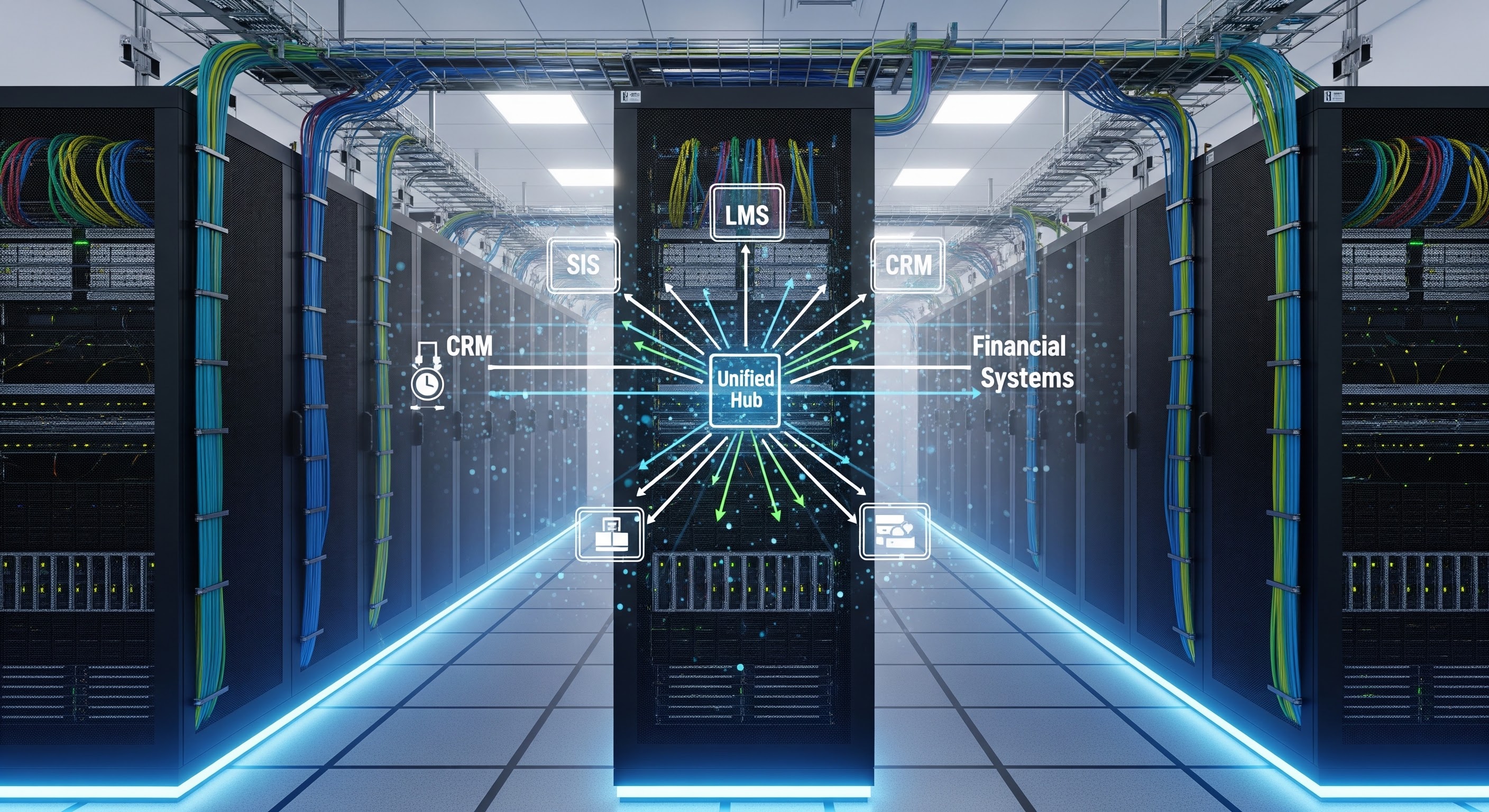
The most effective architecture for a data-connected campus isn’t a single monolithic system that does everything. It’s a hub-and-spoke model where a central data integration layer connects specialized systems that each do their job well.
Your Student Information System (SIS) sits at the center as the system of record for student identity, enrollment, and academic history. Every other system connects to the SIS through standardized integrations, with data flowing in both directions. The SIS is the authoritative source for who the student is and what their academic status is. Other systems contribute their specialized data (LMS provides engagement data, CRM provides recruitment data, finance provides billing data) and receive relevant information back.
This model works because it respects system specialization while ensuring data connectivity. You don’t need your LMS to manage financial aid, and you don’t need your SIS to run your course content. You need them to share the data that’s relevant to both.
The Five Integration Priorities
Not all integrations are equally important. Here’s where to focus, in priority order:
- SIS ↔ LMS integration. This is your highest priority and the integration with the most immediate impact. At minimum, you need automated roster synchronization (when a student enrolls in the SIS, they’re automatically added to the LMS course), grade passback (grades entered in the LMS flow automatically to the SIS), and single sign-on (SSO) so students and faculty access both systems with one login. Without this integration, you’re creating manual work for the registrar, grading discrepancies between systems, and a frustrating user experience for students and faculty.
- SIS ↔ Finance/ERP integration. Enrollment changes should automatically trigger billing adjustments. Financial holds should be visible in the SIS so advisors know when a student has a balance issue. Refund calculations for withdrawals should be automated, not manually computed from enrollment dates pulled from one system and billing data from another.
- SIS ↔ CRM integration. When a prospect converts to an enrolled student, their record should transition seamlessly from the CRM to the SIS—carrying their communication history, inquiry source, and recruitment data with them. This continuity enables you to analyze your recruitment pipeline end-to-end and understand which marketing channels produce students who persist and graduate, not just students who enroll.
- SIS/LMS ↔ Advising Platform integration. Advisors need a unified student view that combines academic performance (from the SIS and LMS), financial status (from the ERP), and engagement data (from the LMS and student services) into a single dashboard. This is the integration that powers effective AI-driven advising and early alert systems.
- All Systems ↔ Analytics/BI Layer. A reporting and analytics platform (such as Tableau, Power BI, or a purpose-built education analytics tool) that draws data from all systems into a single data warehouse. This is where institutional research lives, where compliance reports are generated, and where AI-powered analytics actually function at full capacity.
Interoperability Standards: What to Require From Vendors
When you’re evaluating vendors for any campus system, interoperability should be a non-negotiable procurement criterion. Here’s what to look for:
Open APIs. The vendor must offer well-documented RESTful APIs (Application Programming Interfaces—standardized methods for systems to communicate) that allow your other systems to read and write data. If a vendor says their system is “integration-ready” but can’t provide API documentation, walk away. In 2026, a campus technology system without open APIs is a silo waiting to happen.
LTI compliance. For any tool that integrates with your LMS, require Learning Tools Interoperability (LTI) compliance—the industry standard for connecting educational applications. LTI-certified tools can embed within your LMS, share authentication, and exchange data using established protocols. IMS Global (now 1EdTech) manages the LTI standard, and most major LMS platforms support it.
Data export capabilities. Even with APIs, you should be able to export your data in standard formats (CSV, JSON, XML) at any time. Data portability protects you from vendor lock-in—if a vendor relationship ends, your data comes with you. This sounds obvious, but I’ve seen institutions trapped in vendor relationships because extracting their data would require months of manual effort.
FERPA-compliant data handling. Any system that processes student data must comply with FERPA (the Family Educational Rights and Privacy Act). This includes data encryption at rest and in transit, access controls based on legitimate educational interest, audit logs of data access, and clear data retention and deletion policies. For AI-specific tools, verify that student data is not used for model training without explicit institutional consent.
I want to emphasize this point about vendor evaluation because it’s where I see the most costly mistakes. When a founder is excited about an AI platform, the integration question tends to get asked last—if it’s asked at all. “Does it integrate with our SIS?” becomes an afterthought rather than a threshold requirement. And then, three months after purchase, the IT team discovers that the “integration capability” the vendor advertised is a manual CSV export that someone has to run every Friday afternoon.
Here’s my vendor integration evaluation checklist, distilled from painful experience:
- Does the vendor provide documented REST APIs with write access, not just read? Can you push data in and pull data out?
- Is the vendor LTI-certified by 1EdTech if it’s an instructional tool? Not “LTI-compatible”—certified.
- Does the vendor’s data processing agreement explicitly prohibit using your student data for model training?
- Can you export all your data in standard formats (CSV, JSON) at any time without vendor assistance?
- Does the vendor have documented integrations with your specific SIS and LMS platforms, or will you need custom development?
- What’s the vendor’s uptime SLA, and what happens to your data if the service goes down or the company shuts down?
If a vendor can’t answer all six of these satisfactorily, they’re not ready for your campus. Move on.
Data Governance: The Policy Layer That Makes Integration Sustainable
Data integration without data governance is chaos with better plumbing. If you connect all your systems but don’t establish rules about data quality, data ownership, access controls, and compliance, you’ve just created a faster way to spread bad data.
Data governance is the institutional framework that defines how data is collected, stored, accessed, shared, protected, and retired. For a new institution, building data governance alongside your technology infrastructure is dramatically more efficient than retrofitting it later.
The Five Pillars of Campus Data Governance
1. Data Ownership and Stewardship. Every data element needs a designated owner—the person or department responsible for its accuracy and currency. Student demographic data is typically owned by the registrar. Financial data is owned by the business office. Course content data is owned by academic affairs. When data accuracy issues arise (and they will), ownership determines who’s responsible for fixing them. Without clear ownership, data quality problems get passed around until nobody addresses them.
2. Data Quality Standards. Define what “clean data” means for your institution. This includes formatting standards (how names are entered, how dates are recorded), completeness requirements (which fields are mandatory), validation rules (SSN format checks, email format checks), and deduplication protocols (how you handle students with records in multiple systems). An integration layer that connects two systems without data quality standards will produce a unified dataset full of duplicates, formatting inconsistencies, and conflicting records.
3. Access Control and Role-Based Permissions. Not everyone needs access to everything. A faculty member needs to see grades and attendance for students in their courses. They don’t need to see financial aid records, disciplinary history, or disability documentation. Role-based access control (RBAC) ensures that each user sees only the data relevant to their function—a FERPA requirement and a data security best practice.
4. Compliance and Privacy. Your data governance framework must address FERPA, state privacy laws, and any programmatic accreditation requirements related to data handling. If you’re operating in states like California (with the CCPA/CPRA), Illinois (BIPA), or New York, state-specific privacy obligations may exceed FERPA’s requirements. Document your compliance approach, train your staff, and audit regularly.
5. Data Retention and Disposal. Not all data should live forever. Your governance framework should specify retention periods for different data types (student records, financial data, communications, vendor logs) and establish secure disposal procedures when data reaches end-of-life. This isn’t just housekeeping—it’s a regulatory requirement under multiple frameworks and a practical necessity for keeping your data warehouse manageable.
Here’s a practical detail that catches founders off-guard: data governance needs a budget. You’re not just writing policies—you’re building and maintaining infrastructure to enforce them. Data quality checking tools, access management systems, audit log platforms, and staff time for governance oversight all cost money. Budget $3,000–$8,000 for initial governance development (consulting plus staff time) and $2,000–$5,000 annually for ongoing maintenance and auditing. It’s a tiny fraction of your technology budget, but without it, your integration investments degrade over time as data quality erodes and compliance gaps emerge.
One more thing about governance that’s easily overlooked: vendor management. Every external system that connects to your data ecosystem introduces risk—data leakage, unauthorized access, service interruptions. Your governance framework should include vendor assessment criteria, regular vendor reviews, and clear procedures for what happens when a vendor relationship ends. I’ve helped one institution navigate a vendor shutdown where the vendor gave 60 days notice and the school had to migrate 3 years of student data to a new platform. The institutions with documented data portability requirements in their contracts recovered in weeks. The ones without those clauses spent months rebuilding.
Building a Unified Student Data Profile for AI-Powered Personalization
The ultimate goal of data integration is building what I call a unified student data profile—a single, comprehensive view of each student that combines academic, financial, engagement, and personal data into a record that AI tools can use to deliver genuinely personalized experiences.
Here’s what a mature unified student profile includes:
When an AI tool—whether it’s a retention predictor, an adaptive learning platform, or an intelligent advising assistant—can access this unified profile, it’s working with the full picture. The predictions are more accurate, the personalization is more relevant, and the interventions are more timely. That’s the difference between AI as a genuine institutional capability and AI as an expensive novelty.
Building this profile doesn’t require a single massive database that holds everything. It requires an integration layer—a middleware platform or data warehouse—that pulls relevant data from each source system, reconciles it into a consistent format, and makes it available to authorized applications and users. The source systems remain the systems of record for their respective data types; the integration layer creates the unified view.
The privacy implications deserve explicit attention here. A unified student profile concentrates sensitive information that, in a siloed environment, would be scattered across systems with different access controls. Your data governance framework must ensure that the unified profile enforces role-based access rigorously—an advisor sees academic and advising data but not detailed financial records, a financial aid officer sees payment information but not clinical performance notes, and so on. Integration without access control isn’t progress—it’s a FERPA violation waiting to happen.
Institutional Readiness Assessment: Are You Ready for AI-Grade Data Infrastructure?
Before investing in AI tools, every institution should conduct a data readiness assessment. Here’s a framework based on what I’ve used with clients:
If your institution rates “Not Ready” on more than two dimensions, investing in AI tools before addressing your data infrastructure is likely to produce disappointing results. You’ll be paying for AI capabilities that your data environment can’t fully support. My strong recommendation: get to “Partially Ready” on all six dimensions before deploying your first AI tool, and pursue “AI-Ready” status as a parallel, ongoing initiative.
A Practical Roadmap: From Data Silos to Connected Campus
For institutions at any stage, here’s a phased approach to building AI-grade data infrastructure:
Phase 1: Audit and Inventory (Months 1–3)
Catalog every system that holds student, academic, financial, or operational data. Document what data each system contains, who manages it, how it’s currently shared (if at all), and what integration capabilities exist (APIs, export functions, LTI compliance). Identify your biggest data gaps—where are decisions being made without adequate information? This audit creates the foundation for everything that follows. We typically find that institutions are operating with 30–50% more data-generating systems than leadership realized.
Phase 2: Establish Data Governance (Months 2–5)
Convene a data governance committee with representation from IT, the registrar, academic affairs, finance, enrollment management, and institutional research. Draft governance policies covering ownership, quality standards, access controls, and compliance. Designate data stewards for each major data domain. This doesn’t need to be elaborate—for a new institution with 5–8 programs, a 10–15 page governance document and monthly committee meetings are sufficient.
Phase 3: Implement Core Integrations (Months 4–10)
Start with the highest-priority integration: SIS to LMS. Once that’s stable, add SIS to Finance/ERP, then SIS to CRM. Each integration should include automated data synchronization (daily at minimum, real-time where feasible), error logging and monitoring, and a documented rollback procedure in case something goes wrong. Test each integration thoroughly before moving to the next. Rushing this phase to deploy AI tools faster will create data quality problems that contaminate everything downstream.
Phase 4: Build the Analytics Layer (Months 8–14)
Once your core systems are connected, build a reporting and analytics platform that draws from all sources. Start with the reports you need most: enrollment dashboards, retention tracking, financial aid compliance, and student outcome metrics. This analytics layer is where AI tools will eventually plug in—the unified data environment that gives them the comprehensive view they need to function effectively.
Phase 5: Deploy AI Tools on Integrated Data (Months 12–18)
Now—and not before—you’re ready to deploy AI tools that can leverage your connected data ecosystem. An AI retention predictor deployed on integrated data from the SIS, LMS, financial aid, and advising systems will perform dramatically better than one limited to a single data source. An adaptive learning platform that can access placement test results, prerequisite performance, and accommodation records will personalize far more effectively.
The timing here matters for accreditation, too. If your accreditor visits in year three of operation, you want to show 12–18 months of AI tool performance on integrated data—not 3 months of scrambled deployment on a fragmented foundation. Working backward from your accreditation timeline, the data integration work needs to start in month one of your institutional planning, not month twelve.
A Note on Staffing the Integration Function
Who actually does this work? For a new institution under 500 students, the data integration function typically sits with your IT director or CTO, who dedicates 25–40% of their time to integration management, data governance oversight, and vendor coordination. As you grow past 500 students and your system count increases, you’ll likely need a dedicated data analyst or integration specialist—a role that runs $55,000–$75,000 in salary depending on your market.
Don’t underestimate the importance of this role. The person who manages your data integration is the person who determines whether your AI investments produce reliable results or garbage. They’re the one who catches the data quality issue before it contaminates your retention predictions. They’re the one who ensures that when you pull a compliance report, the numbers are accurate and defensible. It’s not a glamorous hire, but it might be your most consequential one.
An alternative for institutions that can’t justify a dedicated hire: outsource the integration management function to a specialized higher-education IT services firm. Several firms offer managed integration services for small institutions at $1,500–$4,000 per month—less than a full-time hire, with access to specialized expertise across multiple platforms. The trade-off is less institutional knowledge and less immediate responsiveness, but for a startup institution, it’s often the pragmatic choice.
The Cost of Getting Data Integration Right vs. Wrong
The cost ratio is roughly 1:3 to 1:4. Building data integration into your institutional launch costs a fraction of retrofitting it after systems are entrenched. And that doesn’t account for the opportunity cost—the AI tools that underperform, the compliance reports that take weeks instead of hours, and the student interventions that happen too late because the data wasn’t connected.
What Actually Happens When Data Stays Siloed: Two Composites
The School That Bought AI Before Building the Foundation
A proprietary college offering business and IT programs invested $120,000 in its first year on three AI platforms: an adaptive learning system, a predictive enrollment analytics tool, and an AI-powered student services chatbot. The founder had attended an ed-tech conference, seen impressive demos, and was convinced these tools would differentiate the school from day one.
The problems started within weeks. The adaptive learning platform needed student placement data from the SIS to calibrate its initial assessments, but the SIS and the LMS weren’t integrated. The IT director spent two weeks manually exporting and importing placement scores for 180 students. By the time the data was in the adaptive platform, 15% of it was outdated because students had changed sections or dropped courses—changes that the adaptive system couldn’t see because it wasn’t connected to the SIS.
The predictive enrollment tool was supposed to forecast yield from applicants, but it needed historical data about which prospects converted to enrolled students—data that lived partly in the CRM and partly in the SIS, with no link between the two. The school’s first-year enrollment prediction was off by 23%, which directly affected revenue projections and staffing decisions.
The chatbot could answer general questions about programs and deadlines, but when students asked about their specific financial aid status, account balance, or advising hold, the chatbot couldn’t help because it had no access to the SIS or ERP data. Students quickly learned the chatbot was useless for anything personal and stopped using it. The $18,000 annual license was essentially wasted.
By the end of year one, the founder had spent $120,000 on AI and had little measurable impact to show for it. Not because the tools were bad—they were capable platforms used successfully at other institutions. The tools failed because the data infrastructure wasn’t there to support them. The founder told me, with characteristic directness: “I bought a Ferrari and tried to drive it on a dirt road.”
The School That Built the Road First
A career school in the Southeast serving allied health programs took the opposite approach. Before purchasing any AI tools, the founding CTO spent four months establishing the data foundation: selecting an SIS and LMS with documented API integration capabilities, building the SIS-LMS integration during the pre-launch phase, implementing SSO across all campus systems, and establishing a basic data governance framework with designated data stewards.
The total cost of this foundational work was approximately $35,000—significantly less than what the first school spent on AI tools alone. When the institution was ready to deploy its first AI tool (an adaptive learning platform for their medical coding program, 14 months after launch), the integration took three days. Student placement data flowed automatically from the SIS. Engagement data from the LMS fed back to the advising dashboard. When a student stopped logging in and simultaneously fell behind on tuition payments, the system flagged both issues simultaneously—because both data sources were connected.
The adaptive platform showed an 8-point improvement in certification practice exam scores within two cohorts. The accreditor cited the integrated data approach as evidence of strong institutional effectiveness. When the school was ready for its second AI tool (a retention predictor), deployment took one week because the data architecture was already in place.
The first school spent $120,000 on AI and got a Ferrari on a dirt road. The second school spent $35,000 on infrastructure and got a smooth highway—onto which every subsequent AI investment could drive at full speed.
Key Takeaways
For investors and founders building new educational institutions in 2026:
1. Data integration is the unglamorous prerequisite that determines whether every AI investment succeeds or fails.
2. Campus data silos—SIS, LMS, CRM, Finance, Advising, Career Services—prevent AI tools from accessing the comprehensive data they need to function effectively.
3. Adopt a hub-and-spoke architecture with your SIS at the center, connected to specialized systems through open APIs and standardized integrations.
4. Prioritize five integrations in order: SIS-LMS, SIS-Finance, SIS-CRM, SIS/LMS-Advising, and All Systems-Analytics.
5. Require open APIs, LTI compliance, data export capability, and FERPA-compliant data handling from every vendor.
6. Build a data governance framework covering ownership, quality standards, access controls, compliance, and data retention.
7. Conduct a data readiness assessment before deploying AI tools. If you’re “Not Ready” on more than two dimensions, fix the foundation first.
8. Build a unified student data profile that combines academic, financial, engagement, and personal data into a single view that AI tools can leverage.
9. Building integration right costs $28,000–$75,000 over three years. Retrofitting later costs $100,000–$270,000.
10. New institutions have a rare advantage: design your data architecture before you buy your first system.
Frequently Asked Questions
Q: How much does data integration cost for a new institution?
A: For a new institution with 5–8 programs, budget $28,000–$75,000 over the first three years for system integrations, data governance development, and an analytics platform. The largest component is typically the core system integrations (SIS-LMS-CRM-Finance), which can run $10,000–$30,000 depending on the platforms you’ve chosen and how much customization is needed. Selecting systems with strong integration capabilities from the start dramatically reduces this cost.
Q: What’s the single most important integration to get right?
A: SIS to LMS, without question. This is the integration that most directly affects the daily experience of faculty and students (roster synchronization, grade passback, single sign-on) and the one that creates the foundation for all AI tools that need both academic records and engagement data. If you can only do one integration in year one, do this one.
Q: Do we need a full-time IT person dedicated to data integration?
A: For a new institution under 500 students, probably not full-time—but you need someone who owns it. A CTO or IT director who dedicates 25–40% of their time to integration and data governance is sufficient in the early stages. As the institution grows past 500 students and adds more systems, a dedicated data integration function (internal or outsourced) becomes essential. What you can’t do is assume integration will manage itself—it won’t.
Q: Can we use cloud-based systems to avoid integration problems?
A: Cloud-based systems reduce some infrastructure challenges but don’t eliminate integration needs. A cloud SIS and a cloud LMS still need to share data—they just do it via cloud APIs instead of on-premise connections. The advantage of cloud systems is that most modern cloud platforms are designed with APIs as a core feature, making integration easier. The risk is that some cloud vendors lock you into their ecosystem with proprietary integrations that don’t play well with competitors’ products. Always prioritize open standards over vendor-specific connectors.
Q: What about open-source systems like Moodle? Are they better for integration?
A: Open-source LMS platforms like Moodle are often praised for their integration flexibility, and that reputation is largely deserved. Moodle supports LTI, has extensive API documentation, and offers a large ecosystem of plugins that connect with various SIS platforms. The trade-off is that open-source systems require more internal technical capacity to configure, maintain, and secure. For institutions with capable IT teams, open-source can be an excellent choice. For those with limited technical staff, a commercially supported platform with strong integration features may be more practical.
Q: How do we ensure FERPA compliance when data flows between systems?
A: Three requirements are non-negotiable. First, every system that receives student data must have a Data Processing Addendum (DPA) or equivalent agreement that restricts data use to legitimate educational purposes. Second, implement role-based access controls across all connected systems so that each user sees only the data relevant to their role. Third, maintain audit logs of data access and sharing across systems. Your data governance framework should address FERPA explicitly, and your compliance officer or legal counsel should review every integration for privacy implications before it goes live.
Q: What happens if a vendor we’ve integrated with goes out of business?
A: This is a real risk—the edtech landscape is volatile, and vendor consolidation is ongoing. Protect yourself by requiring data portability in every vendor contract: the ability to export your data in standard formats at any time. Avoid deep dependencies on proprietary features that have no equivalent in competing products. Build your integrations through standard protocols (APIs, LTI) rather than vendor-specific connectors where possible. And maintain documentation of your integration architecture so that replacing a component doesn’t require reverse-engineering the entire system.
Q: How long does it take to achieve full data integration?
A: For a new institution building from scratch, 12–18 months to achieve full integration across core systems, including governance development and analytics deployment. For an existing institution retrofitting around legacy systems, 18–36 months is more realistic, depending on the complexity and number of systems involved. Phase the work—don’t try to integrate everything simultaneously. Start with the highest-impact integrations and build from there.
Q: Do accreditors care about data integration?
A: They care about what data integration enables: evidence-based decision making, effective student support, accurate compliance reporting, and continuous improvement. If your systems can’t produce the data needed for accreditation reports, if your retention interventions are delayed because data isn’t flowing, or if your institutional effectiveness assessments rely on manually compiled spreadsheets, accreditors will notice the infrastructure gap even if they don’t use the phrase “data integration.”
Q: Should we start with data integration or AI tool selection?
A: Data integration first, every time. Selecting AI tools before your data infrastructure is in place is like buying a high-performance engine before you’ve built the car. The AI tools will perform dramatically better—and deliver measurably higher ROI—when deployed on integrated, high-quality data. Use your integration roadmap to inform which AI tools are feasible to deploy and when, not the other way around.
Q: What’s the relationship between data integration and the data governance committee?
A: Your data governance committee should oversee both policy and infrastructure. They set the standards for data quality, access, and compliance; they prioritize which integrations to build first; and they review the performance of existing integrations. For new institutions, the governance committee should be formed during the planning phase and should have input into system selection decisions. For existing institutions, the committee becomes the body that resolves cross-departmental data conflicts and allocates integration resources.
Q: Can AI tools themselves help with data integration?
A: Increasingly, yes. AI-powered data integration tools can automate some aspects of data mapping, deduplication, and quality checking. But they’re supplements to a sound architecture, not substitutes for one. An AI tool that cleans up duplicate student records is helpful; an architecture that prevents duplicates from being created in the first place is far more efficient. Use AI to enhance your data infrastructure, but don’t expect it to fix fundamental architectural problems.
Q: We’re using a vendor that offers SIS, LMS, and CRM in one platform. Does that solve the integration problem?
A: It solves part of it. All-in-one platforms from vendors like Anthology (formerly Campus Management), Ellucian, or Jenzabar can reduce integration complexity by keeping core systems on a single infrastructure. The trade-off is reduced flexibility—you’re dependent on a single vendor’s development roadmap and pricing decisions. You’ll still need to integrate with specialized tools (AI platforms, career services systems, employer databases) that aren’t part of the suite. The integration challenge shrinks but doesn’t disappear.
Glossary of Key Terms
Current as of April 2026. Regulatory guidance, accreditation standards, and technology platforms evolve rapidly. Consult current sources and expert advisors before making institutional decisions.
If you’re ready to explore how EEC can de-risk your AI-integrated launch, reach out at sandra@experteduconsult.com or +1 (925) 208-9037.